 Mechanism Diligence
Medicine reading guide
Omeprazole
Prescription acid-reducing medicine
Adults using prescription omeprazole delayed-release capsules. This guide does not cover OTC self-treatment, children or immediate-release combination products.
Educational information. Independent clinical review pending. This is a selective explanation, not the full prescribing information.
Uses / Symptoms
- GERD-related heartburn and acid injury to the esophagus.
- Stomach or duodenal ulcers; selected H. pylori treatment uses it with antibiotics.
Effects
- Reduces stomach acid.
- Helps acid-related injury heal.
Side effects
- Headache, stomach pain, nausea or diarrhea.
- Serious risks include kidney inflammation and severe skin reactions.
Selected information; not a complete safety list. Full prescribing information and patient guidance ↗
How it works
Cells in your stomach lining use tiny pumps to release acid. If stomach contents wash back into the food tube above, that acid can irritate it and cause heartburn. Coated granules protect omeprazole until it reaches the intestine. After absorption, it travels to stomach-lining cells and changes in their acidic spaces so it can switch off acid pumps. Less acid is released. This can ease acid-related irritation, but it does not stop all reflux or give instant relief.
Read the mechanism, step by step
Omeprazole is damaged by stomach acid. These capsules contain enteric-coated granules; absorption begins after the granules leave the stomach. Delayed release protects delivery of the medicine rather than meaning that symptom relief occurs at a fixed time.
The absorbed drug acts on the H+/K+-ATPase, an enzyme called the acid pump, at the secretory surface of stomach parietal cells. Inhibiting this pump reduces the final step of acid production, including both resting and stimulated secretion.
Reduced acid can relieve GERD-related heartburn and support healing of acid-injured esophageal tissue. These are clinical benefits, not promises of immediate relief or a cure for every cause of symptoms. For H. pylori-associated ulcers, the labeled treatment combines omeprazole with antibiotics; acid suppression alone is not the complete regimen.
Audience explanation sources
Editorial source review completed November 11, 2026. Independent clinical review pending. Audience versions explain the same scoped medicine; they are not separate treatment plans.
Questions about Omeprazole
Which conditions does prescription omeprazole treat?
Prescription delayed-release capsules treat acid-related conditions such as GERD, acid injury to the esophagus and certain ulcers. Some uses need other medicines. This guide covers adults taking these capsules, not OTC self-treatment courses, children or immediate-release combination products.
How does it reduce stomach acid?
Cells in your stomach lining use tiny pumps to release acid. If stomach contents wash back into the food tube above, that acid can irritate it and cause heartburn. Coated granules protect omeprazole until it reaches the intestine. After absorption, it travels to stomach-lining cells and changes in their acidic spaces so it can switch off acid pumps. Less acid is released. This can ease acid-related irritation, but it does not stop all reflux or give instant relief.
How soon should it help?
It is not an instant-relief medicine. Acid suppression builds with repeated dosing, reaching a plateau after about four days in the cited label. Heartburn relief and healing are different outcomes; the prescribed healing course can continue after symptoms improve. Persistent or worsening symptoms need reassessment.
How are dose and duration chosen?
The indication determines the dose and course. The adult label uses 20 mg once daily for symptomatic GERD for up to four weeks and for erosive esophagitis for four to eight weeks. Ulcer, maintenance and excess-acid regimens differ. Follow your prescription; these examples are not a personal dosing plan.
How should I take the capsules?
Take before a meal as prescribed. Swallow the capsule whole. For swallowing difficulty, the cited label allows opening it onto one tablespoon of soft, cool applesauce: swallow immediately with cool water, without chewing or crushing the granules. Do not save the mixture. Ask the pharmacist to confirm your exact product.
Why must the granules stay intact?
Stomach acid can break down omeprazole before it is absorbed. The capsule’s enteric-coated granules protect it until intestinal release. Chewing or crushing defeats that protection. Opening an approved capsule for the labeled applesauce method is different from crushing its granules. Tube use needs a separately verified product and method.
What if I miss a dose?
Take the missed dose when remembered unless it is almost time for the next dose; then skip it. Do not double up. If vomiting occurs after taking a capsule, ask before repeating it because the amount absorbed is uncertain. Follow any more specific instructions supplied with your prescription.
What if too much is taken?
Contact US Poison Control at 1-800-222-1222 with the capsule strength, amount and time, even if you feel well. Call 911 for collapse, seizure, serious breathing difficulty or inability to wake. Do not induce vomiting or take another medicine to try to reverse the dose.
Can omeprazole eradicate H. pylori by itself?
No. The labeled H. pylori regimens combine omeprazole with antibiotics. Lowering acid is only one part of that treatment. Do not treat a reflux prescription as an infection-eradication course or reuse leftover antibiotics; the clinician must select and review the complete regimen.
What side effects are common?
Headache, stomach pain, nausea, diarrhea, vomiting and gas are reported. Tell the prescriber about troublesome or persistent symptoms. Persistent watery diarrhea, especially with fever or abdominal pain, requires prompt advice rather than simply continuing treatment or assuming ordinary stomach upset.
Which symptoms need urgent assessment?
Stop omeprazole and get emergency help for breathing trouble, swelling of the face or throat, or a severe blistering or peeling rash. Contact the prescriber promptly for persistent watery diarrhea, blood in the urine or a major change in urination. Vomiting blood, black stools or difficulty swallowing also needs urgent assessment of the underlying condition.
Which interactions need checking?
Do not combine omeprazole with rilpivirine-containing products. The label advises avoiding clopidogrel with omeprazole; do not stop an antiplatelet medicine yourself. Also check high-dose methotrexate, warfarin, digoxin, tacrolimus, medicines needing stomach acid for absorption, rifampin and St. John’s wort. Timing doses apart does not resolve every interaction.
When should ongoing treatment be reviewed?
Follow the prescribed course and arrange review if symptoms persist, return or require continuing treatment. Feeling better does not necessarily mean an erosive injury has healed. Ongoing therapy should have a clear indication, the lowest effective dose and an agreed continuation or stop plan; do not extend a short course indefinitely without review.
Which follow-up checks matter?
Review symptom response and whether the original indication still requires treatment. Persistent diarrhea or urinary changes need assessment. For prolonged treatment or relevant risks, the clinician may check magnesium or vitamin B12 and consider bone health. Not every short course needs a routine laboratory panel.
What about pregnancy or breastfeeding?
Tell the prescriber if you are pregnant, planning pregnancy or breastfeeding. Human pregnancy data have limitations, and omeprazole is present in breast milk. The treatment and feeding decision should consider the condition being treated and the infant’s circumstances; do not change a prescribed course without discussing the plan.
What needs checking before I start, even if symptoms improve?
Tell the prescriber about a known allergy to omeprazole or another proton-pump inhibitor and all medicines you take. Rilpivirine must not be combined with omeprazole; clopidogrel also needs a treatment review. Improvement in heartburn does not rule out a serious stomach condition. Persistent or returning symptoms may need investigation rather than simply a longer course.
How should capsules and opened mixtures be stored?
Follow the exact capsule container’s temperature and moisture instructions and keep it away from children. The labeled applesauce mixture is swallowed immediately and is not stored for another dose. A dry intact capsule and a wet opened preparation do not share a demonstrated shelf life.
Animation chapters, evidence & visual limits
Adults using prescription omeprazole delayed-release capsules for acid-related disease. Excludes OTC self-treatment, children and immediate-release combination products.
Educational, source-checked storyboard; independent scientific review is pending. Schematic shapes, particle counts and time compression are illustrative. No dose, binding pose, exact molecular geometry, guaranteed relief or complete safety guide is supplied.
Original conceptual illustrations. AI-assisted editorial source check; independent clinical review pending. No recorded narration.
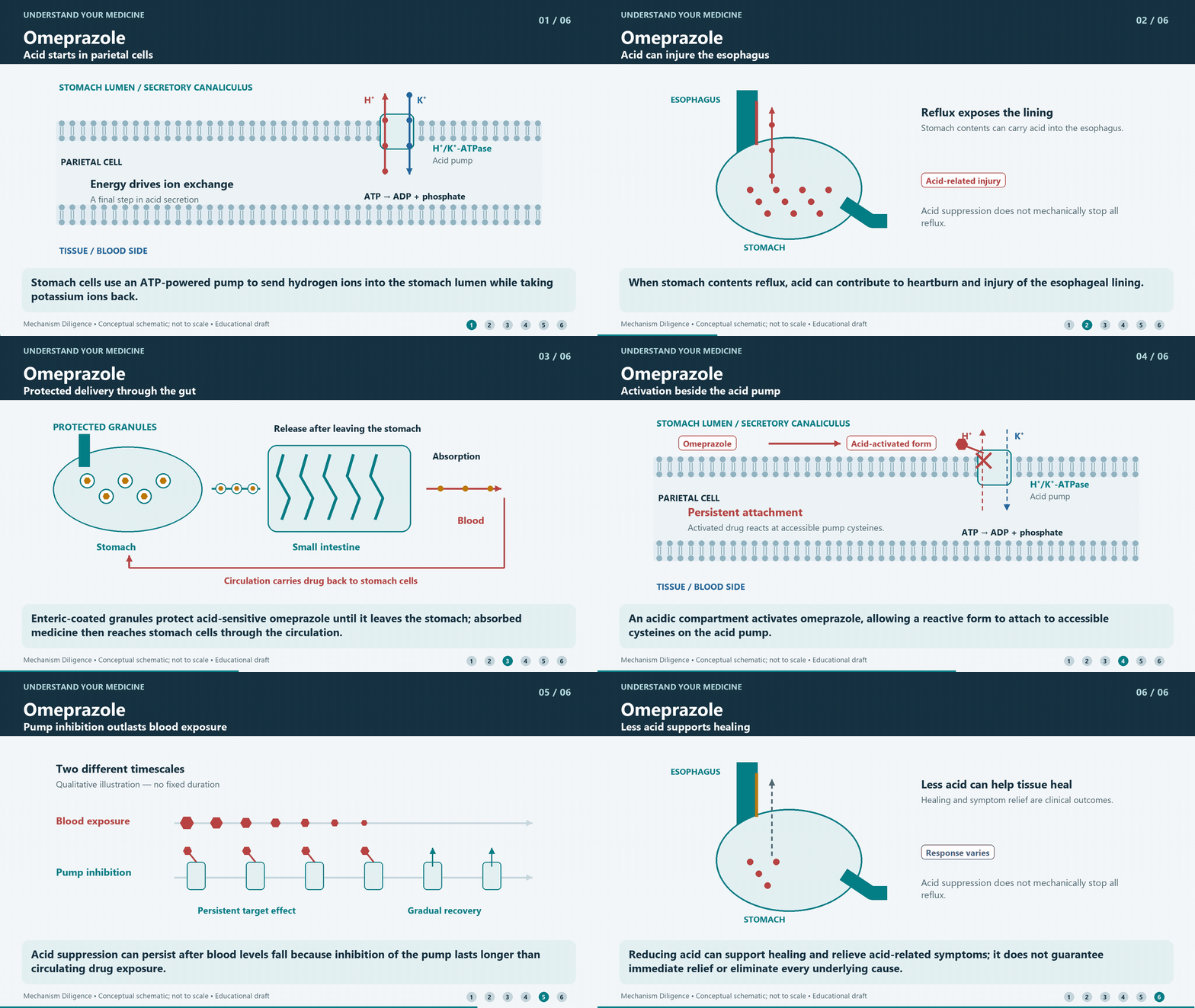
Chapter 1: Acid starts in parietal cells
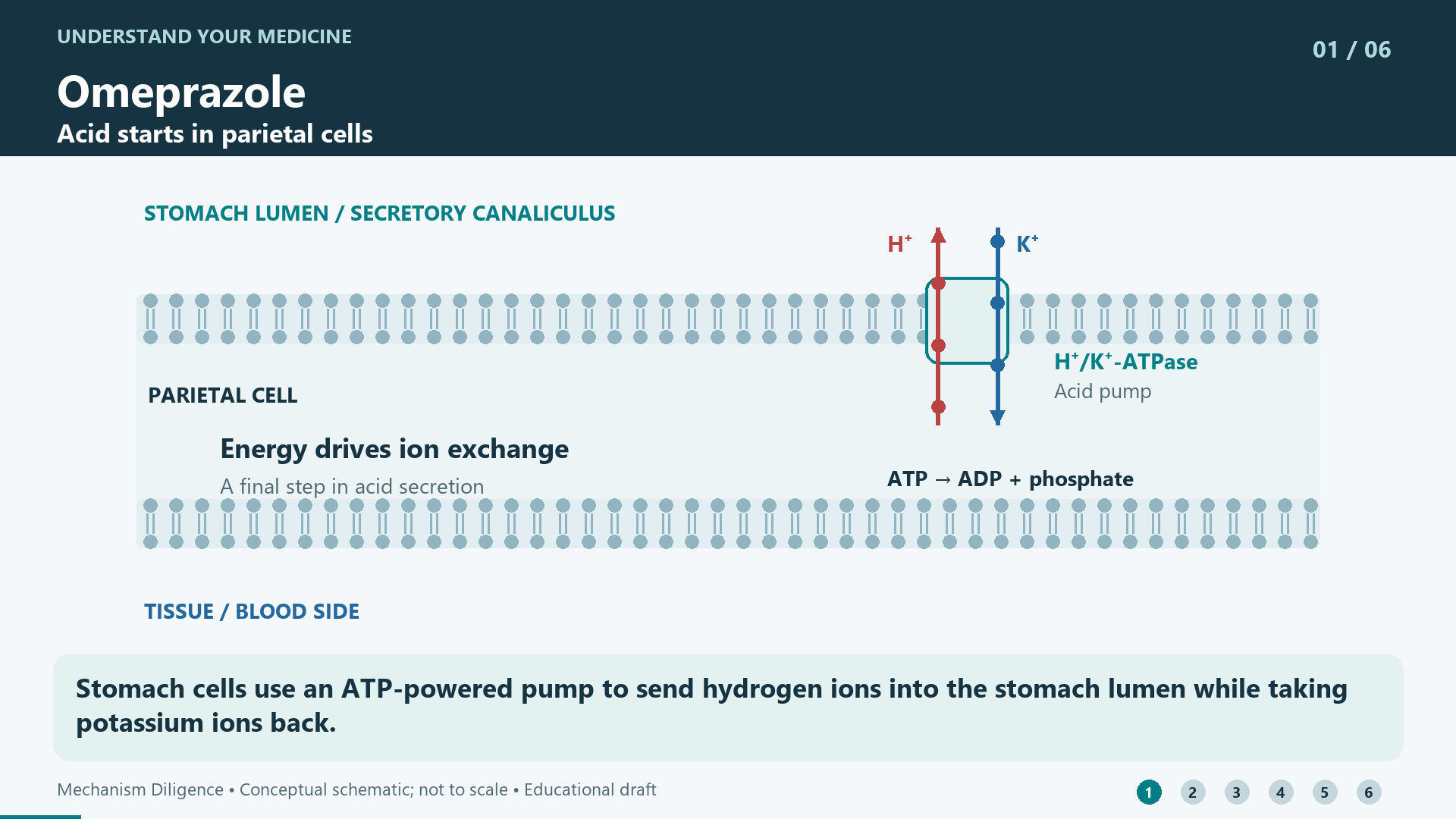
Stomach cells use an ATP-powered pump to send hydrogen ions into the stomach lumen while taking potassium ions back.
The H+/K+-ATPase sits at the acid-secreting surface of a parietal cell. Coupled ion exchange generates an acidic compartment. The drawing shows pump function without specifying a universal ion-per-ATP ratio across conditions.
The protein silhouette is conceptual, not a recovered atomic structure; chloride transport and supporting channels are omitted.
- Abe et al. Gastric proton pump with two occluded K+ engineered with sodium pump-mimetic mutations (2021) · Abstract and introduction: ATP-coupled H+/K+ exchange; DOI 10.1038/s41467-021-26024-1 · Primary structural and biochemical study; indexed abstract/excerpts checked, not full methods · checked 2026-10-17
- Glenmark omeprazole delayed-release capsules prescribing information · Sections 1.2, 1.4-1.5, 5.1, 11, 12.1-12.3; label updated January 19, 2026 · U.S. prescribing information; live selected sections checked · checked 2026-10-17
Chapter 2: Acid can injure the esophagus
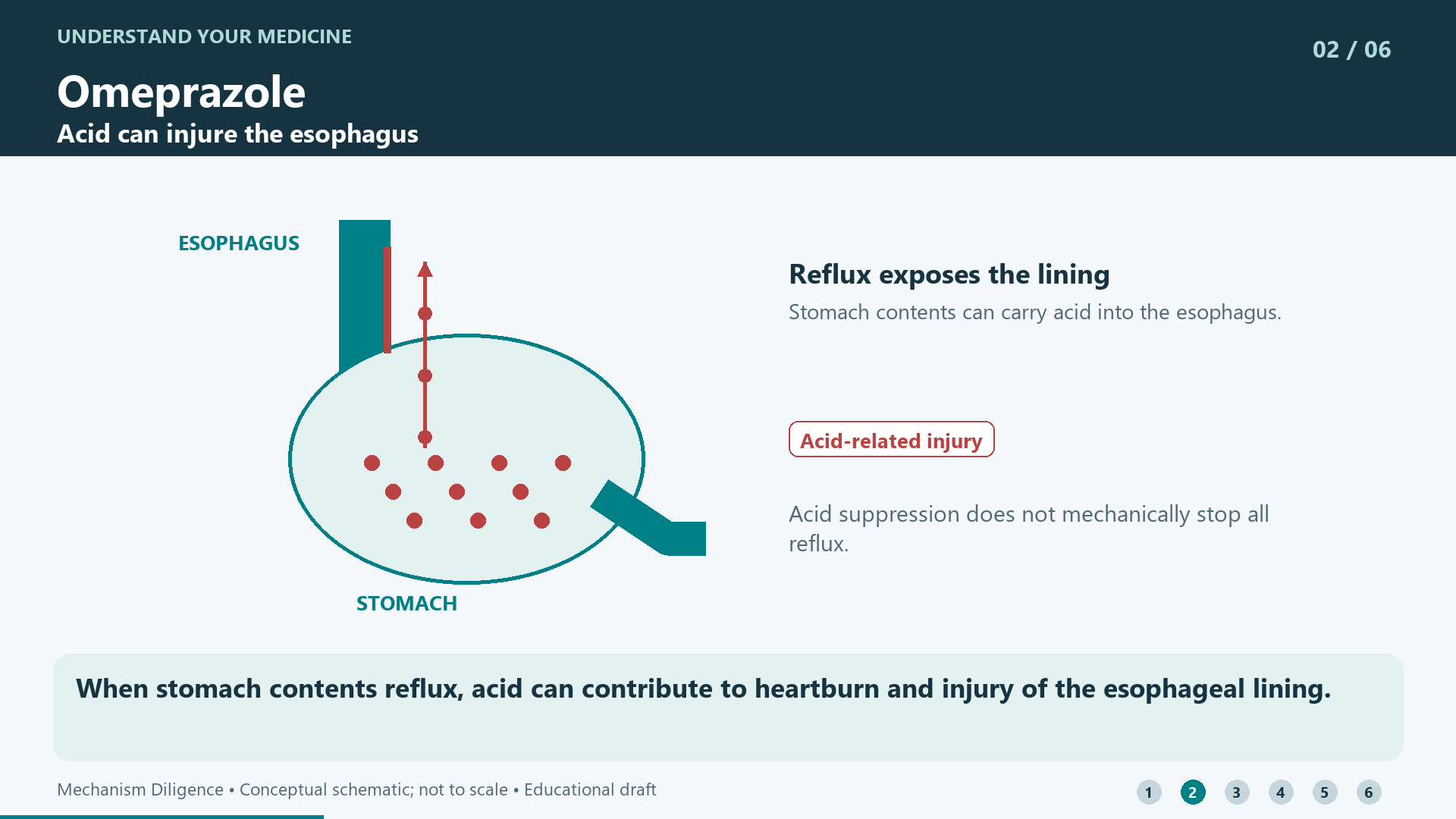
When stomach contents reflux, acid can contribute to heartburn and injury of the esophageal lining.
Acid-mediated GERD provides the clinical setting for this story. Symptom response alone cannot establish the diagnosis or exclude serious disease.
The scene depicts one relevant disease process, not every cause of chest discomfort, heartburn or esophageal symptoms.
- Glenmark omeprazole delayed-release capsules prescribing information · Sections 1.2, 1.4-1.5, 5.1, 11, 12.1-12.3; label updated January 19, 2026 · U.S. prescribing information; live selected sections checked · checked 2026-10-17
Chapter 3: Protected delivery through the gut
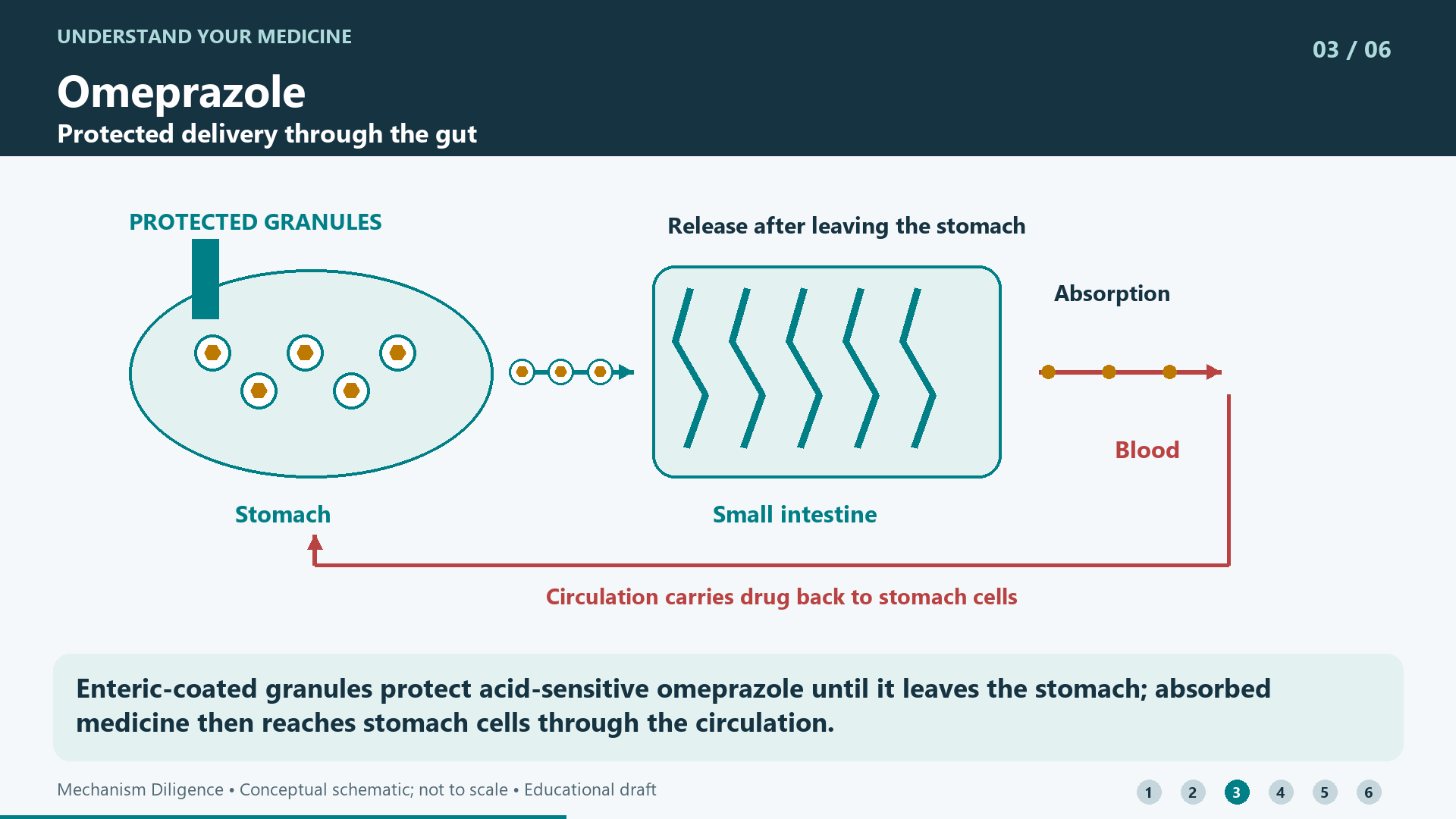
Enteric-coated granules protect acid-sensitive omeprazole until it leaves the stomach; absorbed medicine then reaches stomach cells through the circulation.
Delayed-release capsules contain protected granules. Intestinal absorption precedes systemic delivery to the target tissue; the capsule does not directly coat or neutralize the stomach lumen.
Travel time and relative amounts are illustrative; this is not administration instruction or a promise of onset.
- Glenmark omeprazole delayed-release capsules prescribing information · Sections 1.2, 1.4-1.5, 5.1, 11, 12.1-12.3; label updated January 19, 2026 · U.S. prescribing information; live selected sections checked · checked 2026-10-17
Chapter 4: Activation beside the acid pump
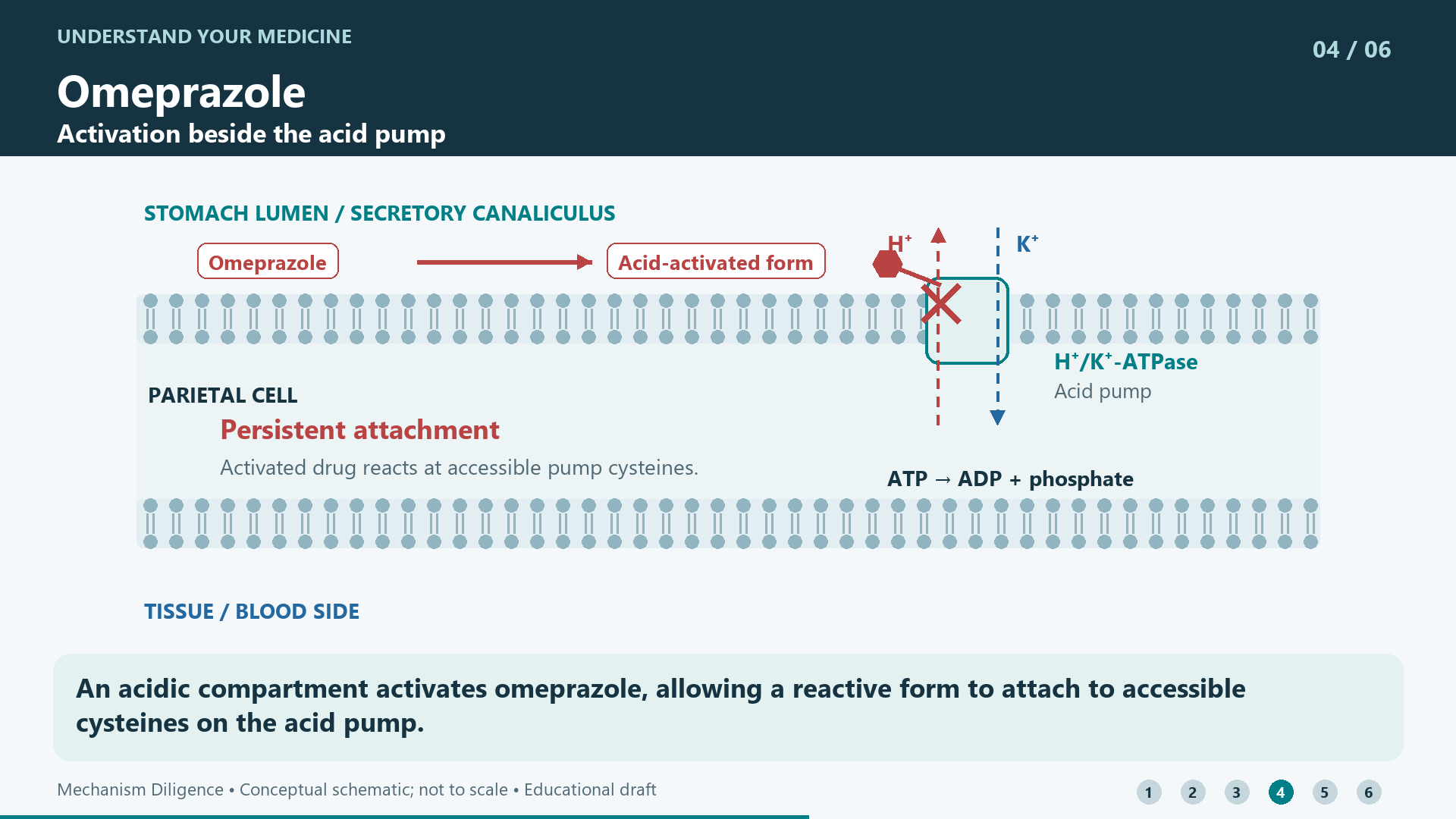
An acidic compartment activates omeprazole, allowing a reactive form to attach to accessible cysteines on the acid pump.
Biochemical experiments support acid-driven accumulation and activation followed by covalent reaction at accessible pump cysteines. A generic activated-drug symbol communicates that the original molecule changes chemically before durable target inhibition.
The attachment cartoon expresses a biochemical mechanism, not a measured trajectory or human-cell movie; no residue-specific geometry is claimed.
- Besancon et al. Sites of reaction of the gastric H,K-ATPase with extracytoplasmic thiol reagents (1997) · Abstract: acidic accumulation, acid-catalyzed activation, covalent cysteine labeling and inhibition; PMID 9278394 · Primary biochemical study; indexed abstract checked, not full methods · checked 2026-10-17
Chapter 5: Pump inhibition outlasts blood exposure
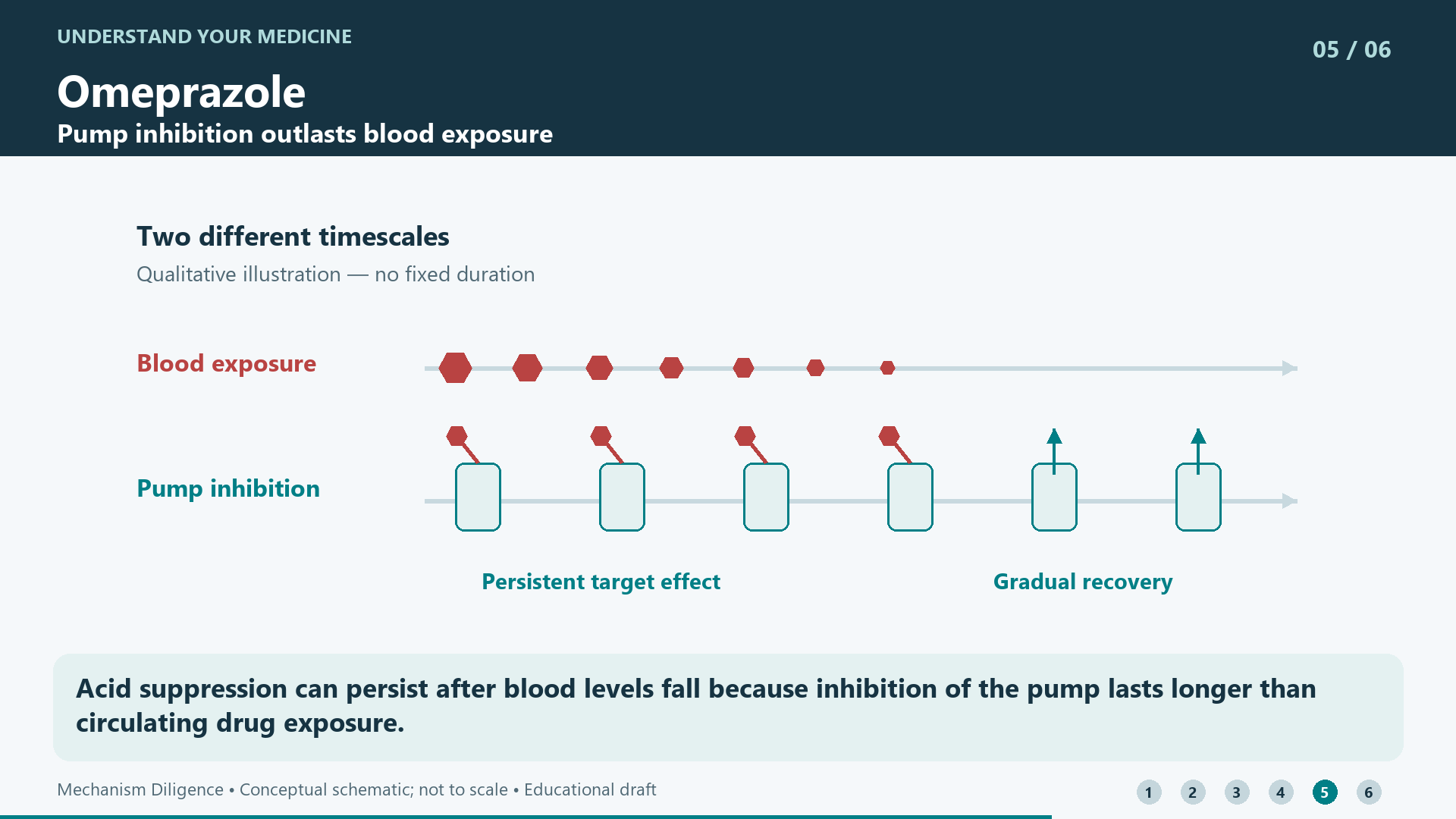
Acid suppression can persist after blood levels fall because inhibition of the pump lasts longer than circulating drug exposure.
Prolonged target engagement explains the separation between plasma exposure and secretion. Recovery is gradual; research identifies pump turnover and possible reversal of inhibition as contributors, so replacement alone is not presented as the entire recovery mechanism.
No individual duration, permanent shutdown or all-or-none suppression is implied.
- Glenmark omeprazole delayed-release capsules prescribing information · Sections 1.2, 1.4-1.5, 5.1, 11, 12.1-12.3; label updated January 19, 2026 · U.S. prescribing information; live selected sections checked · checked 2026-10-17
- Shin et al. Differences in binding properties of two proton pump inhibitors on the gastric H+,K+-ATPase in vivo (2004) · Abstract: recovery may involve protein turnover and reversal of inhibition; PMID 15498502 · Primary preclinical binding study; indexed abstract checked · checked 2026-10-17
Chapter 6: Less acid supports healing
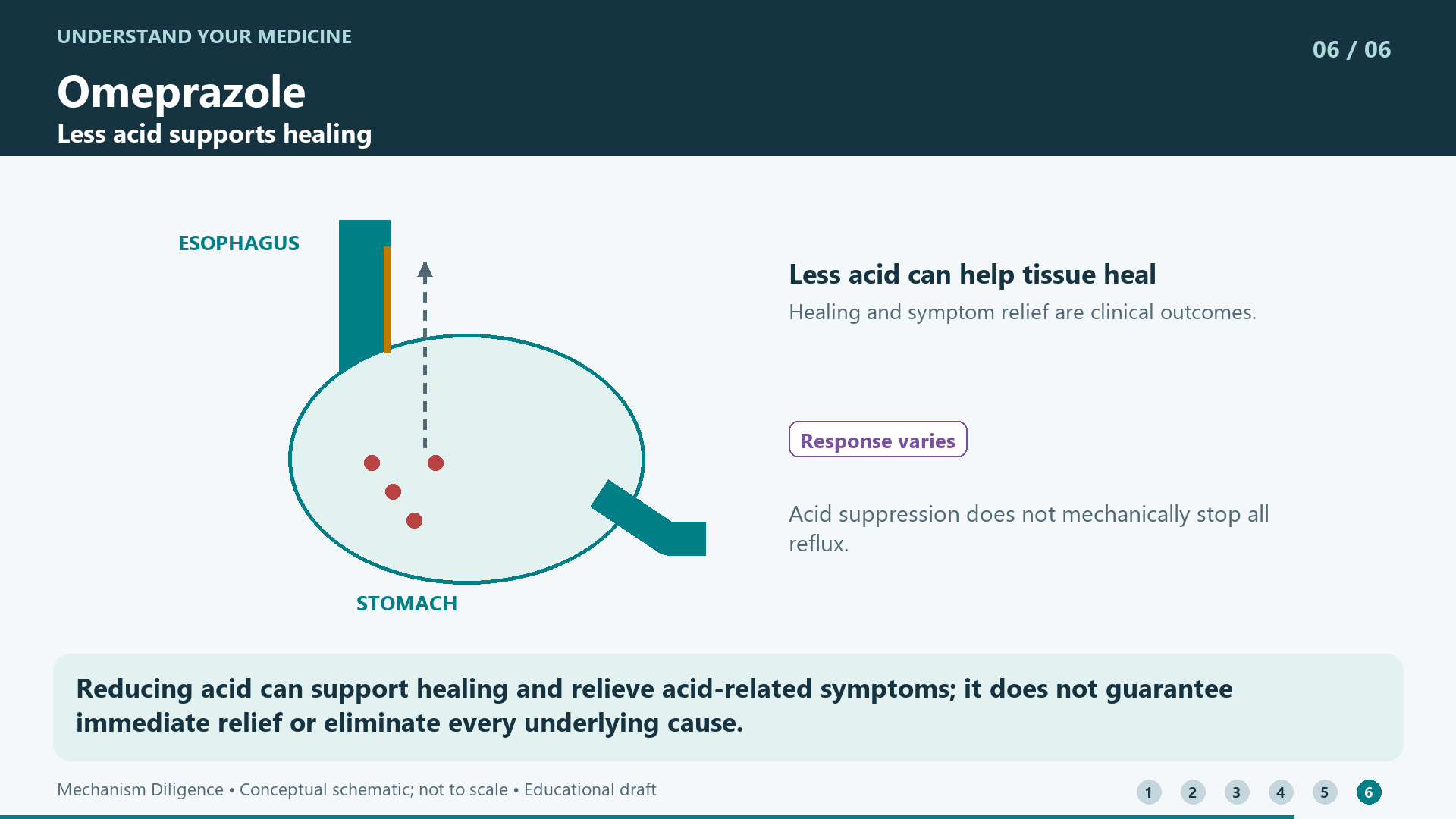
Reducing acid can support healing and relieve acid-related symptoms; it does not guarantee immediate relief or eliminate every underlying cause.
Return from target inhibition to the clinical goal. For H. pylori-associated treatment, omeprazole belongs to a regimen containing antibiotics rather than acting as a stand-alone eradication treatment.
Healing is a clinical outcome assessed over time, not proven by the molecular illustration; safety information is intentionally incomplete.
- Glenmark omeprazole delayed-release capsules prescribing information · Sections 1.2, 1.4-1.5, 5.1, 11, 12.1-12.3; label updated January 19, 2026 · U.S. prescribing information; live selected sections checked · checked 2026-10-17
Sources & scope
Source pages checked 2026-10-12. AI editorial source check; independent clinical review pending.
- No dosing or regimen selection supplied.
- Source mapping is not qualified clinical review.
- No molecular binding animation, clinical effect-size claims or equivalence across manufacturers.
- Safety summary is selective and incomplete; full warning/emergency wording requires editorial and clinical review.
- Originating NDC and cited sections were reconciled October 9; full-label differences were not assessed.
DailyMed / NLM ↗ · REMEDYREPACK INC. · retained source retrieved 2026-10-09 · label effective 20260721
MedlinePlus / NLM ↗ · retained source retrieved 2026-10-09
Patient-language and Rx/OTC formulation boundary cross-check; broad monograph does not override product-specific label.
DailyMed / NLM ↗ · Glenmark Pharmaceuticals Inc., USA · label effective 20260119
Originating NDC 68462-396; October 9 comparison verified all 18 previously cited sections against repackager.