
What medicine or drug mechanism are you interested in?
Choose your perspective or level and follow the drug through the body.
Generic or trade name
Try
How does ibuprofen work (mechanism)?
Explore the body
2D connectivity · not a protein-bound pose
Body locatorDrag to turn · use + / − to zoom
Established Visual: simplified teaching illustration
Ready. Press Play to begin.
The full body remains available in the locator during pathway close-ups. Drug, tissue and enzyme shapes are schematic; they do not show measured drug concentrations, binding geometry or selective targeting.
About the visuals & narration
Adapted reference anatomy · schematic stomach
Conceptual diagrams; shapes, scale and timing are simplified. Synthetic narration, not a clinician recording. Voice quality varies by device and may use its speech service. No microphone is needed. Resume repeats the current caption to keep sound and scenes together. Mute uses timed captions. If voice is unavailable, caption playback remains available.
Safety notes: what to know
Most adults can use ibuprofen, but it is not suitable for everyone. Common side effects include indigestion, stomach upset and nausea; not everyone gets them.
Serious effects are less common, but can include stomach or intestinal bleeding, kidney problems, heart attack, stroke and severe allergic reactions. Risk varies with dose, duration, health conditions and other medicines. Higher doses or longer use can increase risk. Follow your product label and use the smallest effective dose for the shortest time needed. Ask a pharmacist or clinician if you are unsure it suits you, especially with other medicines, a history of ulcers, heart or kidney disease, or pregnancy.
When to get help: stop taking it and seek urgent medical help for vomiting blood, black stools, chest pain, trouble breathing, facial or throat swelling, sudden weakness or slurred speech. Ask a pharmacist or clinician about side effects that persist or bother you.
NHS: suitability and side effects · US 200 mg OTC label: full warnings · Full patient information
Study risk numbers & comparison limits
What do the percentages show?
There is no reliable overall mild / moderate / severe split for everyone who takes ibuprofen. These are results from specific studies, not your personal odds.
Reported symptom intensity · PAIN trial, 1999
Adults aged 18–75 with short-term pain; ibuprofen up to 1,200 mg/day for 1–7 days, compared with paracetamol up to 3,000 mg/day. Follow-up calls: days 7–9. People with contraindications were excluded.
| Intensity | Ibuprofen 2,869 people | Paracetamol 2,874 people |
|---|---|---|
| Mild | Not separately reported | Not separately reported |
| Moderate | 8.5% 245 / 2,869 | 10.2% 294 / 2,874 |
| Severe | 3.5% 100 / 2,869 | 3.2% 92 / 2,874 |
Moderate meant interference with daily activities; severe meant activities were impossible. Severity is different from medical seriousness. Reports do not establish that the medicine caused an event. Categories are not a complete, mutually exclusive breakdown: do not add them or subtract them to calculate “mild.” No placebo group was included. This short study cannot reliably quantify rare serious harm or longer-term risk.
PAIN study: methods and Table II, pages 90–94 · Industry-funded study.
A separate placebo comparison · digestive symptoms
In a 1999 trial of healthy participants taking 1,200 mg/day for 10 days, digestive events were reported by 19% (161 / 833) on ibuprofen and 16% (67 / 413) on placebo. Examples included indigestion, abdominal pain and nausea. These are reported events of any intensity, not percentages proven to be caused by ibuprofen, and not “mild” or “severe” rates. The authors reported similar rates; this does not prove equal safety. Results do not describe high-dose prescription or long-term use, and do not mean zero serious risk. Doyle et al., 1999: study abstract.
Timing: this example covers standard immediate-release ibuprofen taken by mouth. Pain relief may begin in about 30–60 minutes; the person, food and formulation can change timing. This is onset of relief, not peak blood concentration or a dosing interval. Oral pain-relief timing source.
This is a brief overview, not all warnings or personal treatment advice.
Why this schedule? · standard oral 200 mg tablet
This example uses a US over-the-counter label for standard immediate-release 200 mg ibuprofen tablets, for adults and children aged 12 and over. Its directions specify a 4–6 hour interval while symptoms persist, with product-specific daily limits. Follow your own product label or prescription; this explanation does not set your dose.
Conceptual sequence, not a measured concentration curve. Peak blood level, onset of relief and how long relief lasts are different quantities. These figures do not apply to modified-release tablets or other routes.
Exact OTC label: directions · Pharmacokinetic evidence · Oral relief timing
Explore ten questions for your perspective
Check your understanding · optional
No score or answers are sent or saved.
Scientific review record · draft, unreviewed
No independent clinical or scientific reviewer has approved this prototype. No reviewer identity, credentials or review outcome is asserted.
- Scope
- Ibuprofen, standard immediate-release oral example; mechanism, timing, safety, audience scripts and optional answers.
- Content status
- AI-assisted educational draft. Source checks are not clinical validation.
- Sources checked
- September 26–27, 2026. Source links appear with captions, answers and numerical claims.
- Reviewers and approvals
- None recorded. Human review and permission to name the reviewer are still required.
Established marks source-supported clinical or pharmacological statements. Simplified marks teaching models. Proposed experiments are labeled as proposals, not findings. An unanswered question is explicitly marked unavailable.
Download the review recordHelp improve this prototype · local feedback
No feedback is sent. Do not enter names, health details or other personal information. You can save a feedback file on this device and decide whether to share it later.
Open the user-testing guideCatalog matches
Names, strengths and forms identify catalog entries. They are not dosing advice. Interactive content is currently available for ibuprofen only.
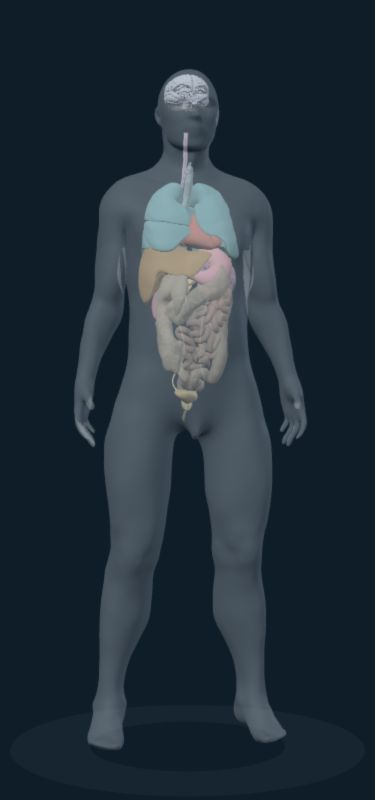
Human contextNEUTRAL ILLUSTRATIVE MODEL
01 / PERSPECTIVE
A human context.
Begin with a medicine.
Explore the science behind it.
AVAILABLE TO EXPLORE
More medicines are searchable in the catalog. More visual explanations are still to come.
Drag to rotate · ← → keyboard
Loading 3D view. Static reference available.
Neutral illustrative model adapted from a male Human Reference Atlas surface. It does not represent all human anatomies. Selected reference organs include spinal cord, trachea, lungs, heart, liver, intestines, kidneys, ureters, bladder, pancreas, spleen and prostate. The brain uses simplified, resized reference cerebral surfaces; the stomach is a schematic teaching shape. This is not a patient-specific model, a complete anatomy atlas or a simulation of drug distribution.
Search terms are sent to the public RxNorm service. Enter drug names only. About the catalog ↗