Zepbound (Drug class: Dual GIP and GLP-1 receptor agonist)
US Zepbound (tirzepatide) subcutaneous injection, label revised August 2026. Alongside reduced-calorie eating and increased activity: long-term weight reduction in adults with obesity or overweight plus a weight-related condition; and moderate-to-severe obstructive sleep apnea in adults with obesity. This is not an indication for every type of sleep apnea.
Educational draft · independent clinical review pending. Silent mechanism animation available; no recorded narration.
Uses / Symptoms
- Weight reduction and long-term maintenance in eligible adults
- Moderate-to-severe obstructive sleep apnea in adults with obesity
- Both uses accompany reduced-calorie eating and increased physical activity
Effects
- Activates GIP and GLP-1 receptors involved in metabolism and appetite
- Reduces calorie intake and body weight; not exclusively fat loss
- Can reduce sleep-related breathing interruptions in its specific OSA population
Side effects
- Nausea, diarrhea, vomiting, constipation or abdominal discomfort
- Indigestion, injection-site reactions, fatigue or hair loss can occur
- Boxed thyroid-tumor warning; important pancreatic, gallbladder, allergic and dehydration risks
How does Zepbound work? What is the Mechanism Of Action (MOA)?
Zepbound activates receptors for GIP and GLP-1, natural signals involved in appetite and metabolism. It reduces food intake and can lower body weight. Its sleep-apnea benefit is thought to be related to weight reduction, not an immediate opening of the airway.
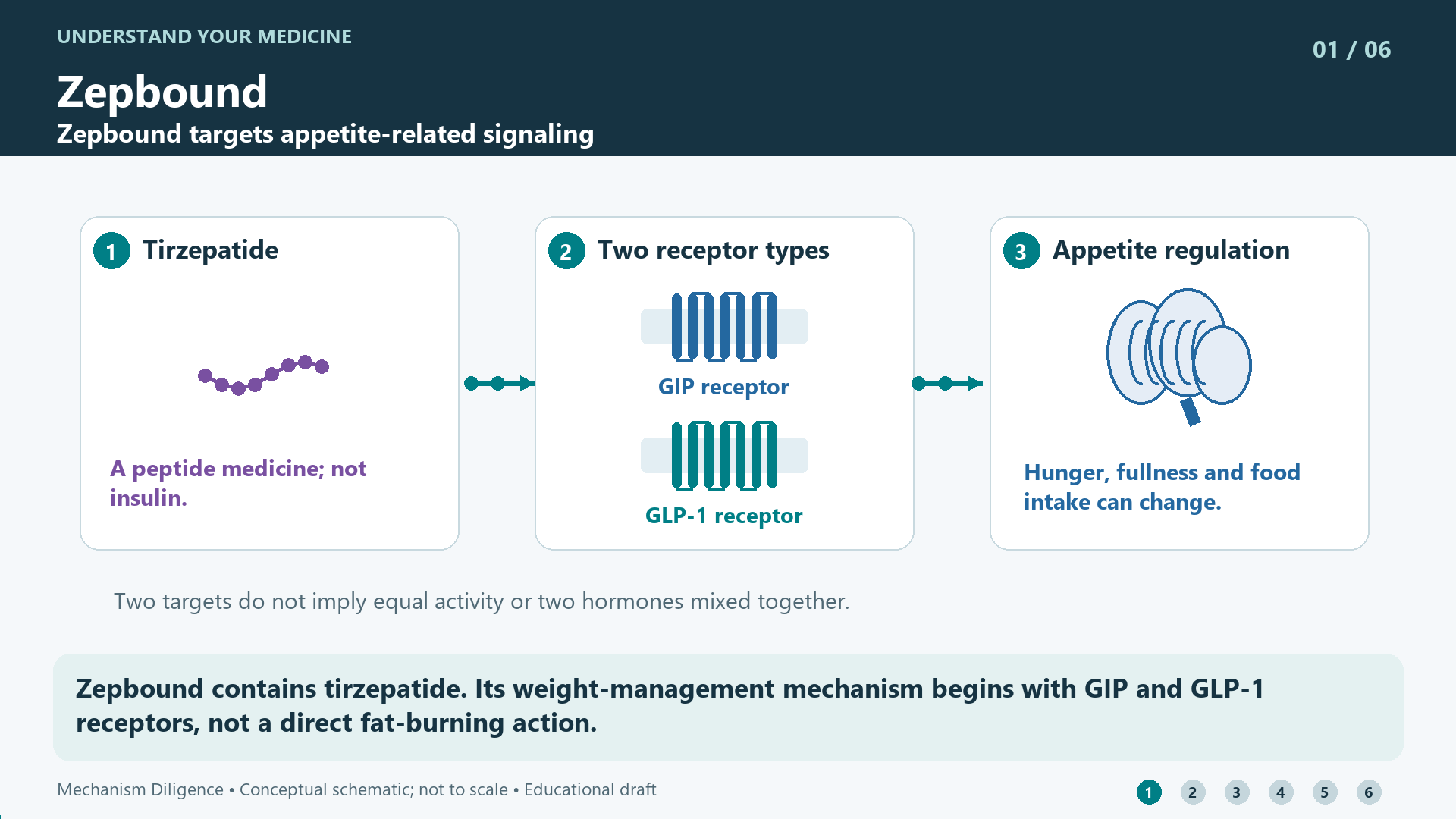
The mechanism, step by step
- Metabolic signals regulate food intake
GLP-1 and GIP receptor pathways participate in appetite and metabolic regulation.
- Tirzepatide activates two receptors
The peptide engages GIP and GLP-1 receptors; nonclinical evidence suggests GIP adds to food-intake regulation.
- Calorie intake and weight can decrease
Appetite-related effects reduce intake. Both fat and lean mass can decline, with greater fat-mass loss.
- Obesity-associated OSA may improve
Trials in adults with obesity and moderate-to-severe OSA demonstrated fewer apnea and hypopnea events; improvement is likely related to weight loss.
- Response is not automatic PAP replacement
The OSA studies did not establish the timing or appropriateness of stopping positive airway pressure in established users.
- Zepbound US prescribing information — revised August 2026 ↗
- Tirzepatide is an imbalanced and biased dual GIP and GLP-1 receptor agonist ↗
- FDA approves Zepbound for specified obstructive sleep apnea, December 20, 2024 ↗
- Tirzepatide for the Treatment of Obstructive Sleep Apnea and Obesity ↗
- FDA Mounjaro prescribing information — revised August 2026 ↗
A perspective-aware, six-chapter visual narration is available when JavaScript is enabled.
Questions & Answers (FAQ)
How does Zepbound work?
Zepbound activates receptors for GIP and GLP-1, natural signals involved in appetite and metabolism. It reduces food intake and can lower body weight. Its sleep-apnea benefit is thought to be related to weight reduction, not an immediate opening of the airway.
- Zepbound US prescribing information — revised August 2026 ↗
- Tirzepatide is an imbalanced and biased dual GIP and GLP-1 receptor agonist ↗
- FDA approves Zepbound for specified obstructive sleep apnea, December 20, 2024 ↗
- Tirzepatide for the Treatment of Obstructive Sleep Apnea and Obesity ↗
- FDA Mounjaro prescribing information — revised August 2026 ↗
What is Zepbound approved for?
With reduced-calorie eating and increased physical activity, it is approved for long-term weight reduction in adults with obesity or overweight plus a weight-related condition. It is also approved for moderate-to-severe obstructive sleep apnea in adults with obesity. Pediatric safety and effectiveness are not established.
How is Zepbound different from Mounjaro?
Both contain tirzepatide. Zepbound has adult weight-management and specified OSA indications; Mounjaro has type 2 diabetes indications, including glycemic control from age 10 and cardiovascular-risk reduction in specified adults. The brands' labeled uses are not interchangeable.
Does it treat every kind of sleep apnea?
No. The indication is moderate-to-severe obstructive sleep apnea in adults with obesity. It is not a general indication for mild OSA, central sleep apnea, snoring or daytime sleepiness. FDA describes the OSA improvement as likely related to body-weight reduction.
Do the studies prove PAP can be stopped?
No. Separate trials enrolled people not using PAP and people already using PAP. The label explicitly states that the studies did not evaluate the timing or appropriateness of PAP discontinuation in established users. Improvement in trial averages is not a personal stopping rule.
What side effects are common?
Nausea, diarrhea, vomiting, constipation, abdominal pain and indigestion are common. Injection-site reactions, fatigue, allergic-type reactions, belching, hair loss and reflux also appear in the common-adverse-reaction list. These effects do not measure the amount of benefit.
What does the thyroid boxed warning mean?
Tirzepatide caused thyroid C-cell tumors in rats; its relevance to human tumor risk remains unknown. Personal or family medullary thyroid carcinoma, or MEN2, is a contraindication. This warning is not a claim that human thyroid cancer has been proven to result from treatment.
What other important risks are described?
Risks include severe gastrointestinal reactions, dehydration-related kidney injury, gallbladder disease, pancreatitis and serious allergic reactions. The label also addresses diabetic-retinopathy complications and hypoglycemia, particularly with insulin or sulfonylureas. Zepbound is not recommended in severe gastroparesis.
Why do pregnancy and oral medicines matter?
Weight loss offers no benefit during pregnancy, and animal findings indicate potential fetal harm. Delayed stomach emptying can affect oral-drug absorption, including oral hormonal contraceptives. The full label explains the reproductive precautions.
Why does the label discuss anesthesia?
Delayed stomach emptying can leave residual contents despite fasting, and rare pulmonary aspiration has been reported during general anesthesia or deep sedation with GLP-1 medicines. Available data do not establish a universal withholding schedule that prevents the risk.
Does sharing a target justify combining products?
No. The Zepbound label does not recommend combining it with another tirzepatide-containing product or any GLP-1 receptor agonist. Similar mechanisms are not evidence that a combination is safe or more effective.
Where can official access information be found?
The manufacturer provides Zepbound savings and insurance information. Prescription, program and insurance conditions apply. These links are informational and do not guarantee coverage, pharmacy stock, eligibility or a final price.
Online stores and Pharmacies (Buy)
Official US manufacturer information, checked October 17, 2026. Prescription, program eligibility and insurance conditions apply. No current price, stock or coverage guarantee is made.
No live price, stock or individual eligibility is verified here.
Animation chapters, evidence & visual limits
US Zepbound (subcutaneous tirzepatide), August 2026 label: adult weight management and moderate-to-severe obstructive sleep apnea in adults with obesity, with reduced-calorie eating and increased activity.
Educational draft; independent clinical review pending. Detailed brain-target distribution is animal evidence, not direct human circuit mapping. The separate clinical contribution of GIP versus GLP-1 is not quantified by this animation. OSA studies do not establish when positive-airway-pressure treatment can be stopped.
Original conceptual illustrations. AI-assisted editorial source check; independent clinical review pending. No recorded narration.
Chapter 1: Zepbound targets appetite-related signaling
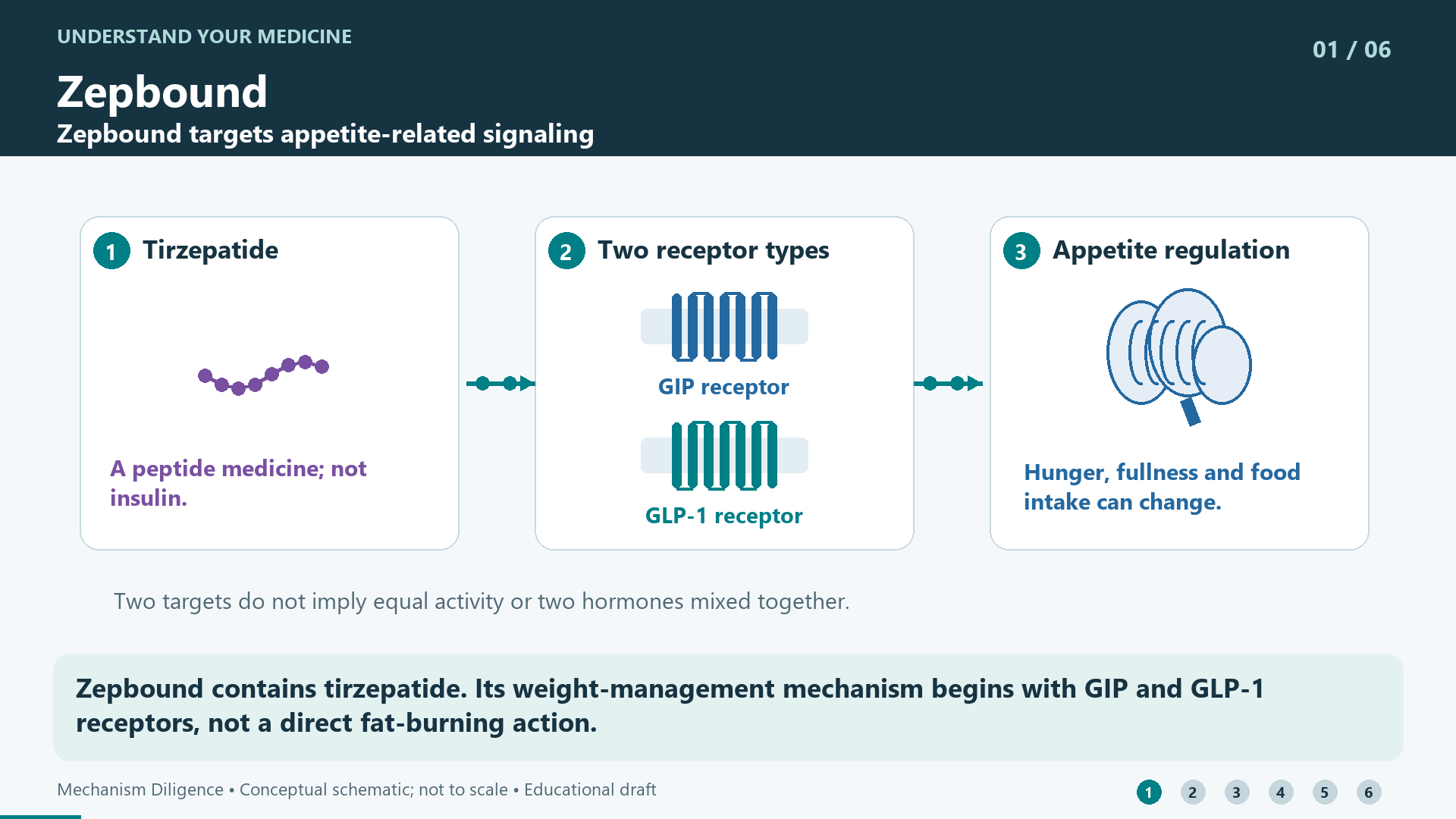
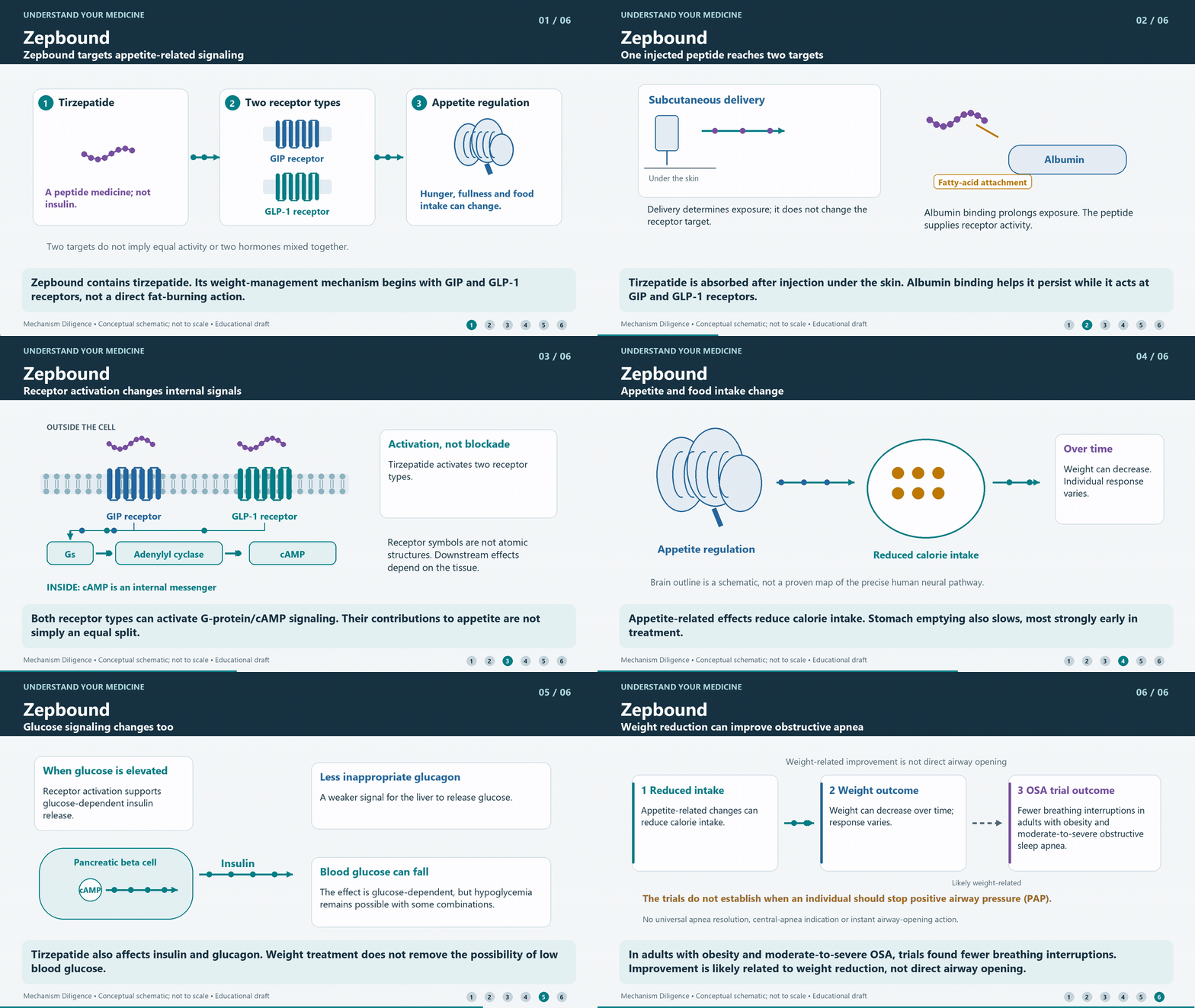
Zepbound contains tirzepatide. Its weight-management mechanism begins with GIP and GLP-1 receptors, not a direct fat-burning action.
The ingredient is shared with Mounjaro, but the product's approved uses differ. This story focuses on intake, weight and obesity-associated obstructive sleep apnea.
A mechanism diagram does not determine eligibility or predict the amount of weight lost.
- Zepbound prescribing information — August 2026 · Sections 1, 5, 12.1–12.3 and 14.2, including PAP discontinuation limitation · Current manufacturer US prescribing information; selected sections inspected · checked 2026-10-17
Chapter 2: One injected peptide reaches two targets
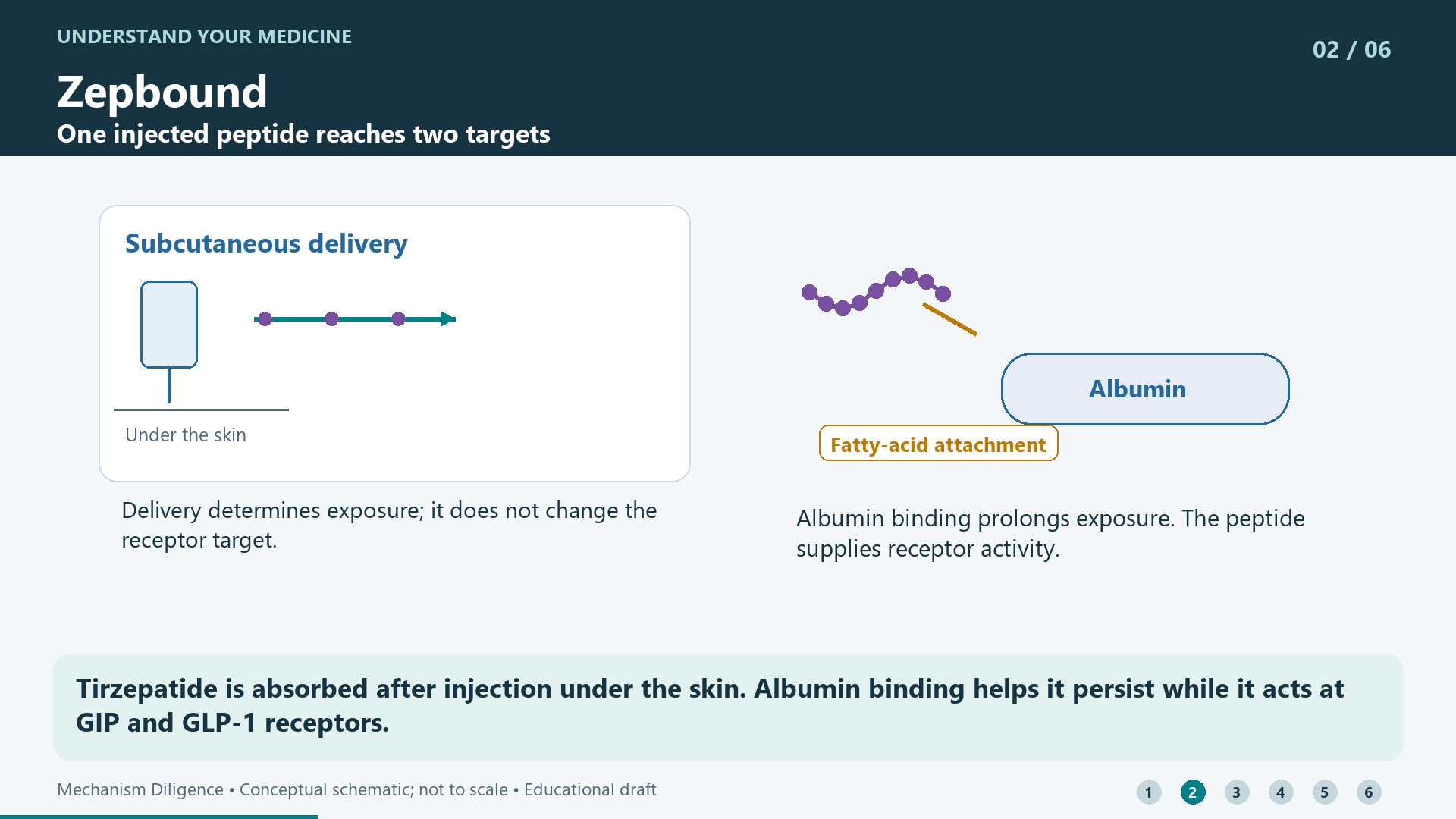
Tirzepatide is absorbed after injection under the skin. Albumin binding helps it persist while it acts at GIP and GLP-1 receptors.
Two receptor activities belong to the same peptide, not two drugs in one syringe. Albumin association changes exposure; receptor agonism produces signaling.
Token size and timing are illustrative; equal receptor activation is not implied.
- Zepbound prescribing information — August 2026 · Sections 1, 5, 12.1–12.3 and 14.2, including PAP discontinuation limitation · Current manufacturer US prescribing information; selected sections inspected · checked 2026-10-17
- Willard et al. — Tirzepatide dual-receptor pharmacology · Results: GIPR/GLP-1R Gs/cAMP pharmacology; DOI 10.1172/jci.insight.140532 · Primary receptor-assay study; results inspected · checked 2026-10-17
Chapter 3: Receptor activation changes internal signals
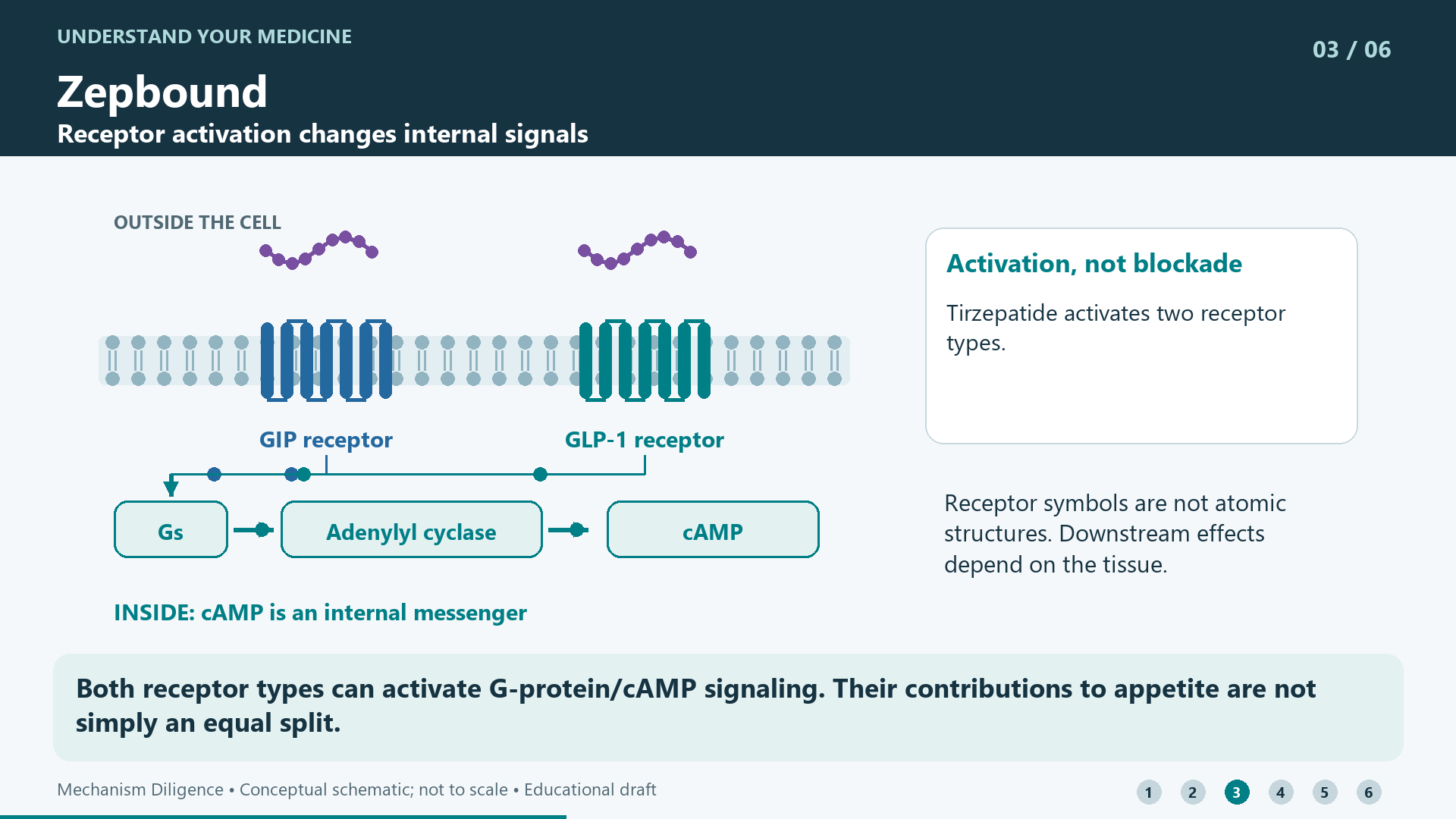
Both receptor types can activate G-protein/cAMP signaling. Their contributions to appetite are not simply an equal split.
Cell experiments characterize different GIPR and GLP-1R signaling profiles. Those measurements support dual agonism but cannot measure the percentage of human weight loss caused by each target.
Assay signaling bias is not proof of superior patient benefit or a complete neural mechanism.
- Willard et al. — Tirzepatide dual-receptor pharmacology · Results: GIPR/GLP-1R Gs/cAMP pharmacology; DOI 10.1172/jci.insight.140532 · Primary receptor-assay study; results inspected · checked 2026-10-17
Chapter 4: Appetite and food intake change
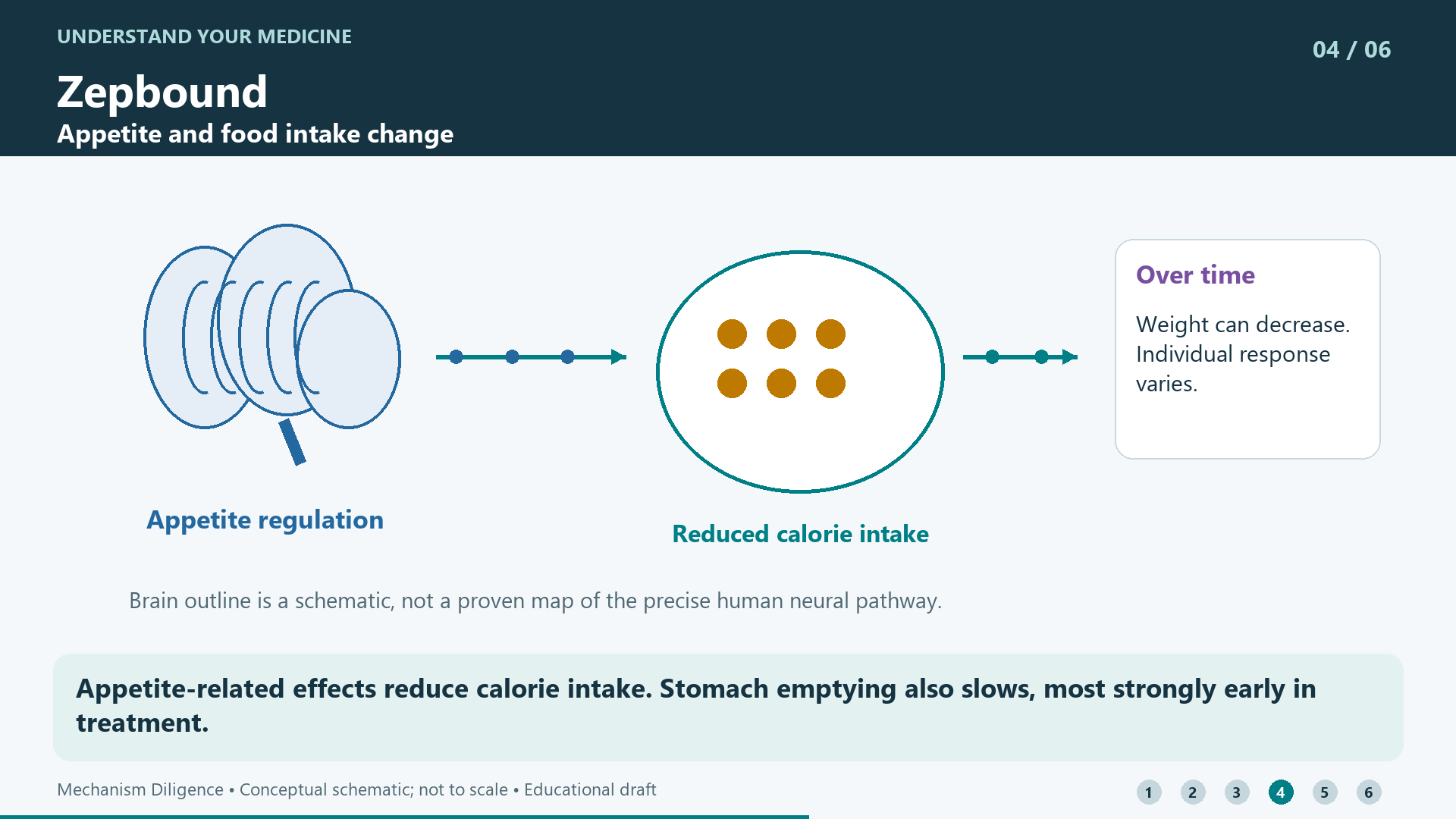
Appetite-related effects reduce calorie intake. Stomach emptying also slows, most strongly early in treatment.
The label's detailed brain-distribution evidence is from animals. Gastric experiments show that the early delay diminishes with repeated exposure; reduced intake must not be explained entirely by food remaining in the stomach.
Nausea is an adverse effect, not the required mechanism of weight reduction.
- Zepbound prescribing information — August 2026 · Sections 1, 5, 12.1–12.3 and 14.2, including PAP discontinuation limitation · Current manufacturer US prescribing information; selected sections inspected · checked 2026-10-17
- Urva et al. — Tirzepatide transiently delays gastric emptying · Abstract and clinical gastric-emptying results; DOI 10.1111/dom.14110 · Primary preclinical and phase 1 study; indexed abstract inspected · checked 2026-10-17
Chapter 5: Glucose signaling changes too
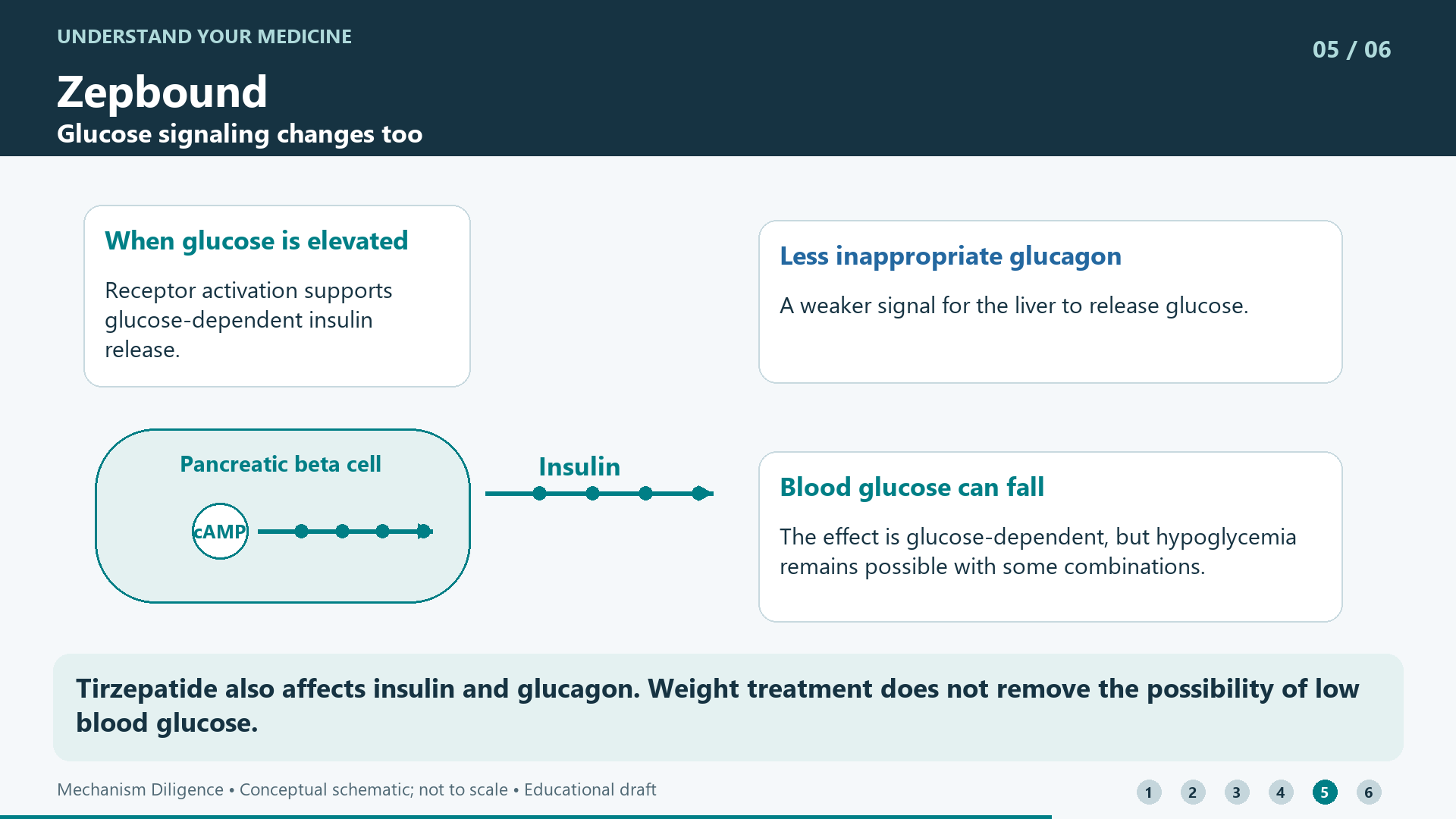
Tirzepatide also affects insulin and glucagon. Weight treatment does not remove the possibility of low blood glucose.
The same dual-receptor pharmacology underlies glucose-related effects. Insulin or insulin-releasing medicines can increase hypoglycemia risk. These actions do not transfer Mounjaro's diabetes indication to Zepbound.
This is not an instruction to change other medicines or a complete safety assessment.
- Zepbound prescribing information — August 2026 · Sections 1, 5, 12.1–12.3 and 14.2, including PAP discontinuation limitation · Current manufacturer US prescribing information; selected sections inspected · checked 2026-10-17
- Willard et al. — Tirzepatide dual-receptor pharmacology · Results: GIPR/GLP-1R Gs/cAMP pharmacology; DOI 10.1172/jci.insight.140532 · Primary receptor-assay study; results inspected · checked 2026-10-17
Chapter 6: Weight reduction can improve obstructive apnea
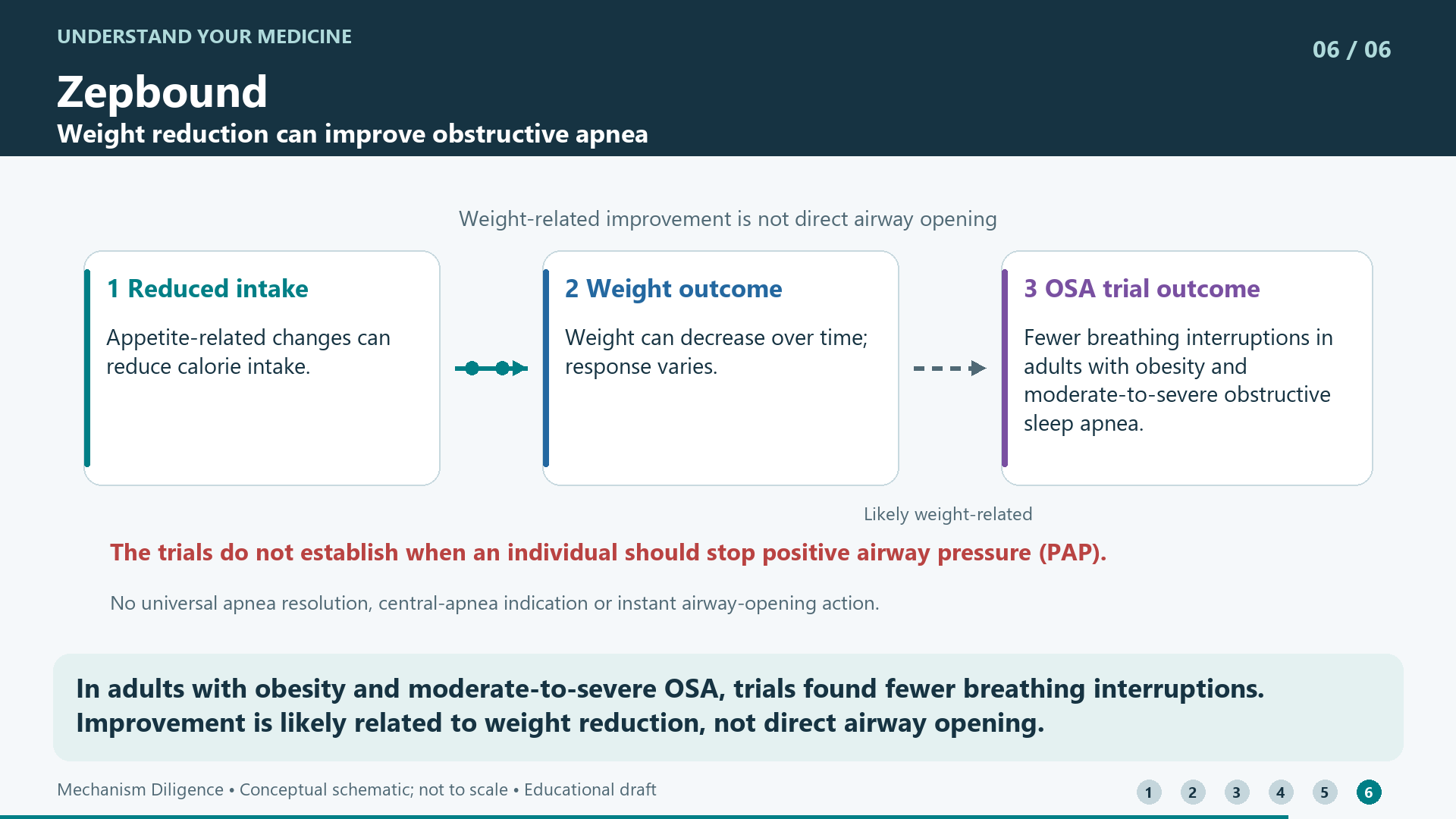
In adults with obesity and moderate-to-severe OSA, trials found fewer breathing interruptions. Improvement is likely related to weight reduction, not direct airway opening.
Two trials studied people with different baseline PAP use and measured apnea-hypopnea events per hour. They do not establish when an individual should stop PAP. Weight-related improvement does not imply universal resolution or treatment of central apnea.
OSA benefit is a trial outcome with a likely weight-mediated explanation, not a fully established causal pathway for every patient.
- FDA approval of Zepbound for obstructive sleep apnea · December 20, 2024: eligible population and likely weight-related AHI improvement · Regulatory approval explanation · checked 2026-10-17
- Malhotra et al. — Tirzepatide for obstructive sleep apnea and obesity · Abstract: two 52-week trials, baseline PAP groups and apnea-hypopnea outcomes · Primary randomized clinical trials; abstract inspected · checked 2026-10-17
- Zepbound prescribing information — August 2026 · Sections 1, 5, 12.1–12.3 and 14.2, including PAP discontinuation limitation · Current manufacturer US prescribing information; selected sections inspected · checked 2026-10-17
References & Sources
Source pages checked 2026-10-17. AI-assisted editorial source checking is not independent clinical review. Sources support the summary, mechanism, safety and access information; references are also kept beside each question.
- Zepbound US prescribing information — revised August 2026 ↗ · Boxed Warning; 1, 3–8, 11, 12.1–12.3, 14.1–14.2; Medication Guide
- FDA approves Zepbound for specified obstructive sleep apnea, December 20, 2024 ↗ · Adult obesity/moderate-to-severe OSA scope; likely weight-related mechanism; two trial populations
- Tirzepatide for the Treatment of Obstructive Sleep Apnea and Obesity ↗ · Primary SURMOUNT-OSA randomized trials; PAP and non-PAP populations; apnea-hypopnea index
- Tirzepatide is an imbalanced and biased dual GIP and GLP-1 receptor agonist ↗ · Primary receptor-signaling experiments; not proof of a complete clinical mechanism
- FDA Mounjaro prescribing information — revised August 2026 ↗ · 1 and 8.4: brand-specific indications and ages
- Zepbound official savings and insurance information ↗ · Manufacturer access options, eligibility and terms; prices intentionally not reproduced
Selective US-label-based information, not a complete safety list or a personal treatment recommendation. Do not change treatment based on this page; use the product-specific label and your care team's advice.