Wegovy (Drug class: GLP-1 receptor agonist)
US Wegovy injection and tablets for eligible weight-management and cardiovascular uses. Injection alone covers obesity at ages 12 and older and adult noncirrhotic MASH with F2–F3 fibrosis. Wegovy HD is an adult weight-management option. Formulation-specific eligibility is explained below; dosing and switching instructions are outside this guide.
Educational draft · independent clinical review pending. Silent mechanism animation available; no recorded narration.
Uses / Symptoms
- Adults: long-term weight management with obesity, or overweight plus a weight-related condition; injection also covers obesity at ages 12 and older
- Injection and tablets: reduce major cardiovascular events in adults with established cardiovascular disease and overweight or obesity
- Injection only: adult noncirrhotic MASH with moderate-to-advanced liver fibrosis, under accelerated approval
Effects
- Changes appetite signaling and reduces calorie intake to support weight loss and maintenance
- Can reduce cardiovascular events in the labeled adult population
- Can improve liver inflammation and fibrosis findings in eligible adults with MASH; long-term clinical benefit still needs confirmation
Side effects
- Nausea, vomiting, diarrhea, constipation, abdominal pain and other digestive symptoms are common
- Important risks include pancreatitis, gallbladder disease, dehydration-related kidney injury, severe digestive problems, allergic reactions and increased heart rate
- Boxed thyroid C-cell tumor warning; hypoglycemia risk rises with insulin or sulfonylureas
How does Wegovy work? What is the Mechanism Of Action (MOA)?
Wegovy contains semaglutide, which activates GLP-1 receptors involved in appetite and blood-sugar regulation. It can reduce hunger and the amount of food eaten, helping with weight loss and maintenance. The pill and injection share this target, but their approved ages and liver-disease uses differ.
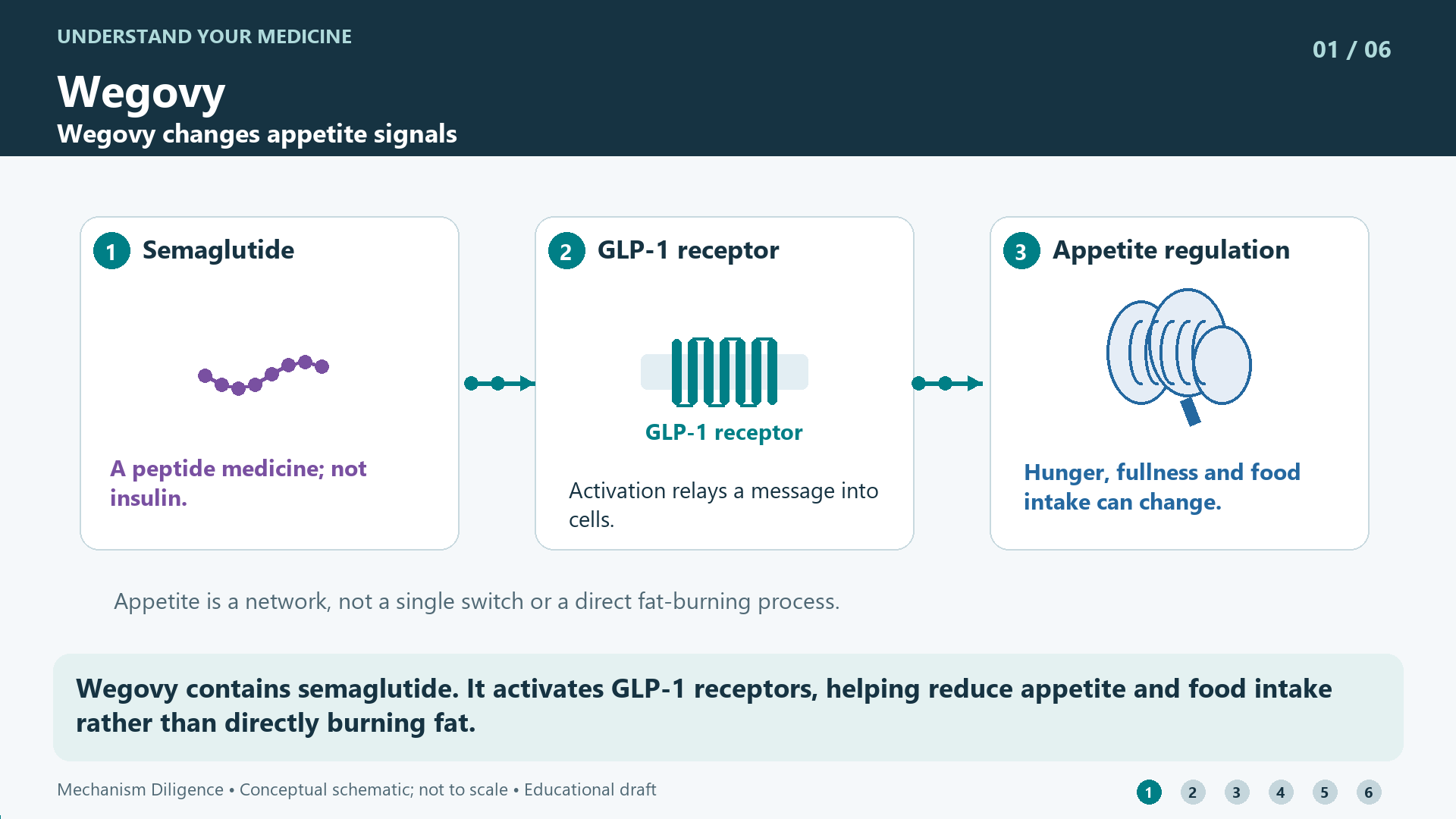
The mechanism, step by step
- Appetite and glucose have biological signals
GLP-1 helps regulate food intake and the body's response to elevated blood sugar.
- Semaglutide reaches the circulation
Injection delivers it under the skin; tablets use SNAC to support uptake through the stomach.
- GLP-1 receptors receive a longer-lasting signal
Semaglutide activates the receptor and persists longer than native GLP-1.
- Food intake can decrease
Appetite effects help reduce calorie intake. Stomach emptying also slows, but that is not the whole weight-loss mechanism.
- Weight and other outcomes are assessed separately
Weight management, cardiovascular events and MASH histology have distinct evidence. Exact cardiovascular and liver pathways remain incompletely understood.
- Wegovy injection and tablets US prescribing information, revised June 2026 ↗
- FDA Wegovy prescribing information, June 2026, reference ID 5819850 ↗
- Lincoff et al. SELECT cardiovascular-outcomes randomized trial, 2023 ↗
- Sanyal et al. ESSENCE phase 3 MASH trial, 2025 ↗
- Wharton et al. OASIS 4 oral semaglutide randomized trial, 2025 ↗
- Buckley et al. Transcellular stomach absorption of oral semaglutide, 2018 ↗
A perspective-aware, six-chapter visual narration is available when JavaScript is enabled.
Questions & Answers (FAQ)
How does Wegovy work?
Wegovy contains semaglutide, which activates GLP-1 receptors involved in appetite and blood-sugar regulation. It can reduce hunger and the amount of food eaten, helping with weight loss and maintenance. The pill and injection share this target, but their approved ages and liver-disease uses differ.
- Wegovy injection and tablets US prescribing information, revised June 2026 ↗
- FDA Wegovy prescribing information, June 2026, reference ID 5819850 ↗
- Lincoff et al. SELECT cardiovascular-outcomes randomized trial, 2023 ↗
- Sanyal et al. ESSENCE phase 3 MASH trial, 2025 ↗
- Wharton et al. OASIS 4 oral semaglutide randomized trial, 2025 ↗
- Buckley et al. Transcellular stomach absorption of oral semaglutide, 2018 ↗
What is Wegovy approved for?
With reduced-calorie eating and increased activity, both formulations cover weight management in adults with obesity, or overweight plus a weight-related condition, and cardiovascular risk reduction in adults with established cardiovascular disease and overweight or obesity. Injection also covers obesity at ages 12 and older and adult noncirrhotic MASH with F2–F3 fibrosis. The MASH indication is accelerated approval, requiring confirmation of clinical benefit.
Are the pill, standard injection and Wegovy HD the same?
They contain semaglutide but are not interchangeable products or strengths. Tablets are for adults; pediatric obesity and MASH indications belong to injection. Wegovy HD is a higher-strength injection option for adult weight management, not a higher-strength option for every Wegovy indication; follow the exact prescribed product's instructions.
Does Wegovy just slow the stomach or burn fat directly?
No. It reduces calorie intake, with appetite effects likely playing an important role; delayed stomach emptying is an additional action, not the full explanation. The label reports greater fat-mass than lean-mass loss, so weight lost should not be described as exclusively fat. It is not a direct fat-dissolving treatment.
What does the heart benefit mean?
Wegovy reduces the combined risk of cardiovascular death, nonfatal heart attack or nonfatal stroke in adults with established cardiovascular disease and overweight or obesity. SELECT tested injectable semaglutide in adults without diabetes; the current label also authorizes tablets for the stated adult indication. That does not mean an identical cardiovascular-outcomes trial was separately completed with Wegovy tablets, and the exact protective mechanism remains uncertain.
What is the liver indication, and what remains uncertain?
Only injection is approved for adults with noncirrhotic metabolic dysfunction-associated steatohepatitis, or MASH, with moderate-to-advanced fibrosis corresponding to F2–F3. ESSENCE showed improvements in liver-biopsy endpoints, supporting accelerated approval. This is not a general fatty-liver or cirrhosis indication, and confirmation of long-term clinical benefit is still required; the precise human mechanism is not fully understood.
What evidence supports the Wegovy pill for weight management?
OASIS 4 randomized adults with overweight or obesity but without diabetes to oral semaglutide or placebo alongside lifestyle intervention. Weight reduction was greater with semaglutide, and digestive adverse effects were more common. The label notes that Wegovy tablets have not been studied for weight reduction in adults with type 2 diabetes and overweight or obesity. This was not a head-to-head trial proving the pill better than an injection, nor evidence for pediatric or MASH use of the pill.
What side effects are common?
Nausea, diarrhea, vomiting, constipation and abdominal pain are common; headache, fatigue and other digestive symptoms can also occur. Side-effect frequencies vary across formulations and studies. Severe or persistent symptoms need attention, and Wegovy is not recommended with severe gastroparesis.
Which symptoms need urgent attention?
Severe, persistent abdominal pain needs immediate medical advice because it may signal pancreatitis; breathing difficulty or face, tongue or throat swelling needs emergency help. Promptly report persistent vomiting or diarrhea, new vision changes, upper abdominal pain with fever or jaundice, or a racing heartbeat at rest. These may reflect dehydration, eye, gallbladder or heart-rate problems.
What does the boxed warning mean?
Semaglutide caused thyroid C-cell tumors in rodents; whether this occurs in humans remains unknown. Wegovy is contraindicated with personal or family medullary thyroid carcinoma, multiple endocrine neoplasia syndrome type 2, or a prior serious allergic reaction to semaglutide or its ingredients. A new neck lump, persistent hoarseness or trouble swallowing needs assessment.
What about other medicines or a planned procedure?
Using Wegovy with another semaglutide product or another GLP-1 receptor agonist is not recommended. Insulin or sulfonylureas increase hypoglycemia risk, and delayed stomach emptying can affect other oral medicines. Tell the anesthesia team before surgery or deep sedation because aspiration has been reported; do not set your own switching or procedure-hold schedule, and never share a FlexTouch pen.
What about pregnancy and breastfeeding?
Contact the prescriber promptly about pregnancy or plans to conceive because semaglutide persists for weeks and may harm a fetus. Wegovy should be stopped when pregnancy is recognized for weight or cardiovascular-risk use; MASH treatment requires its own individualized benefit-risk assessment. Breastfeeding is not recommended with the tablets because of SNAC, while the injection has separate lactation guidance.
Where can I check legitimate product and access information?
The official Wegovy site and current prescribing information distinguish the pill, injection presentations and eligible uses. A prescription and individual clinical assessment are required. Manufacturer access information does not establish your coverage, eligibility, price or pharmacy stock.
Online stores and Pharmacies (Buy)
Prescription medicine. The official product site provides current formulation and access information, not a verified individual price, coverage decision or stock check.
No live price, stock or individual eligibility is verified here.
Animation chapters, evidence & visual limits
US Wegovy injection and tablets. Adult weight-management and cardiovascular indications have eligibility requirements; adolescent obesity and adult MASH indications are injection-only. Higher-dose injection scope is not transferred to tablets or children.
Educational draft; independent clinical review pending. Original qualitative diagrams, not human brain imaging, atomic docking or a forecast of weight loss. Wegovy tablets, standard injection and higher-dose injection have distinct instructions and evidence. No dose conversion is shown. Brain distribution details are informed partly by animal work. Gastric slowing is not a complete explanation for weight loss. Cardiovascular mechanism is not established. MASH accelerated approval is based on histology, not demonstrated prevention of liver failure; no direct liver-cell repair is depicted. This selected mechanism story is not a full safety list. Boxed warning, digestive risks and hypoglycemia with certain other medicines remain important.
Original conceptual illustrations. AI-assisted editorial source check; independent clinical review pending. No recorded narration.
Chapter 1: Wegovy changes appetite signals
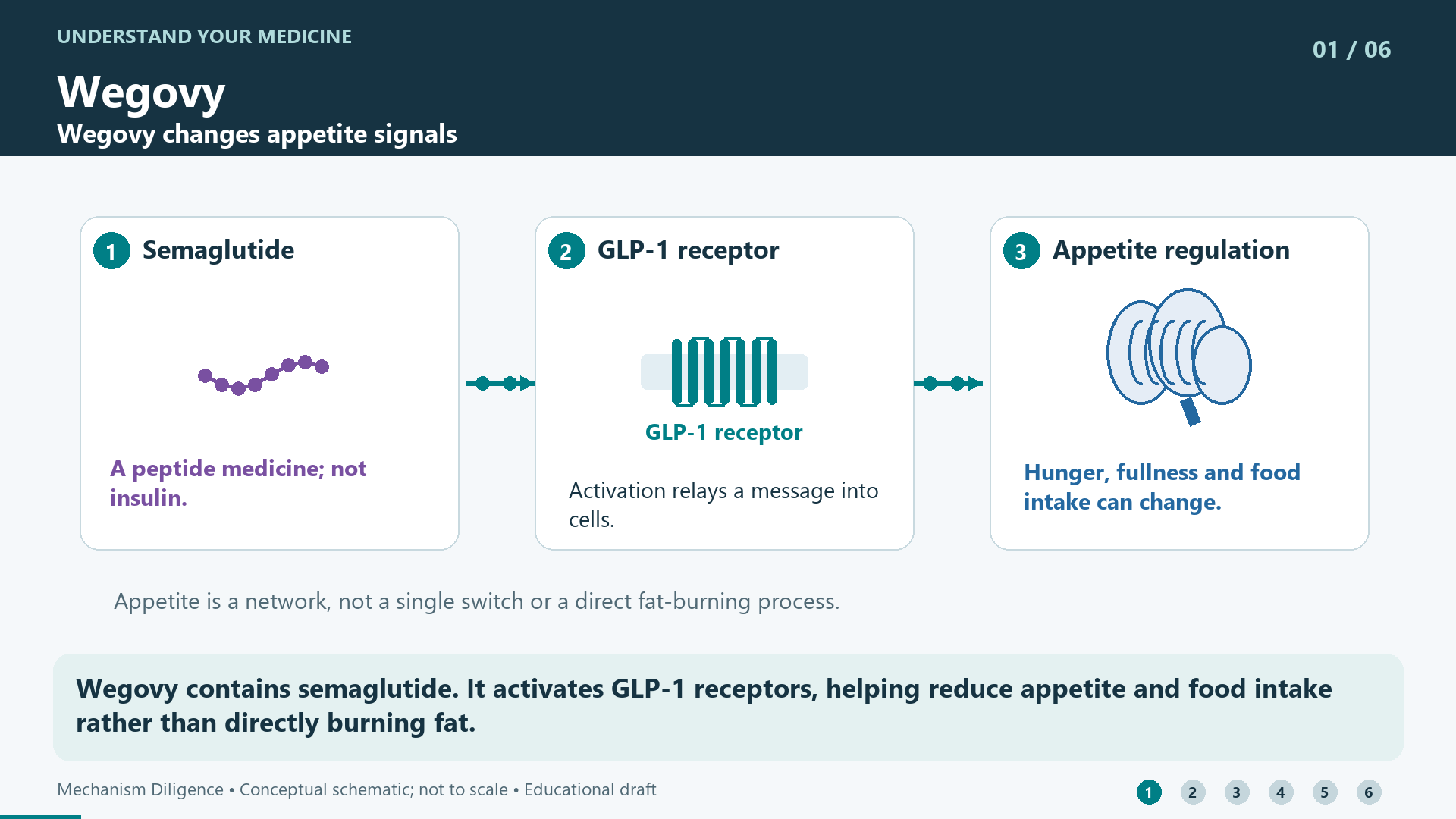
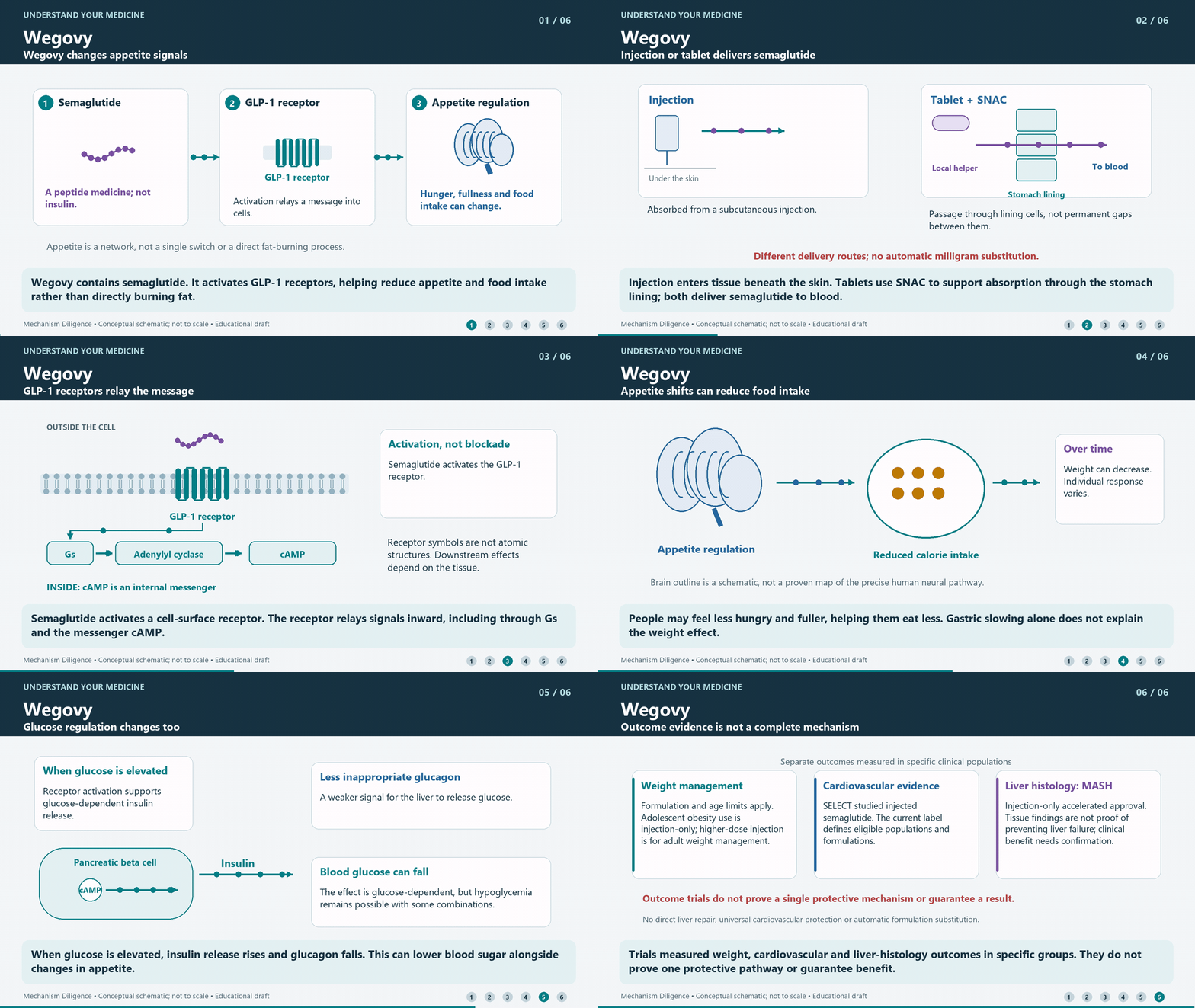
Wegovy contains semaglutide. It activates GLP-1 receptors, helping reduce appetite and food intake rather than directly burning fat.
GLP-1 participates in appetite regulation. Human experimental evidence supports reduced hunger and energy intake with semaglutide; individual response is not captured by a single cartoon.
Appetite is regulated by many pathways; this is not a complete obesity model.
- Wegovy injection and tablets US prescribing information, June 2026 · Sections 1, 2, 5, 8.4, 8.6, 12.1–12.3, 14.1–14.4 · Current manufacturer-hosted US label; selected sections inspected · checked 2026-10-17
- Friedrichsen et al. — Semaglutide, appetite, energy intake and gastric emptying, 2021 · Abstract and conclusion: 72 adults with obesity, 20 weeks; indirect paracetamol gastric-emptying measure · Primary randomized human mechanistic study; selected text inspected · checked 2026-10-17
Chapter 2: Injection or tablet delivers semaglutide
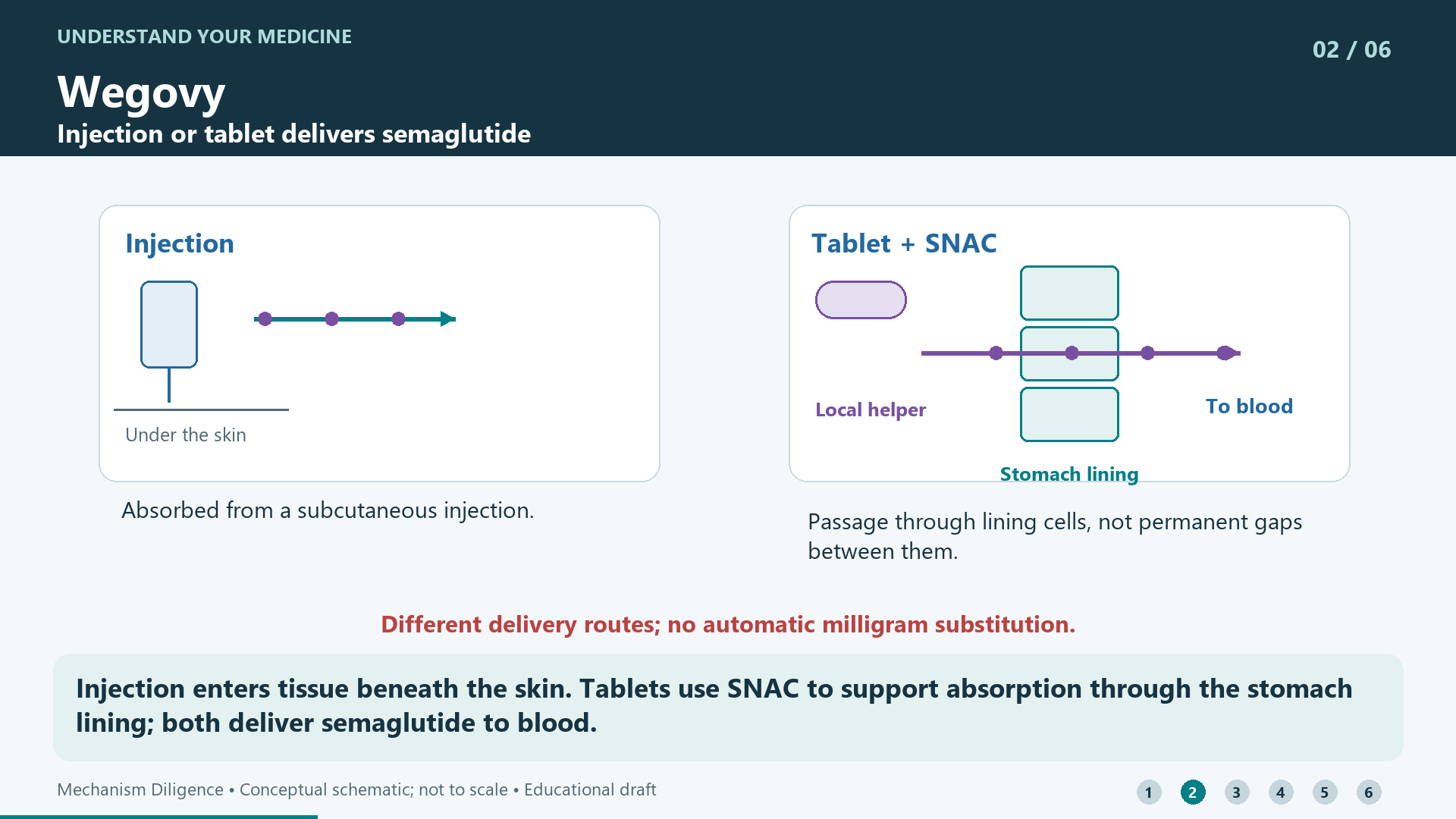
Injection enters tissue beneath the skin. Tablets use SNAC to support absorption through the stomach lining; both deliver semaglutide to blood.
The routes share receptor pharmacology but differ in absorption and product instructions. Tablets do not inherit every injection indication, and higher-dose injection is not a separate receptor mechanism.
No dose equivalence, absorption percentage or identical exposure is implied.
- Wegovy injection and tablets US prescribing information, June 2026 · Sections 1, 2, 5, 8.4, 8.6, 12.1–12.3, 14.1–14.4 · Current manufacturer-hosted US label; selected sections inspected · checked 2026-10-17
- Buckley et al. — Transcellular stomach absorption of oral semaglutide, 2018 · Abstract: localized SNAC-enabled gastric absorption; DOI 10.1126/scitranslmed.aar7047 · Primary clinical and preclinical absorption study; abstract inspected; not a Wegovy dose-equivalence trial · checked 2026-10-17
Chapter 3: GLP-1 receptors relay the message
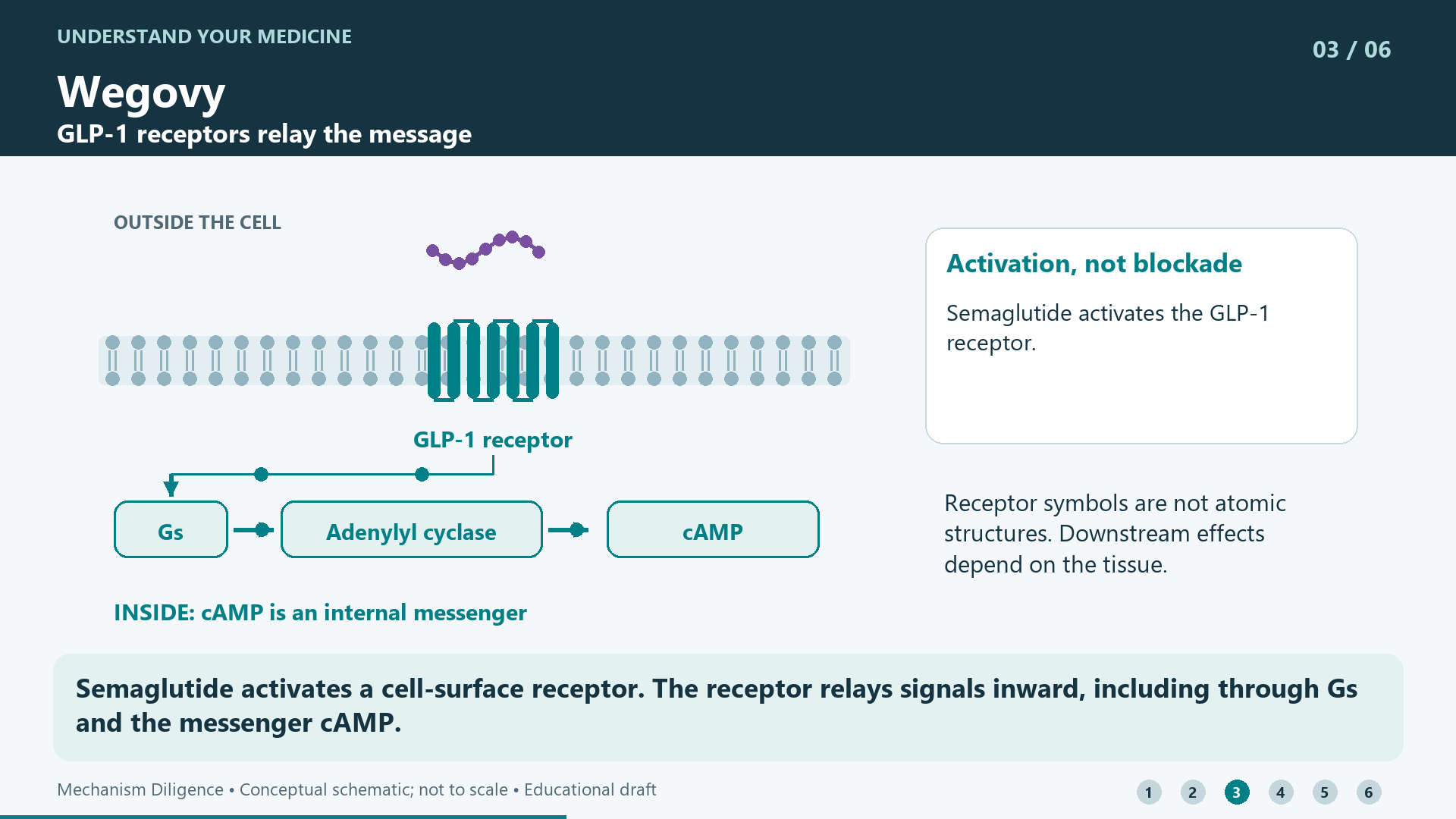
Semaglutide activates a cell-surface receptor. The receptor relays signals inward, including through Gs and the messenger cAMP.
Cryo-EM structures and cell signaling experiments support this receptor activation model. It explains a molecular starting point, not the complete human appetite circuit or every clinical benefit.
Laboratory receptor evidence does not map all brain regions reached in a treated person.
- Structure and dynamics of semaglutide- and taspoglutide-bound GLP-1R–Gs complexes, 2021 · Summary; Figures 2–4; cAMP assay; DOI 10.1016/j.celrep.2021.109374 · Primary cryo-EM and recombinant-cell study; selected text and methods inspected · checked 2026-10-17
Chapter 4: Appetite shifts can reduce food intake
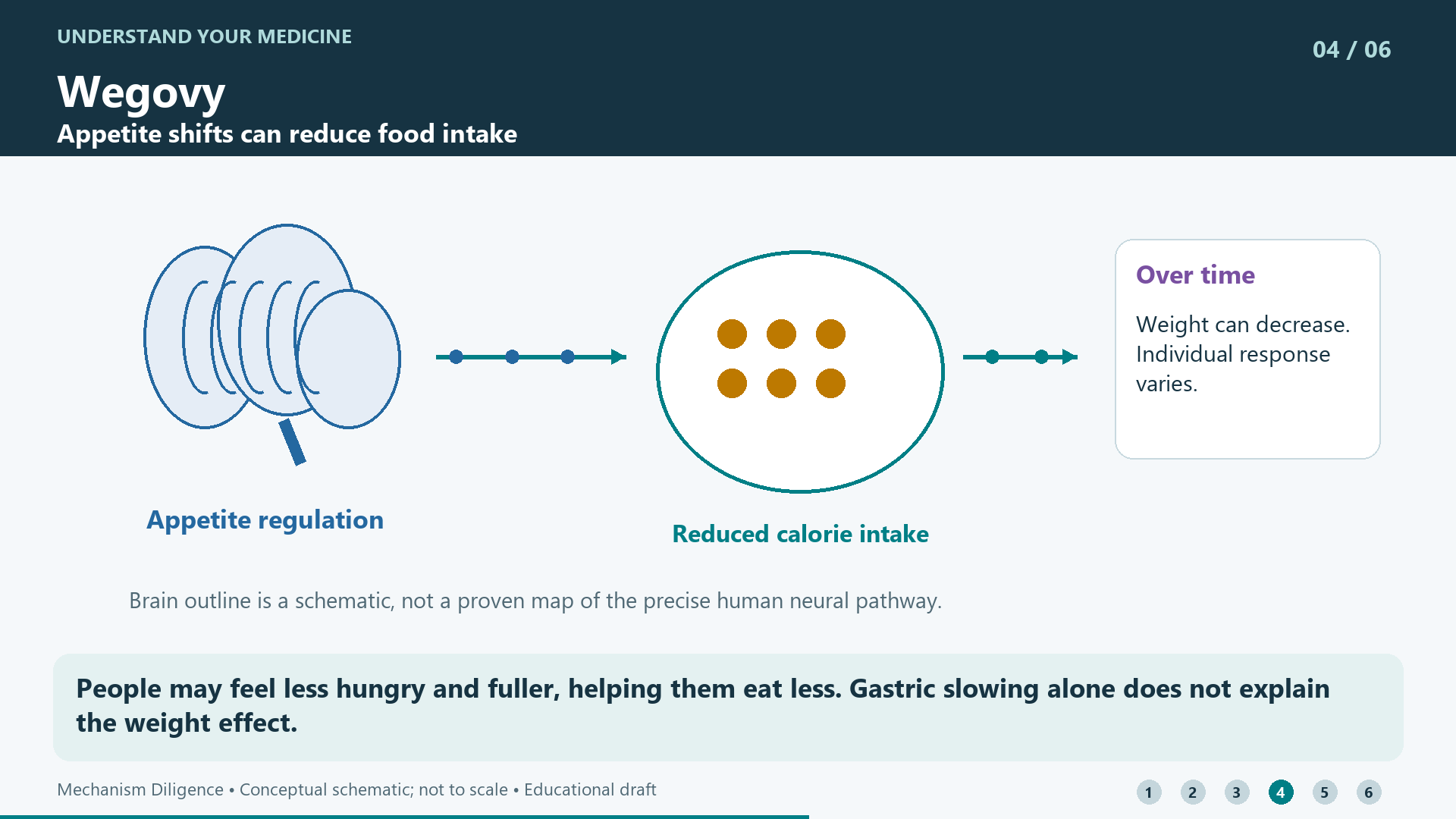
People may feel less hungry and fuller, helping them eat less. Gastric slowing alone does not explain the weight effect.
A 20-week randomized study in adults with obesity found appetite and intake changes, but no delayed gastric emptying by its indirect test at that time. The label still recognizes gastric-emptying effects; they vary with context and measurement.
The study used injected 2.4 mg in adults; effect size and gastric findings do not transfer unchanged to every formulation, dose or person.
- Friedrichsen et al. — Semaglutide, appetite, energy intake and gastric emptying, 2021 · Abstract and conclusion: 72 adults with obesity, 20 weeks; indirect paracetamol gastric-emptying measure · Primary randomized human mechanistic study; selected text inspected · checked 2026-10-17
- Wegovy injection and tablets US prescribing information, June 2026 · Sections 1, 2, 5, 8.4, 8.6, 12.1–12.3, 14.1–14.4 · Current manufacturer-hosted US label; selected sections inspected · checked 2026-10-17
Chapter 5: Glucose regulation changes too
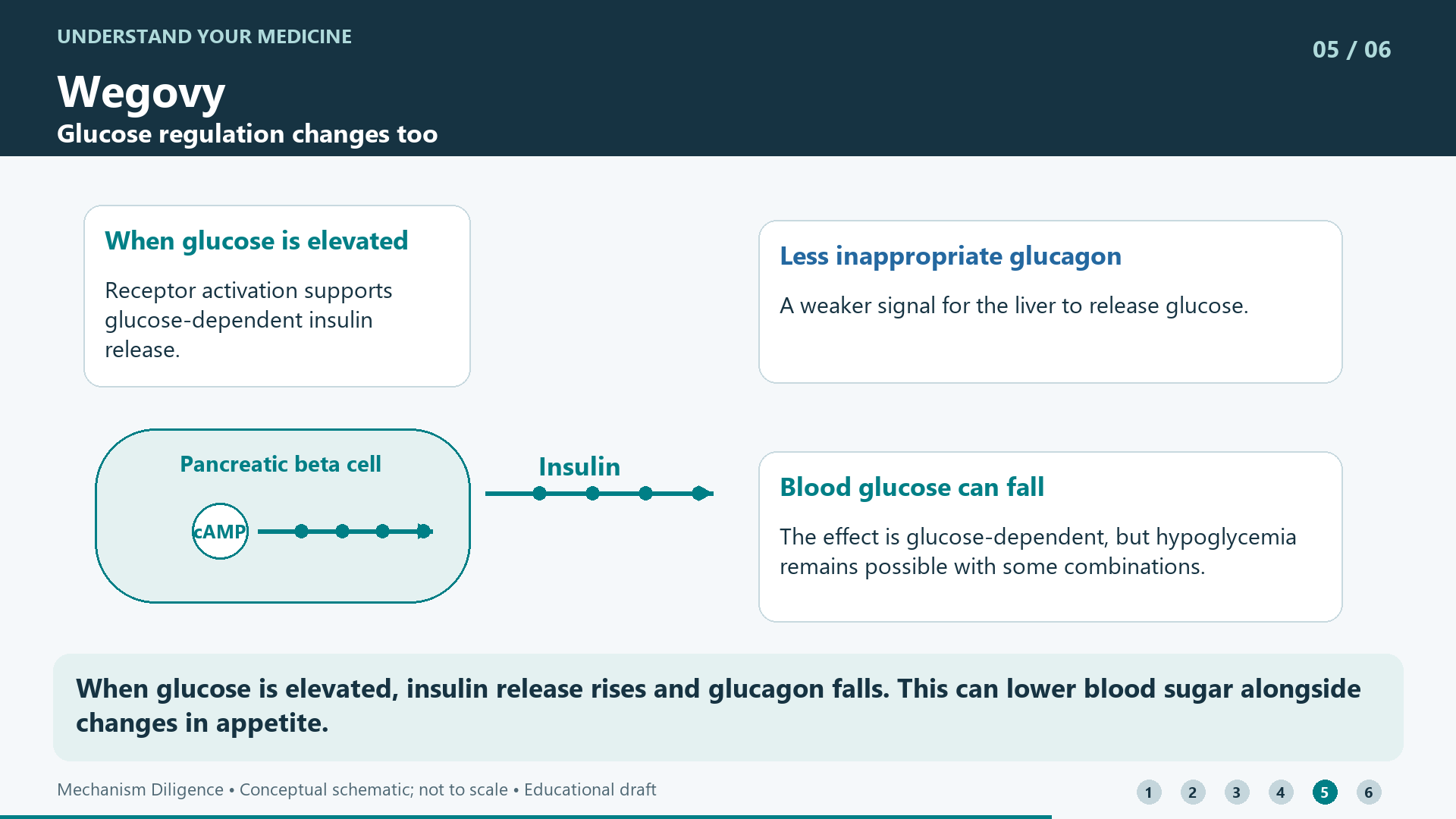
When glucose is elevated, insulin release rises and glucagon falls. This can lower blood sugar alongside changes in appetite.
The pancreas and liver hormone balance is a related pathway, not evidence that every person receiving Wegovy has diabetes. Low glucose remains possible, especially with insulin or sulfonylureas.
Glucose-dependent physiology does not remove interaction-related hypoglycemia risk.
- Wegovy injection and tablets US prescribing information, June 2026 · Sections 1, 2, 5, 8.4, 8.6, 12.1–12.3, 14.1–14.4 · Current manufacturer-hosted US label; selected sections inspected · checked 2026-10-17
Chapter 6: Outcome evidence is not a complete mechanism
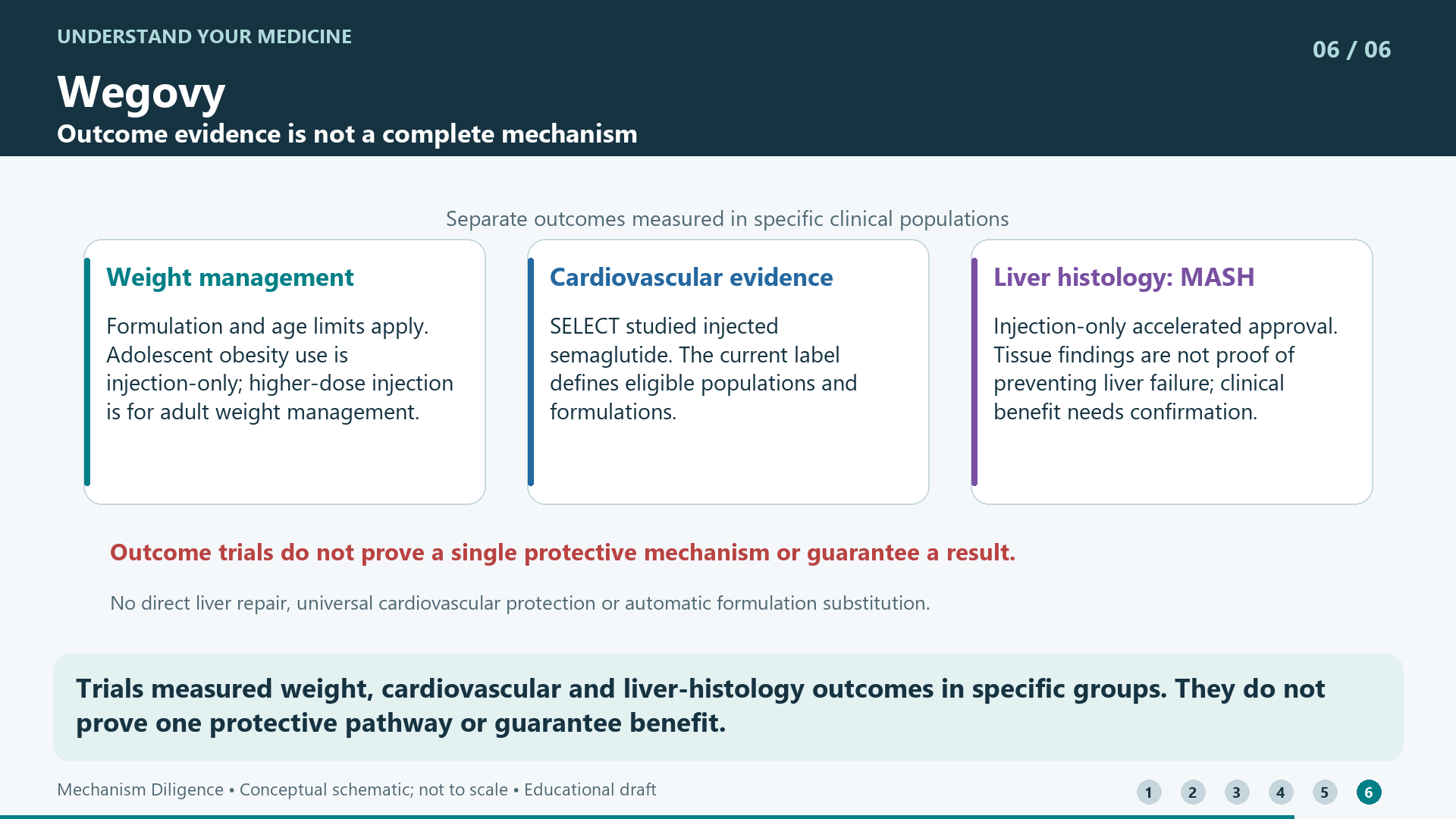
Trials measured weight, cardiovascular and liver-histology outcomes in specific groups. They do not prove one protective pathway or guarantee benefit.
SELECT established cardiovascular evidence with injection; the current label defines eligible formulations and populations. ESSENCE histology supports injection-only accelerated MASH approval, not proven prevention of liver failure. Adolescent weight treatment is also injection-only; higher-dose injection is for adult weight management.
Product and population eligibility must be checked in the label; histology and clinical events are not interchangeable endpoints.
- Lincoff et al. — SELECT cardiovascular-outcomes trial, 2023 · Abstract: subcutaneous semaglutide, established CVD and overweight/obesity without diabetes · Randomized clinical outcome trial; indexed abstract inspected · checked 2026-10-17
- Sanyal et al. — Phase 3 semaglutide trial in MASH, 2025 · Abstract and results: ESSENCE interim histologic endpoints in F2–F3 MASH · Randomized clinical trial; indexed abstract/results inspected; not proof of reduced liver failure · checked 2026-10-17
- Wegovy injection and tablets US prescribing information, June 2026 · Sections 1, 2, 5, 8.4, 8.6, 12.1–12.3, 14.1–14.4 · Current manufacturer-hosted US label; selected sections inspected · checked 2026-10-17
References & Sources
Source pages checked 2026-10-17. AI-assisted editorial source checking is not independent clinical review. Sources support the summary, mechanism, safety and access information; references are also kept beside each question.
- Wegovy injection and tablets US prescribing information, revised June 2026 ↗ · Boxed warning; 1–8; 11–12; 14.1–14.4; Medication Guide; HD and formulation distinctions
- FDA Wegovy prescribing information, June 2026, reference ID 5819850 ↗ · 1; 2.2–2.3; 3; 8.4; 14: adult tablet, pediatric injection and accelerated MASH scope
- Lincoff et al. SELECT cardiovascular-outcomes randomized trial, 2023 ↗ · Abstract: injected semaglutide, established CVD and overweight/obesity without diabetes; MACE
- Sanyal et al. ESSENCE phase 3 MASH trial, 2025 ↗ · Abstract: planned week-72 interim histology analysis; first 800 patients; F2–F3 fibrosis
- Wharton et al. OASIS 4 oral semaglutide randomized trial, 2025 ↗ · Abstract: adult population without diabetes, placebo comparator, week-64 weight outcomes and adverse events
- Buckley et al. Transcellular stomach absorption of oral semaglutide, 2018 ↗ · Abstract: clinical and preclinical SNAC-enabled gastric absorption
- Official Wegovy patient product information ↗ · Current pill and injection information; patient access resources
Selective US-label-based information, not a complete safety list or a personal treatment recommendation. Do not change treatment based on this page; use the product-specific label and your care team's advice.