Victoza (Drug class: GLP-1 receptor agonist — diabetes product)
US Victoza liraglutide subcutaneous pen: glucose control with diet and exercise for type 2 diabetes from age 10, and cardiovascular-risk reduction in adults with type 2 diabetes and established cardiovascular disease. This is not Saxenda's weight-management indication. No dosing or switching instructions are provided.
Educational draft · independent clinical review pending. Silent mechanism animation available; no recorded narration.
Uses / Symptoms
- Glucose control in type 2 diabetes from age 10 years, with diet and exercise
- Reduction of major cardiovascular events in adults with type 2 diabetes and established cardiovascular disease
- Not the Saxenda weight-management indication
Effects
- Increases insulin secretion and reduces glucagon in a glucose-dependent way
- Slows stomach emptying and lowers fasting and after-meal glucose
- Cardiovascular benefit is supported by an outcomes trial, not inferred solely from glucose lowering
Side effects
- Nausea, diarrhea, vomiting, constipation and reduced appetite are common
- Important risks include pancreatitis, gallbladder disease and dehydration-related kidney injury
- Boxed thyroid C-cell tumor warning; hypoglycemia risk is especially important with insulin or sulfonylureas and in children
How does Victoza work? What is the Mechanism Of Action (MOA)?
Victoza activates GLP-1 receptors, helping your pancreas release insulin when blood sugar is high. It also reduces glucagon, a signal that tells the liver to release sugar, and slows food leaving the stomach. These effects lower blood sugar; its heart-risk benefit is supported by clinical studies in certain adults with type 2 diabetes and heart or blood-vessel disease.
The mechanism, step by step
- Glucose and incretins coordinate insulin
GLP-1 is a physiological signal that helps beta cells respond appropriately to raised glucose.
- Liraglutide activates GLP-1 receptors
The modified peptide stimulates receptor signaling, including the Gs–adenylyl cyclase–cAMP pathway in beta cells.
- Pancreatic hormone responses change
Insulin secretion increases and glucagon secretion decreases in a glucose-dependent manner.
- Gastric emptying is delayed
Slower movement of stomach contents contributes to the glucose-lowering effect and can affect oral-medication absorption.
- Glycemic and cardiovascular evidence differ
Glucose-lowering physiology and cardiovascular outcome trials answer different questions. LEADER supports the defined adult cardiovascular indication, not a universal promise of protection.
A perspective-aware, six-chapter visual narration is available when JavaScript is enabled.
Questions & Answers (FAQ)
How does Victoza work?
Victoza activates GLP-1 receptors, helping your pancreas release insulin when blood sugar is high. It also reduces glucagon, a signal that tells the liver to release sugar, and slows food leaving the stomach. These effects lower blood sugar; its heart-risk benefit is supported by clinical studies in certain adults with type 2 diabetes and heart or blood-vessel disease.
What are Victoza's two US indications?
Glucose control with diet and exercise in adults and children aged 10 years and older with type 2 diabetes; and reduction of major cardiovascular events in adults with type 2 diabetes and established cardiovascular disease. The cardiovascular indication is not a pediatric indication.
Has Victoza been discontinued in the US?
The US Drugs@FDA and Orange Book records checked October 17, 2026 list Victoza as Prescription, not Discontinued. EMA's notice concerns the EU/EEA, so it cannot establish US discontinuation. These records do not guarantee pharmacy stock or future supply.
Can Saxenda be treated as the same prescription?
No. The active ingredient is shared, but the brands have different labeled purposes and instructions. Victoza's label advises against coadministration with other liraglutide products; do not switch or combine them without the prescriber.
What evidence supports its cardiovascular indication?
LEADER randomized adults with type 2 diabetes and high cardiovascular risk to liraglutide or placebo with usual care and found fewer primary major cardiovascular events with liraglutide. The US indication is limited to adults with established cardiovascular disease; a trial average is not an individual guarantee.
Which adverse effects are common?
Nausea, diarrhea, vomiting, reduced appetite, indigestion and constipation are common. Ongoing vomiting or diarrhea can cause dehydration, so persistent symptoms or inability to drink need medical review.
What is the thyroid boxed warning?
Liraglutide caused thyroid C-cell tumors in rats and mice; the relevance to humans is unknown. Victoza is contraindicated with personal or family medullary thyroid carcinoma or MEN2. The warning is not a claim that every user develops thyroid cancer.
Who is especially vulnerable to low glucose?
Risk increases with insulin or sulfonylureas. Children can experience hypoglycemia even without those medicines. Ask the care team about monitoring and symptom recognition rather than assuming glucose dependence removes the risk.
Does kidney disease rule out Victoza in the same way as exenatide?
Do not transfer exenatide's numeric kidney restrictions to Victoza. Its label describes experience across renal-impairment groups but limited experience in end-stage disease, and warns about acute kidney injury from fluid loss. The individual's kidney function and symptoms still matter.
Which symptoms need prompt help?
Severe persistent abdominal pain can indicate pancreatitis; upper-abdominal pain with fever or jaundice may reflect gallbladder disease. Seek emergency help for breathing difficulty or face or throat swelling. These are selected warnings, not a complete safety list.
Why tell the anesthesia team and pharmacist?
Victoza delays gastric emptying, which can affect oral-drug absorption and creates an aspiration concern during anesthesia or deep sedation. Tell the relevant team before a procedure; the label does not establish a universal holding interval.
What should be discussed before treatment?
Discuss pregnancy, severe gastroparesis, pancreas or gallbladder problems, kidney disease, allergies and the full medicine list. Do not share pens even with a changed needle. Dosing, switching and injection training require the exact product's instructions and the care team.
Online stores and Pharmacies (Buy)
Prescription required. US FDA records list Victoza as Prescription as of October 17, 2026; this is not confirmation of pharmacy inventory. The official support page may help with coverage questions, but no price, eligibility, continued-supply or automatic-substitution promise is made.
No live price, stock or individual eligibility is verified here.
Animation chapters, evidence & visual limits
Liraglutide injection for type 2 diabetes glucose control from age 10; cardiovascular-risk reduction is limited to adults with type 2 diabetes and established cardiovascular disease.
Educational draft; independent clinical review pending. Original explanatory schematics, not atomic structures, microscopy, measured concentrations or patient simulations. Selective mechanism and safety context, not complete prescribing information or dosing/switching instructions. Shared liraglutide does not transfer Saxenda's weight-management indication or permit substitution. A cardiovascular composite benefit does not identify a single causal pathway or guarantee protection.
Original conceptual illustrations. AI-assisted editorial source check; independent clinical review pending. No recorded narration.
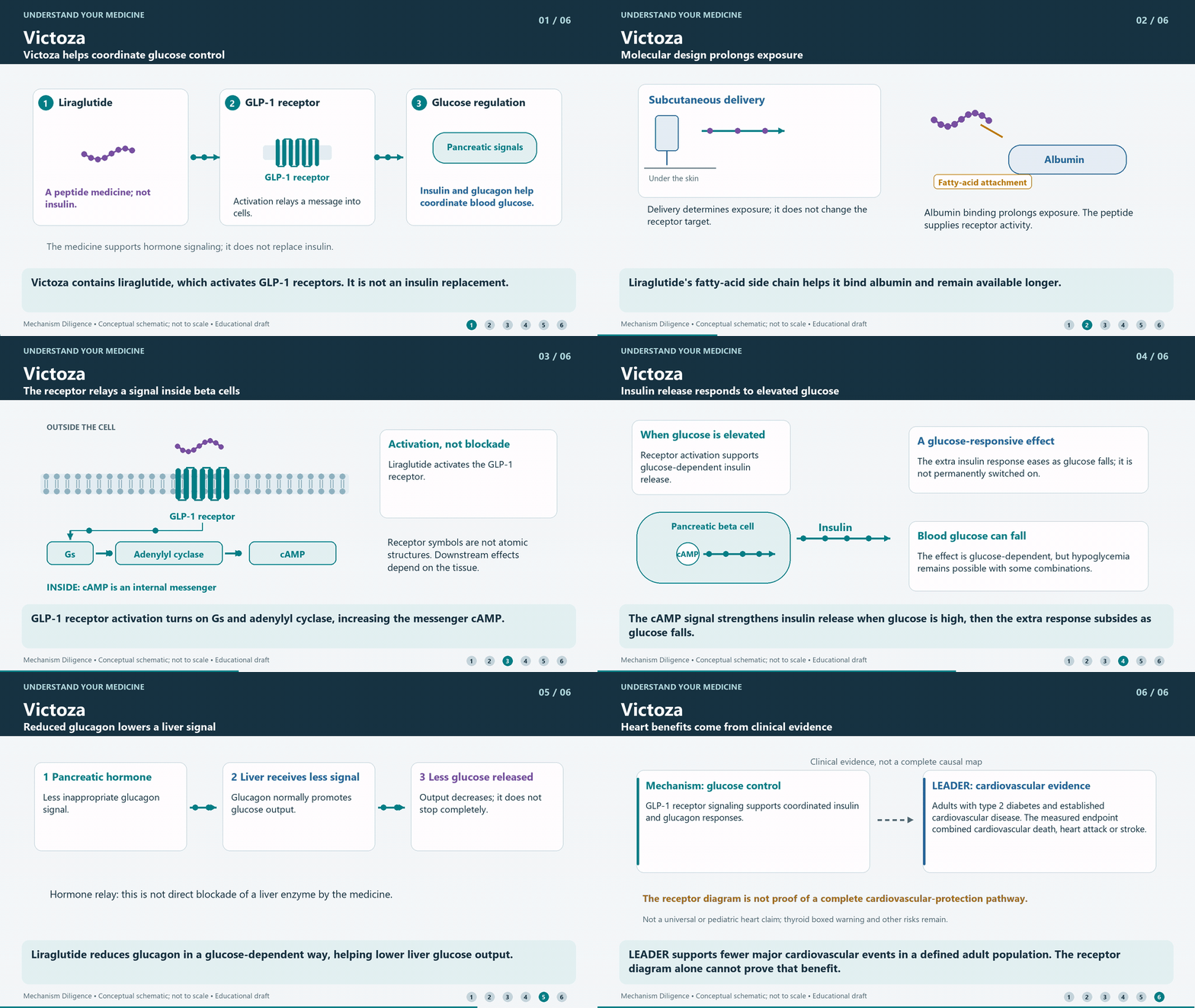
Chapter 1: Victoza helps coordinate glucose control
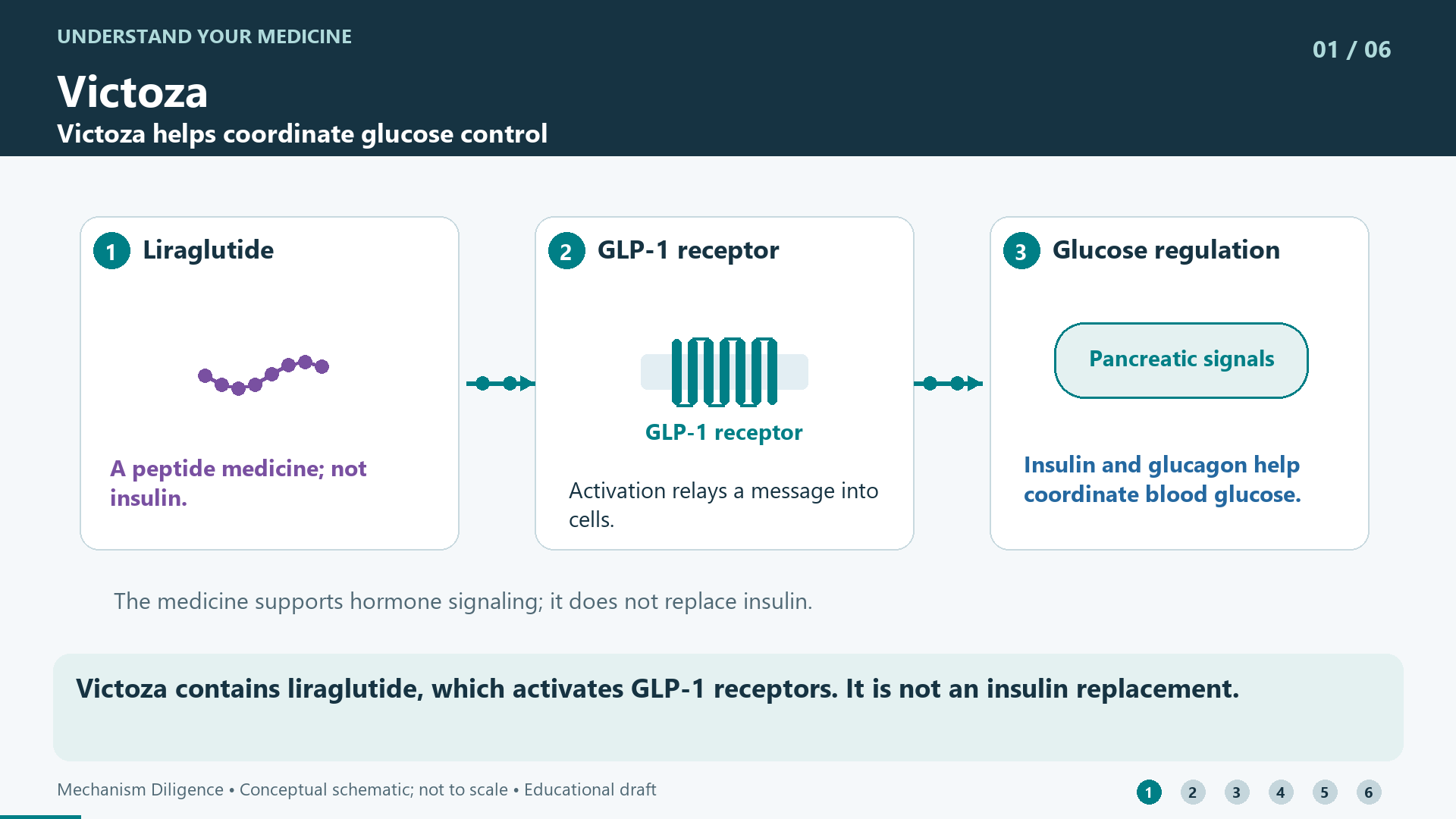
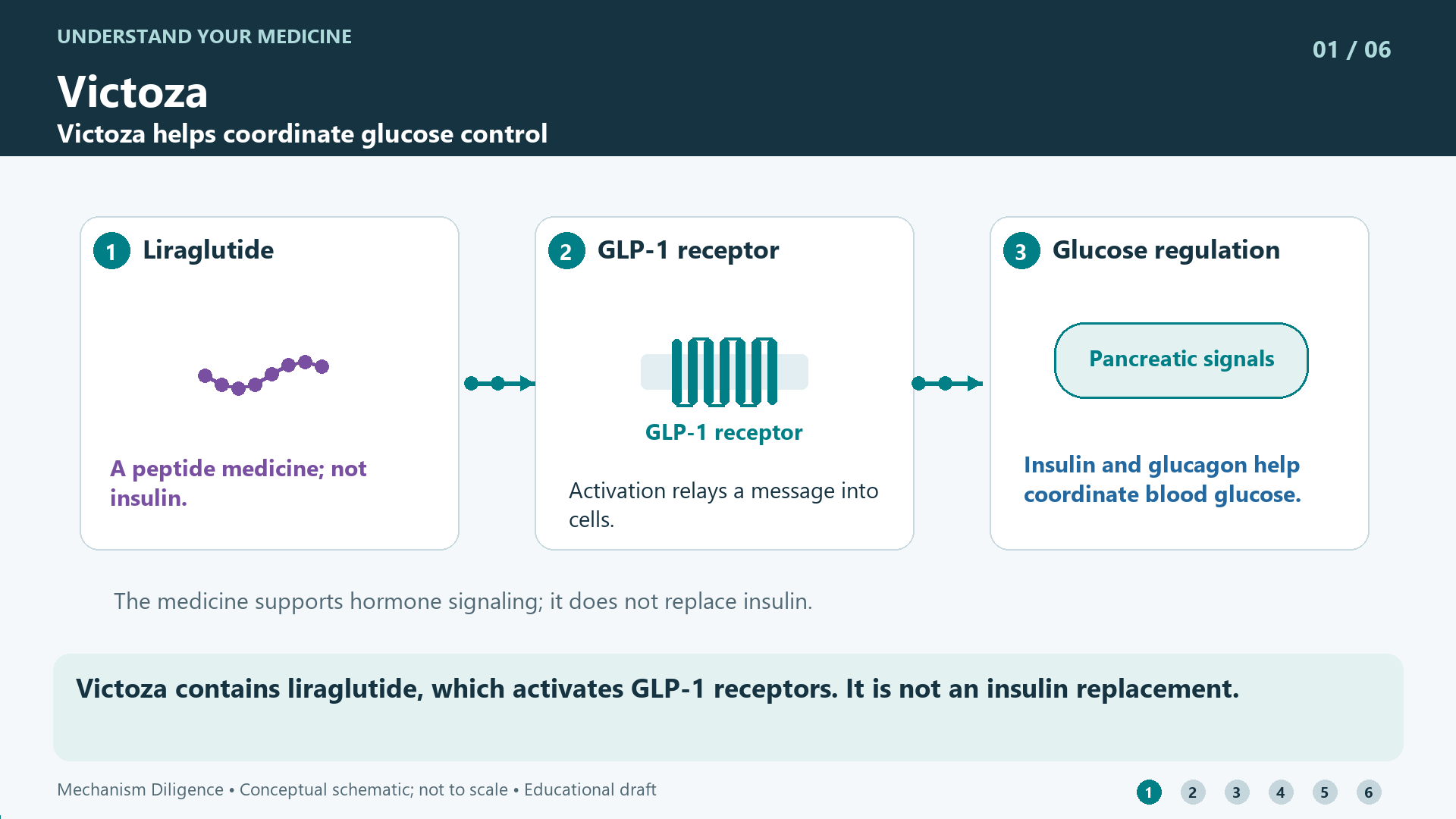
Victoza contains liraglutide, which activates GLP-1 receptors. It is not an insulin replacement.
Type 2 diabetes involves impaired insulin response and other metabolic changes. This product's glycemic indication is distinct from Saxenda's weight-management use despite sharing the same molecule.
The diagram is an overview, not a diagnosis or treatment-selection tool.
- Victoza US prescribing information — Novo Nordisk · Revised October 2025; sections 1, 5, 11–12, 14.3; boxed warning. · Primary source; relevant sections inspected · checked 2026-10-17
Chapter 2: Molecular design prolongs exposure
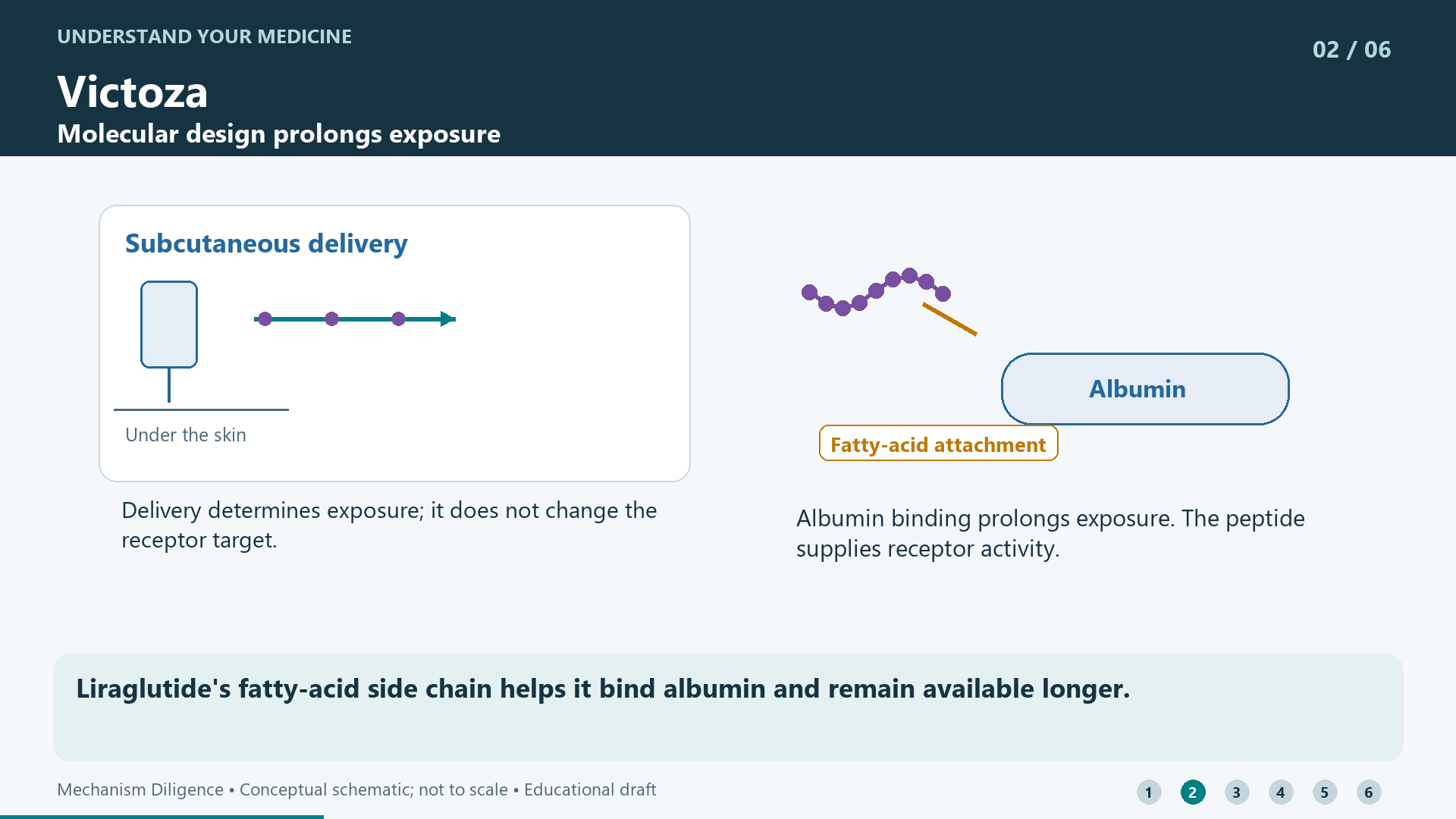
Liraglutide's fatty-acid side chain helps it bind albumin and remain available longer.
Self-association delays absorption; plasma protein binding and metabolic stability also contribute. This is different from exenatide microspheres or dulaglutide's Fc fusion.
No exact exposure curve or equivalence to other products is implied.
- Victoza US prescribing information — Novo Nordisk · Revised October 2025; sections 1, 5, 11–12, 14.3; boxed warning. · Primary source; relevant sections inspected · checked 2026-10-17
- Knudsen et al. — Potent GLP-1 derivatives with prolonged pharmacokinetics · Journal of Medicinal Chemistry 2000;43:1664–1669; DOI 10.1021/jm9909645. · Primary medicinal chemistry study; indexed abstract inspected; albumin-binding design, not comparative clinical outcomes. · checked 2026-10-17
Chapter 3: The receptor relays a signal inside beta cells
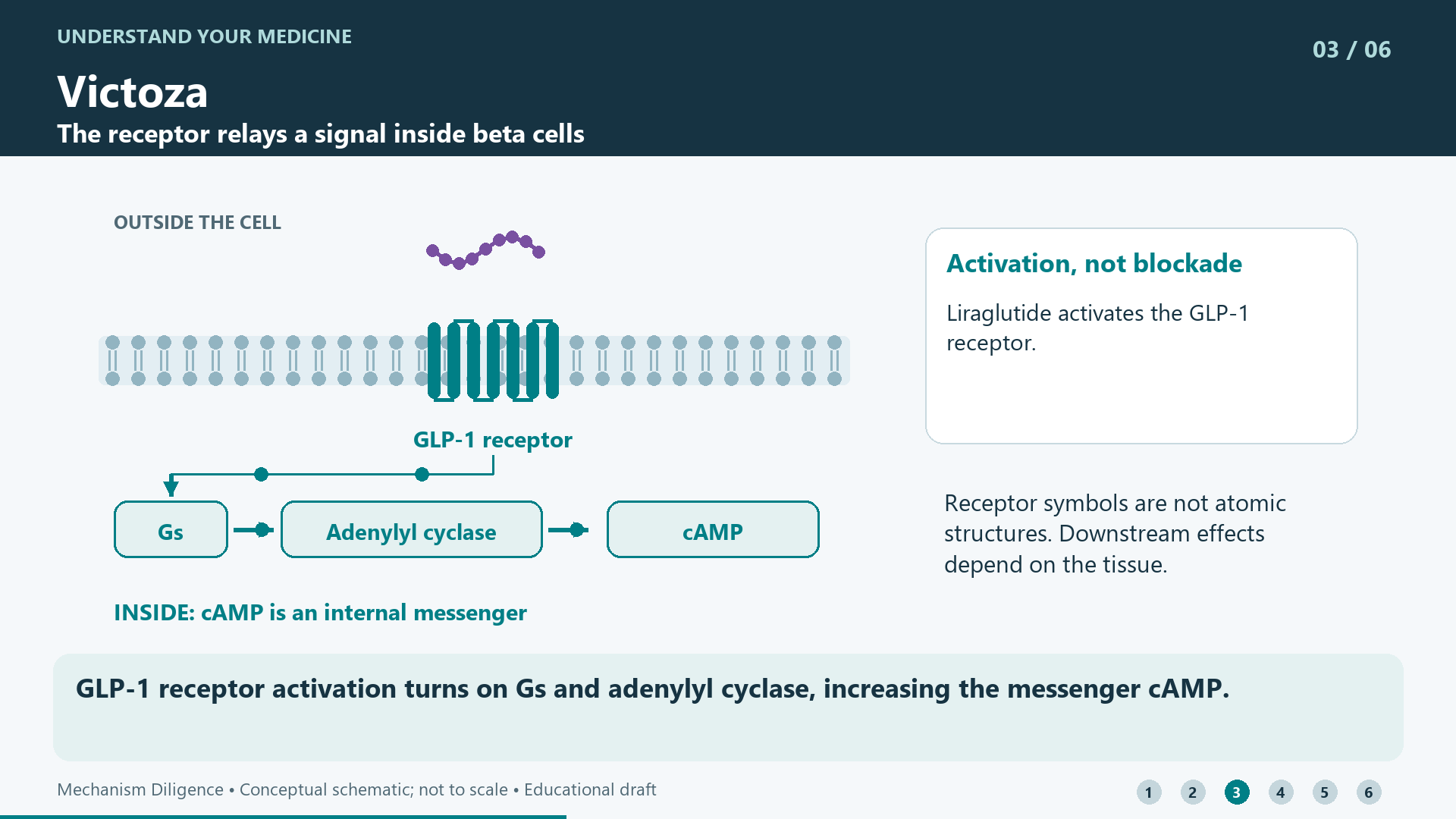
GLP-1 receptor activation turns on Gs and adenylyl cyclase, increasing the messenger cAMP.
The receptor spans the beta-cell membrane. Gs couples it to adenylyl cyclase; cAMP helps translate receptor activation into glucose-dependent insulin secretion.
This is a signaling schematic, not literal measured distances or complete pathway coverage.
- Victoza US prescribing information — Novo Nordisk · Revised October 2025; sections 1, 5, 11–12, 14.3; boxed warning. · Primary source; relevant sections inspected · checked 2026-10-17
Chapter 4: Insulin release responds to elevated glucose
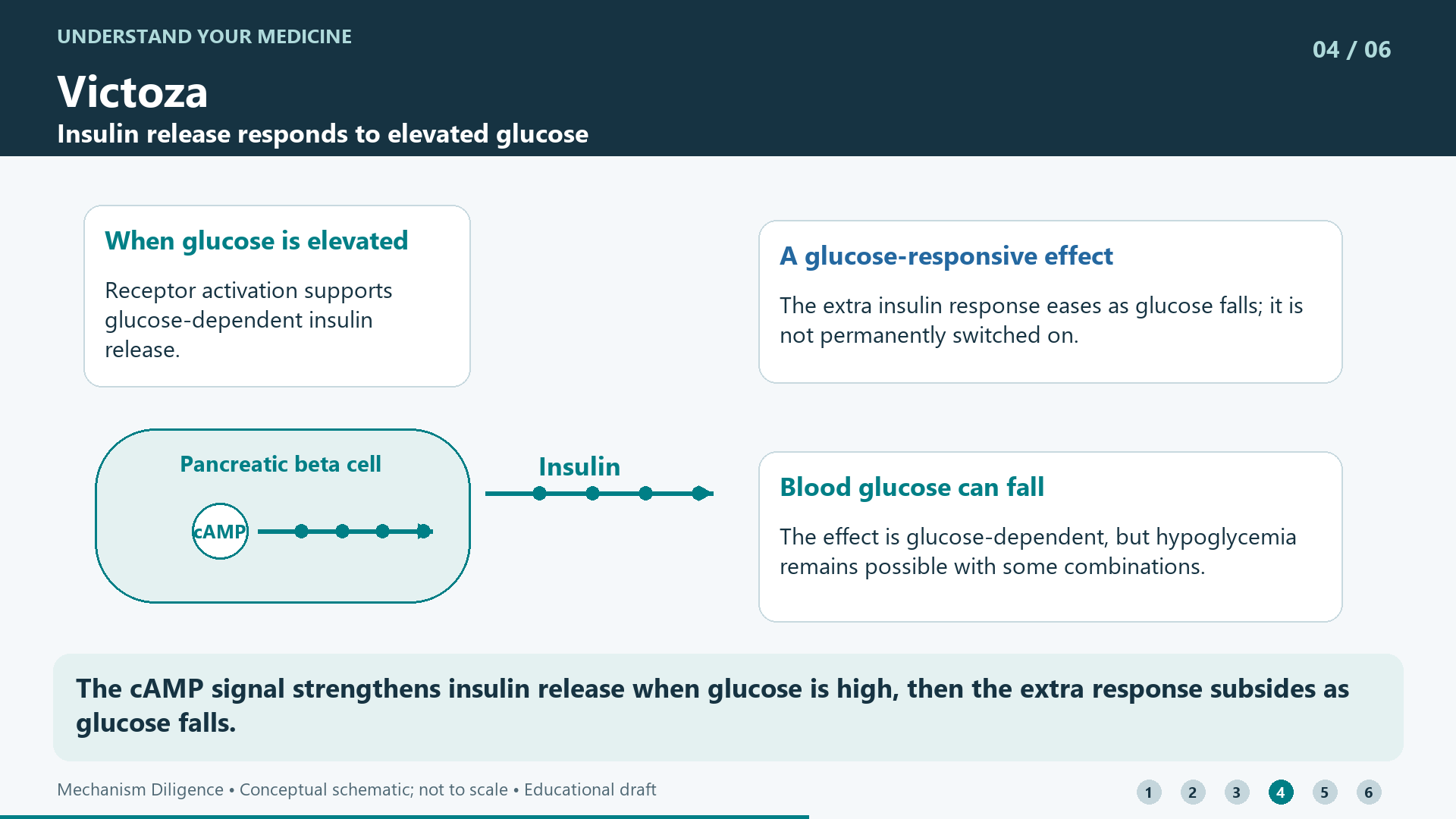
The cAMP signal strengthens insulin release when glucose is high, then the extra response subsides as glucose falls.
Glucose dependence avoids describing continuous forced insulin release. Low glucose can still occur, especially with insulin or sulfonylureas; pediatric patients can experience hypoglycemia without those drugs.
Individual glucose response depends on the full regimen and clinical context.
- Victoza US prescribing information — Novo Nordisk · Revised October 2025; sections 1, 5, 11–12, 14.3; boxed warning. · Primary source; relevant sections inspected · checked 2026-10-17
Chapter 5: Reduced glucagon lowers a liver signal
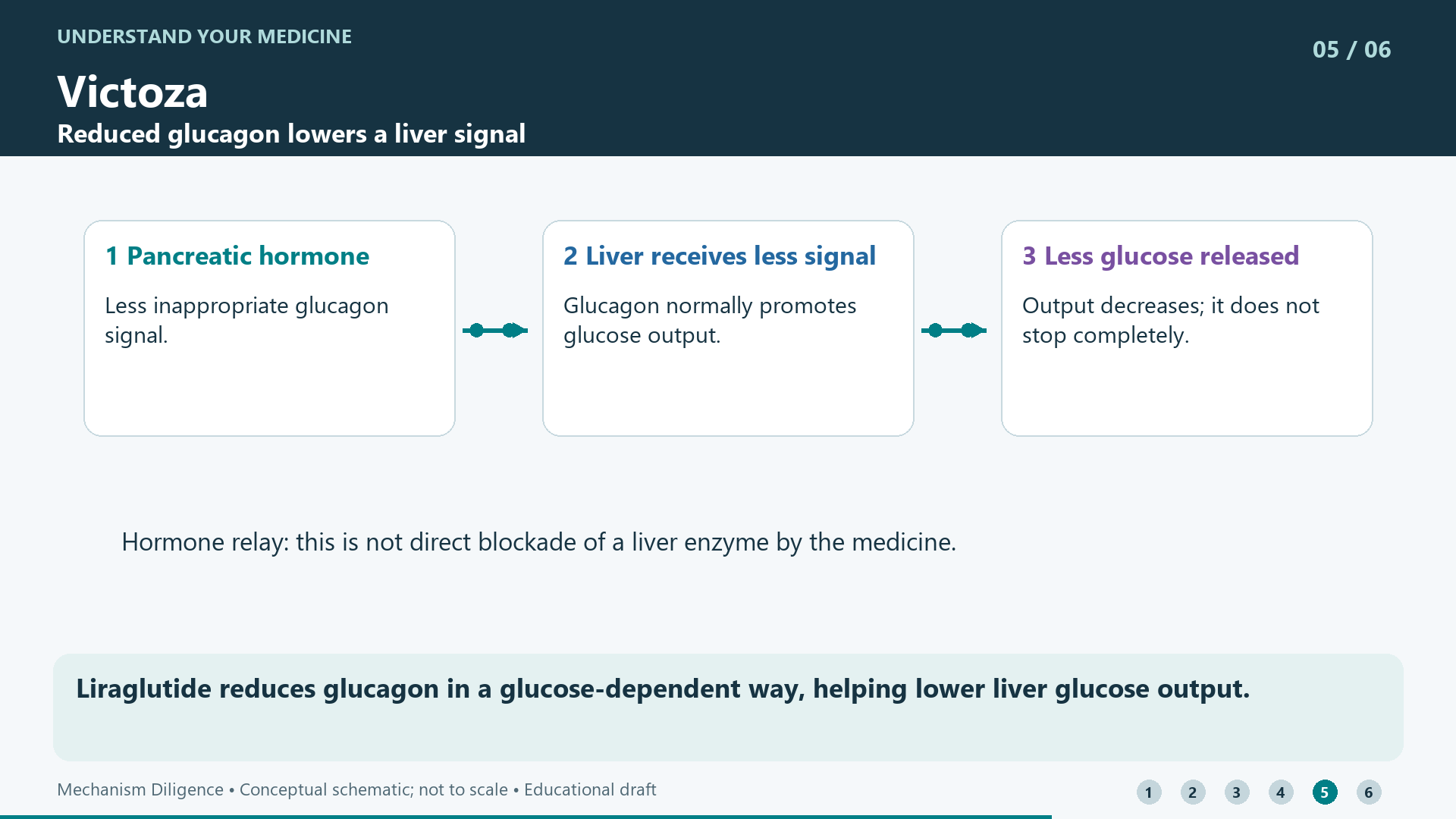
Liraglutide reduces glucagon in a glucose-dependent way, helping lower liver glucose output.
Glucagon is an endocrine signal, not glucose itself. Slower stomach emptying also contributes to glucose lowering, but is separate from this pancreas-to-liver pathway.
The diagram does not quantify each pathway's contribution.
- Victoza US prescribing information — Novo Nordisk · Revised October 2025; sections 1, 5, 11–12, 14.3; boxed warning. · Primary source; relevant sections inspected · checked 2026-10-17
Chapter 6: Heart benefits come from clinical evidence
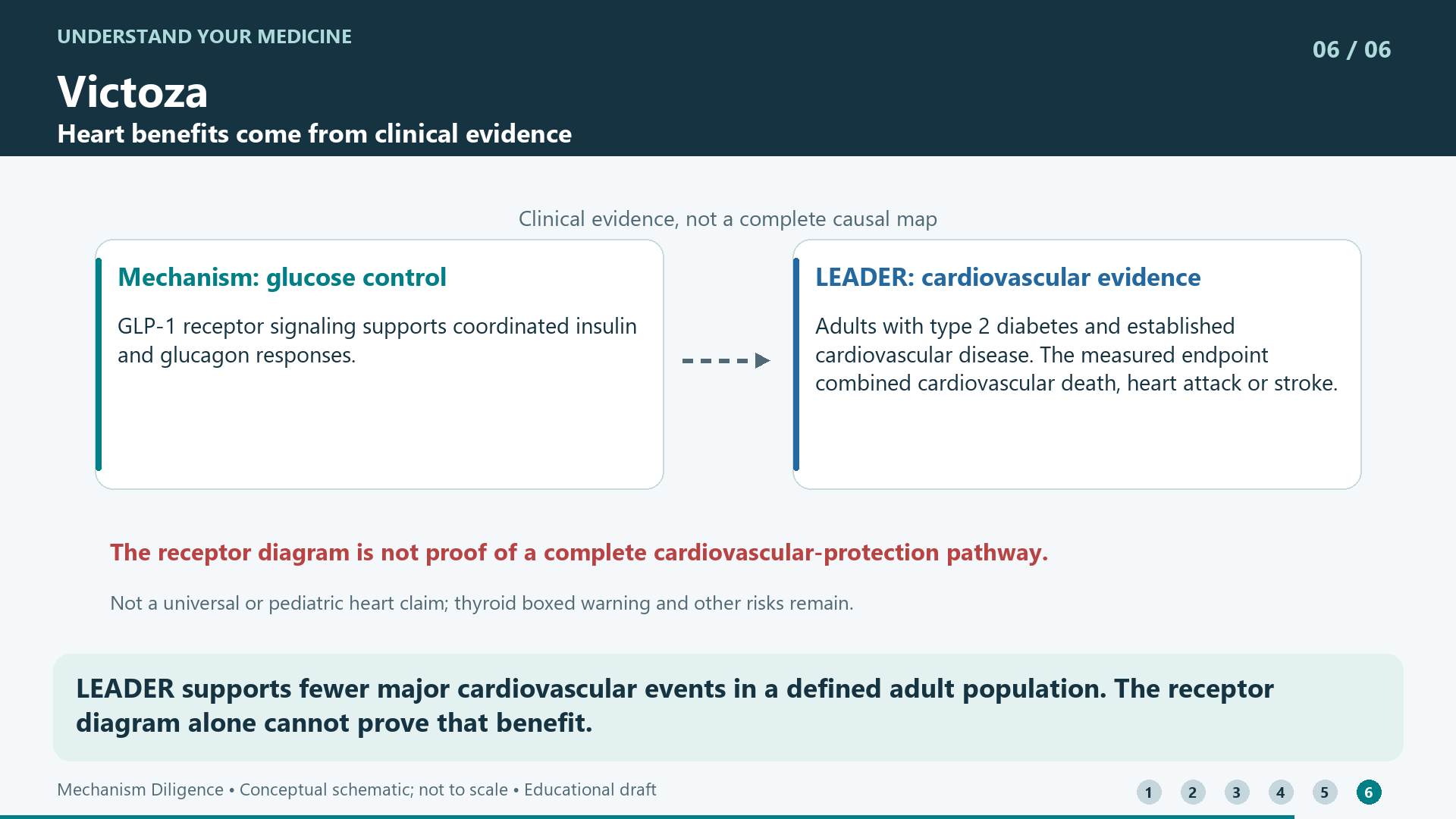
LEADER supports fewer major cardiovascular events in a defined adult population. The receptor diagram alone cannot prove that benefit.
The labeled cardiovascular population is adults with type 2 diabetes and established cardiovascular disease. The trial measured cardiovascular death, nonfatal heart attack or nonfatal stroke as a composite. This is not a universal or pediatric heart-protection claim.
The full causal explanation of cardiovascular effects is not established by this animation; thyroid boxed warning and other risks remain.
- Victoza US prescribing information — Novo Nordisk · Revised October 2025; sections 1, 5, 11–12, 14.3; boxed warning. · Primary source; relevant sections inspected · checked 2026-10-17
- Marso et al. — Liraglutide and cardiovascular outcomes in type 2 diabetes · LEADER; NEJM 2016; DOI 10.1056/NEJMoa1603827; primary composite cardiovascular outcome. · Primary randomized trial; indexed results and label section 14.3 inspected. · checked 2026-10-17
References & Sources
Source pages checked 2026-10-17. AI-assisted editorial source checking is not independent clinical review. Sources support the summary, mechanism, safety and access information; references are also kept beside each question.
- Novo Nordisk: Victoza US prescribing information ↗ · Revised 10/2025; boxed warning; 1; 3–8; 11–12; 14.2–14.3; Medication Guide. Checked 2026-10-17.
- Marso et al. (2016): LEADER cardiovascular outcomes ↗ · Primary randomized trial indexed abstract and current PI 14.3 cross-check; high-risk adults with type 2 diabetes; composite cardiovascular outcome. PMC access was inconsistent; no full-text review claimed. Checked 2026-10-17.
- FDA Drugs@FDA: Victoza NDA 022341 ↗ · Product table: Prescription marketing status; approval history. Checked 2026-10-17; not a stock guarantee.
- FDA Orange Book: Victoza product record ↗ · NDA 022341 product 001, subcutaneous solution; Prescription marketing status. Checked 2026-10-17.
- EMA: Victoza EU/EEA supply and marketing notice ↗ · EU/EEA discontinuation by end of 2026; used only to distinguish jurisdictions, not to infer US status. Checked 2026-10-17.
- Novo Nordisk: Saxenda US prescribing information — product distinction ↗ · Revised 02/2026; 1; 3; 11. Separate weight-management indication and product instructions. Checked 2026-10-17.
Selective US-label-based information, not a complete safety list or a personal treatment recommendation. Do not change treatment based on this page; use the product-specific label and your care team's advice.