Sodium oxybate (Drug class: Central nervous system depressant; oxybate)
US XYREM immediate-release sodium oxybate oral solution is the primary reference. LUMRYZ extended-release suspension, XYWAV mixed oxybate salts and manufacturer-specific generic access programs are distinguished below. Educational draft; independent clinical review pending.
Educational draft · independent clinical review pending. Silent mechanism animation available; no recorded narration.
Uses / Symptoms
- Narcolepsy-related cataplexy or excessive daytime sleepiness, ages 7 and older.
- Cataplexy means sudden muscle weakness; this is not a general insomnia treatment.
Effects
- Can reduce cataplexy episodes and excessive daytime sleepiness in narcolepsy.
- The exact treatment mechanism is unknown; GABA-B signalling is a proposed explanation.
Side effects
- Common adult effects: nausea, dizziness, vomiting, sleepiness, bedwetting or tremor; pediatric effects are detailed below.
- Boxed warnings: serious central nervous system and breathing suppression, and abuse or misuse.
- Other concerns: depression or suicidality, confusion, sleepwalking or falls, sleep-disordered breathing and high sodium exposure.
How does Sodium oxybate work? What is the Mechanism Of Action (MOA)?
Sodium oxybate slows some activity in the central nervous system and may act through brain receptors called GABA-B. How this improves cataplexy and daytime sleepiness in narcolepsy is not fully understood.
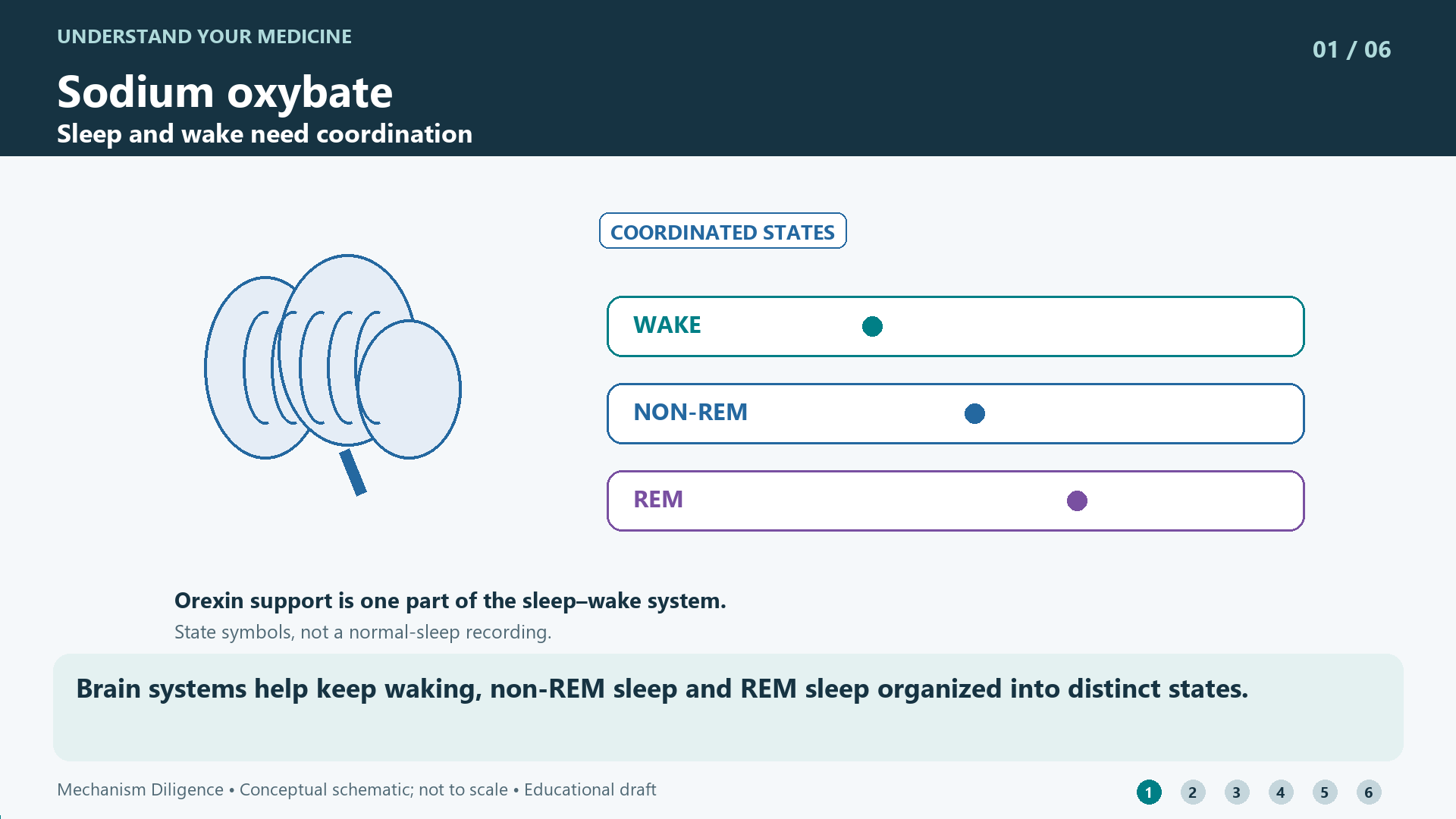
The mechanism, step by step
- Defined oral product
This page describes Xyrem immediate-release sodium oxybate solution; other oxybate products have separate formulations and labeling.
- CNS effects
Sodium oxybate is the sodium salt of GHB and depresses central nervous system activity.
- Proposed receptor pathway
GABA-B actions in several neuronal systems are hypothesized to contribute to benefit; the exact therapeutic mechanism is unknown.
- Clinical outcomes and safety
Cataplexy and daytime sleepiness outcomes are assessed separately from sedation, breathing effects and other risks.
Questions & Answers (FAQ)
How does Sodium oxybate work?
Sodium oxybate slows some activity in the central nervous system and may act through brain receptors called GABA-B. How this improves cataplexy and daytime sleepiness in narcolepsy is not fully understood.
What is Xyrem used for?
Xyrem is indicated for cataplexy or excessive daytime sleepiness in people aged 7 years and older with narcolepsy. Cataplexy involves sudden loss of muscle strength. Its label does not establish it as a general treatment for insomnia or every cause of daytime sleepiness.
Are Xyrem, Lumryz and Xywav the same product?
No. Xyrem is immediate-release sodium oxybate oral solution; Lumryz is sodium oxybate for extended-release oral suspension. Xywav contains calcium, magnesium, potassium and sodium oxybate salts and has a separate adult idiopathic-hypersomnia indication as well as narcolepsy indications. Formulation names and indications must not be silently substituted.
What side effects may occur?
Common adult Xyrem effects include nausea, dizziness, vomiting, sleepiness, bedwetting and tremor. Common pediatric effects also include headache, reduced appetite, weight loss and sleepwalking. These lists are not exhaustive and do not predict an individual's experience.
Which major warnings matter?
Xyrem can cause profound CNS depression and serious respiratory depression. Abuse or misuse is another boxed-warning concern. Other warnings address sleep-disordered breathing, depression and suicidality, psychiatric changes, parasomnias such as sleepwalking, and sodium exposure in susceptible patients.
Why are alcohol and sedating medicines important?
Xyrem is contraindicated with alcohol and sedative hypnotics. Combining it with other CNS depressants can raise the risk of respiratory depression, profound sedation, fainting and death. The label also identifies an interaction with divalproex; medication changes require clinical review rather than an automatic rule from this page.
Why does sodium content matter?
Xyrem contains substantial sodium, which matters in conditions such as heart failure, hypertension or renal impairment. Xywav uses mixed oxybate salts and is a different formulation; that distinction does not by itself establish a clinical-outcome advantage for an individual. This page does not provide conversion or switching instructions.
How is access controlled?
Xyrem is a US Schedule III controlled prescription medicine. It uses the XYWAV and XYREM REMS, with certified prescribers, a certified central pharmacy and enrolled patients. Lumryz has its own REMS, and some generic sodium oxybate solutions use the Sodium Oxybate REMS program. The exact manufacturer's label determines the applicable program; a single access link should not be assumed to cover every oxybate product.
What does the evidence leave uncertain?
Clinical studies support effects on cataplexy and excessive daytime sleepiness, but they do not resolve the complete therapeutic mechanism. Mouse studies of slow-wave activity are experimental evidence, not proof of a specific human causal pathway or a cure for narcolepsy. Independent clinical validation of this educational page remains pending.
Online stores and Pharmacies (Buy)
Xyrem is a US Schedule III controlled prescription medicine supplied through the XYWAV and XYREM REMS, with certified prescribers and pharmacy and patient enrollment. Access for generic solutions and other formulations is product-specific. No price, pharmacy inventory, substitution or eligibility claim is made.
- XYWAV and XYREM REMS ↗
- Xyrem full prescribing information ↗
- Generic example: Amneal product-specific access information ↗
No live price, stock or individual eligibility is verified here.
Animation chapters, evidence & visual limits
US XYREM immediate-release sodium oxybate oral solution for narcolepsy; other oxybate formulations have separate labeling. Educational draft; independent clinical review pending.
No dosing schedule, product interchangeability, orexin replacement, cure or guaranteed sleep-normalization claim. Sleep-wave graphics are illustrative, not patient EEG or a direct measure of restorative sleep.
Original conceptual illustrations. AI-assisted editorial source check; independent clinical review pending. No recorded narration.
Chapter 1: Sleep and wake need coordination
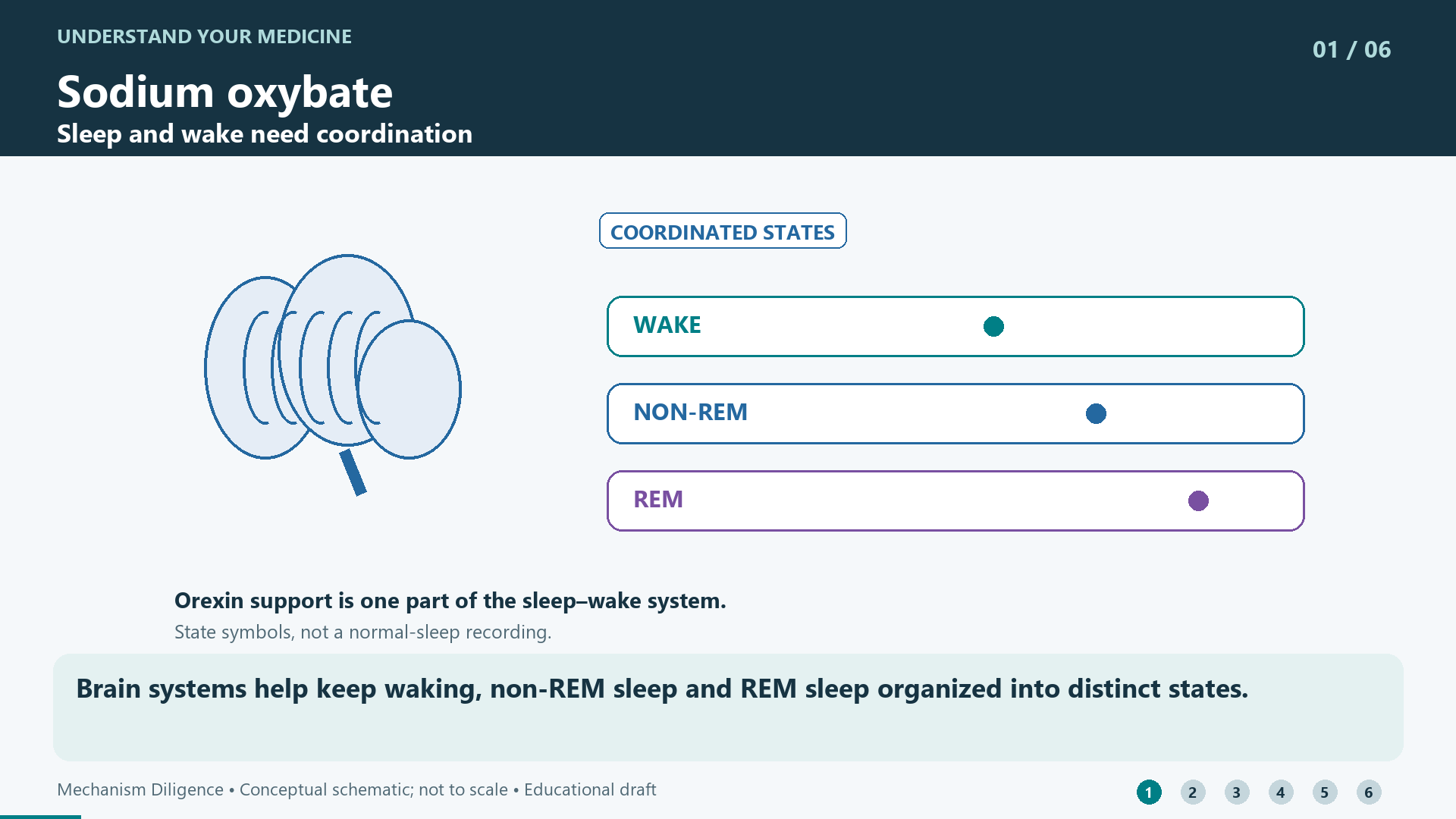
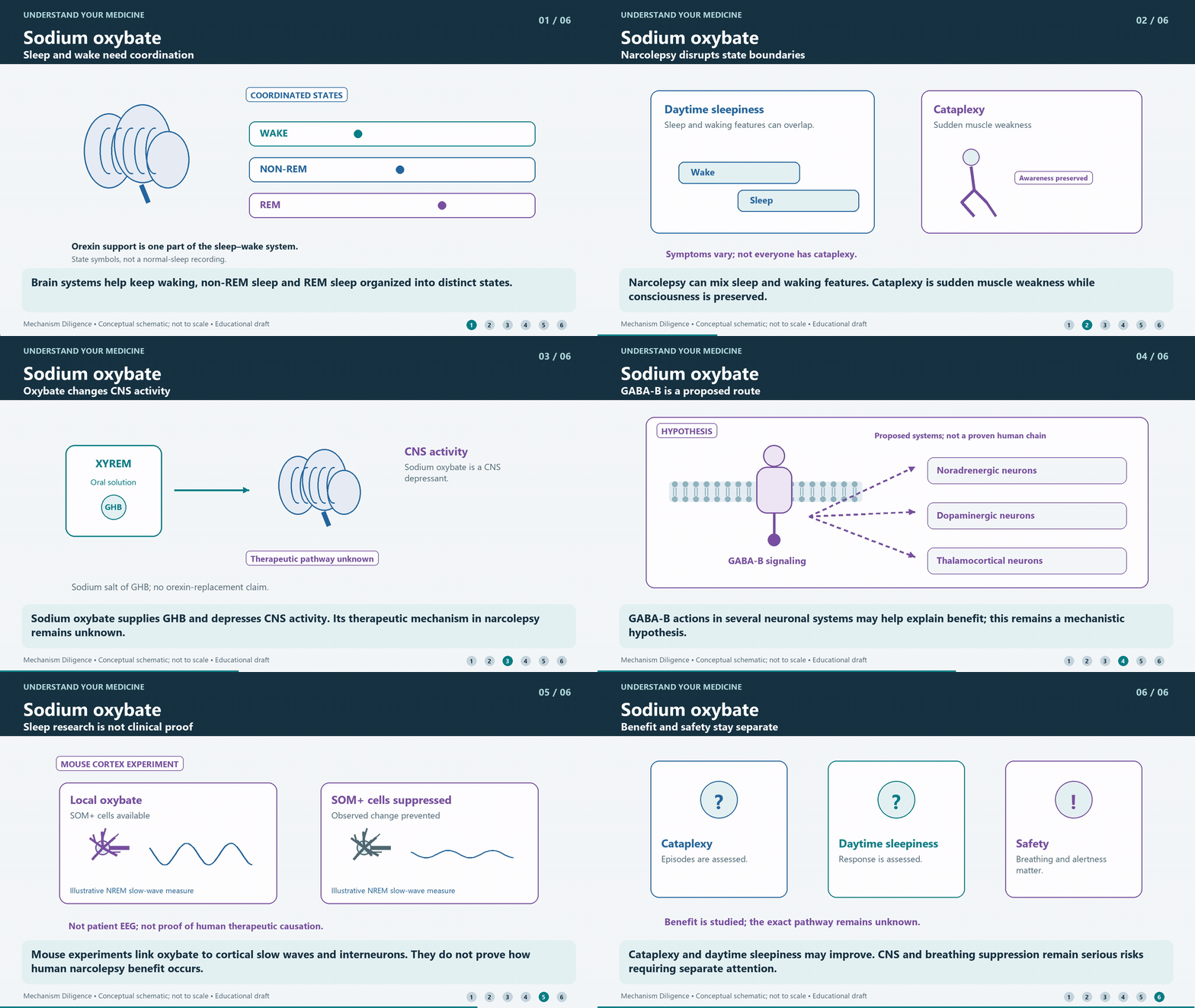
Brain systems help keep waking, non-REM sleep and REM sleep organized into distinct states.
Begin with normal state organization. Orexin, also called hypocretin, contributes to maintaining wakefulness and regulating REM sleep, but the diagram should not reduce sleep biology to one messenger.
State bands are educational symbols, not a normal-sleep diagnostic chart.
- NIH: Narcolepsy · Sleep-wake boundaries; cataplexy with preserved consciousness; type 1 and type 2 distinctions · Official neuroscience and condition information · checked 2026-10-17
Chapter 2: Narcolepsy disrupts state boundaries
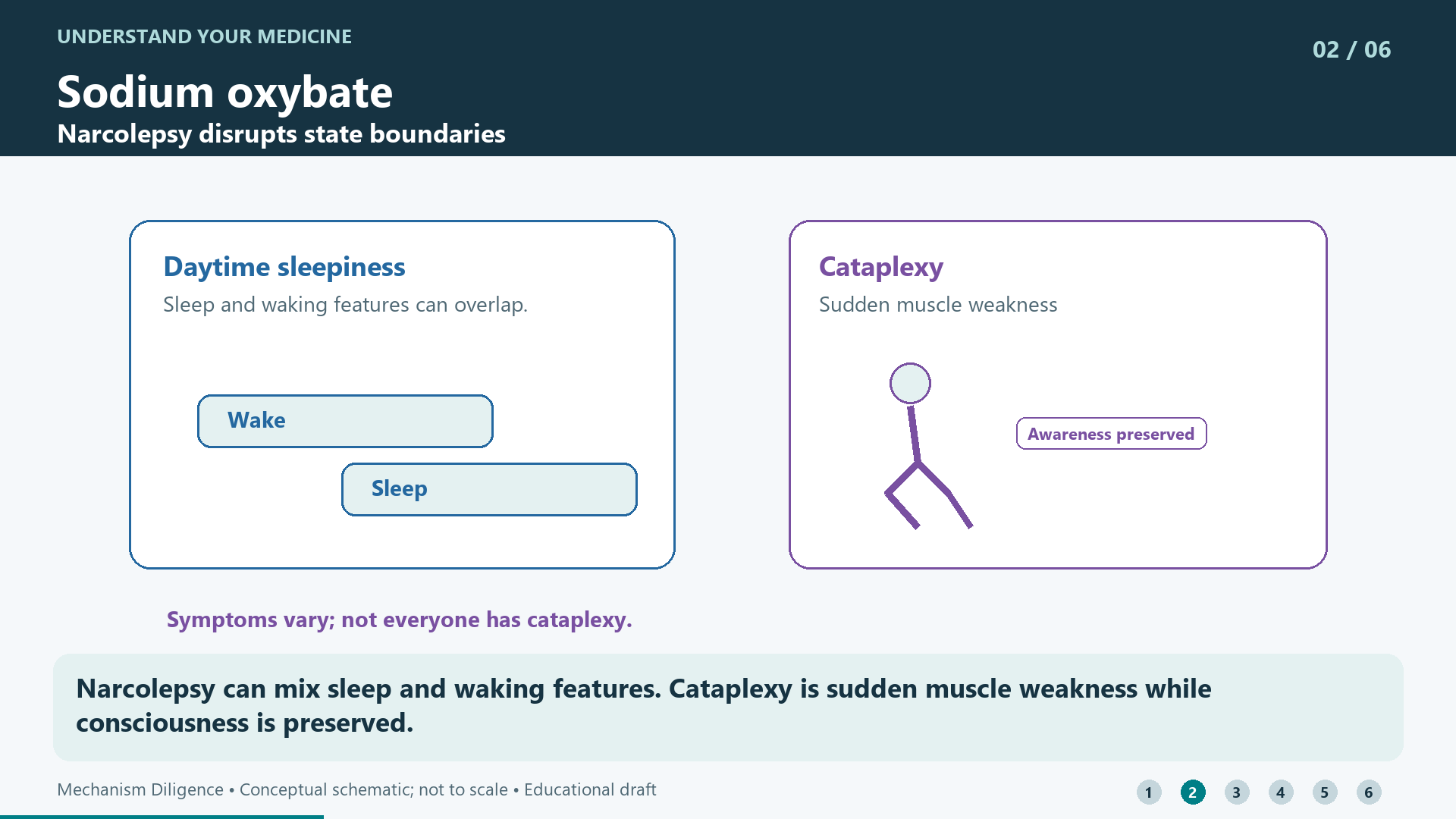
Narcolepsy can mix sleep and waking features. Cataplexy is sudden muscle weakness while consciousness is preserved.
Daytime sleepiness and cataplexy are distinct outcomes. Type 1 narcolepsy commonly involves reduced orexin signaling; type 2 usually lacks cataplexy and has normal hypocretin levels. Do not depict all narcolepsy identically.
This is not a diagnostic demonstration; not everyone with narcolepsy has cataplexy.
- NIH: Narcolepsy · Sleep-wake boundaries; cataplexy with preserved consciousness; type 1 and type 2 distinctions · Official neuroscience and condition information · checked 2026-10-17
Chapter 3: Oxybate changes CNS activity
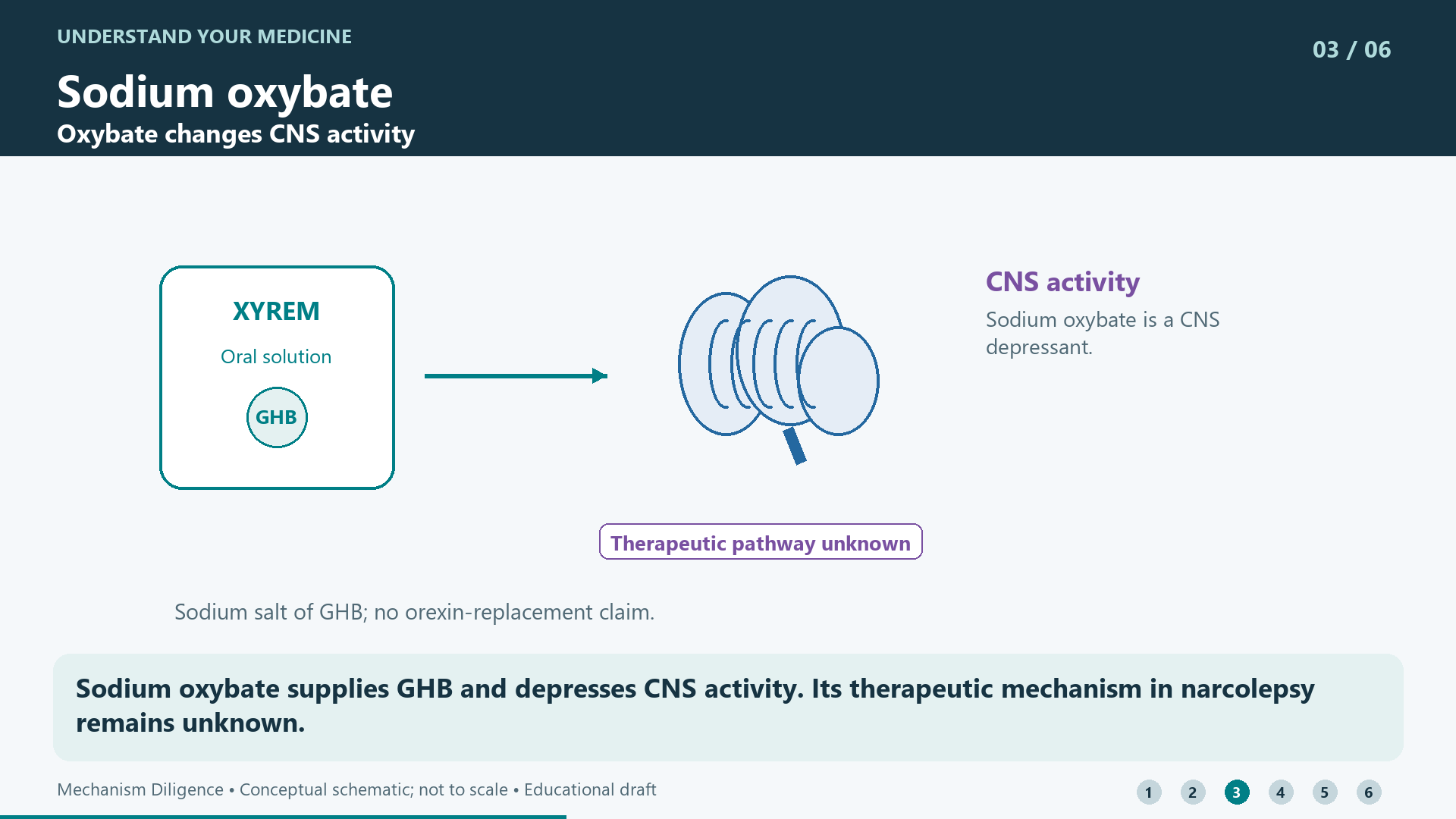
Sodium oxybate supplies GHB and depresses CNS activity. Its therapeutic mechanism in narcolepsy remains unknown.
Xyrem contains the sodium salt of gamma-hydroxybutyrate. This identity does not imply a simple GABA replacement, orexin restoration or equivalence among different oxybate products.
The scene establishes product and pharmacology context, not a proven receptor-to-benefit chain.
- XYREM US prescribing information · Revised 7/2025; sections 1, 4, 5, 11, 12.1 and 14 · US product label · checked 2026-10-17
Chapter 4: GABA-B is a proposed route
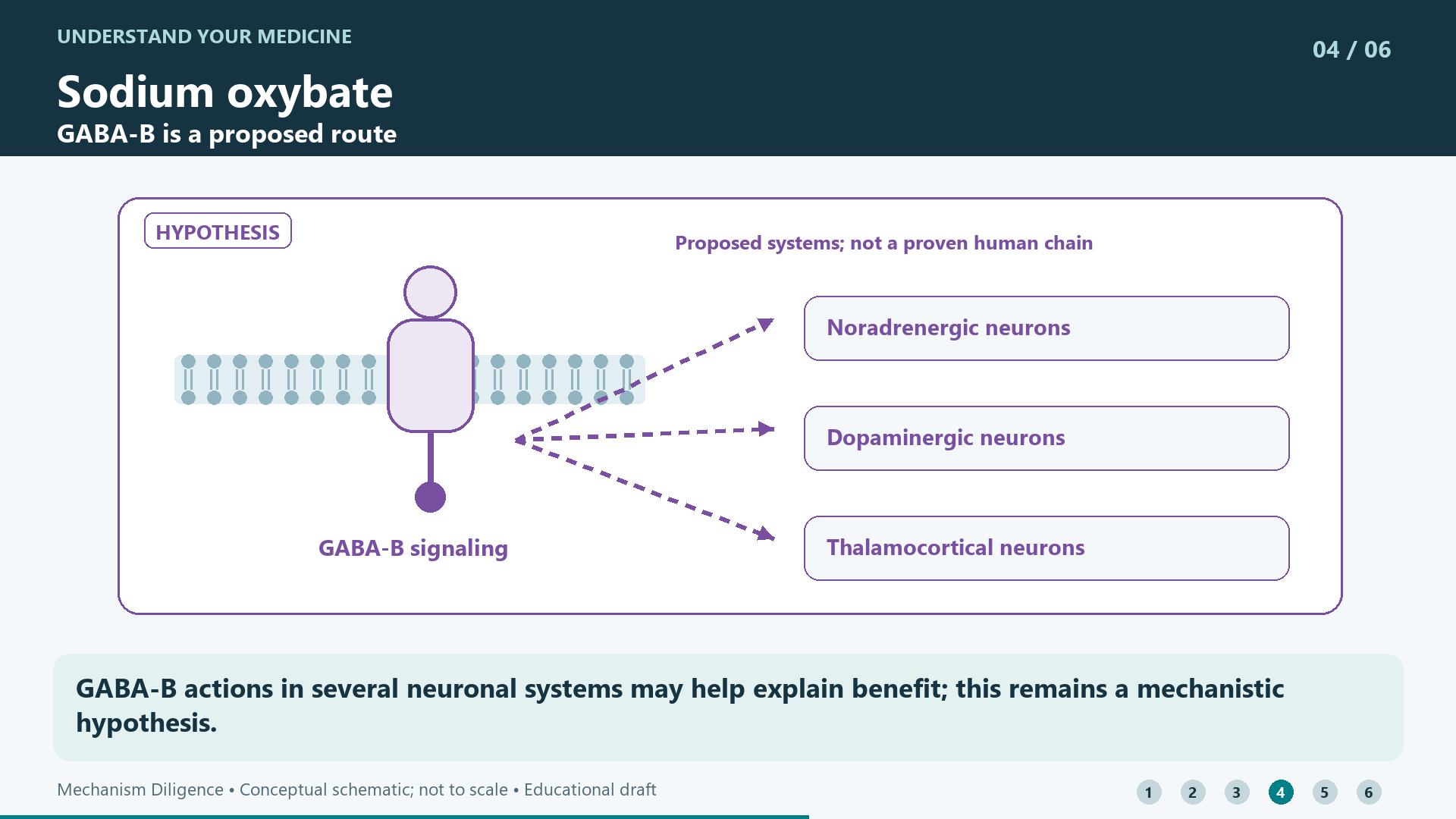
GABA-B actions in several neuronal systems may help explain benefit; this remains a mechanistic hypothesis.
The label proposes GABA-B actions involving noradrenergic, dopaminergic and thalamocortical neurons. Do not portray the hypothesis as a single validated human pathway or confuse GABA-B receptors with GABA-A ion channels.
Proposed therapeutic explanation; the human pathway and contributions of each circuit are unresolved.
- XYREM US prescribing information · Revised 7/2025; sections 1, 4, 5, 11, 12.1 and 14 · US product label · checked 2026-10-17
Chapter 5: Sleep research is not clinical proof
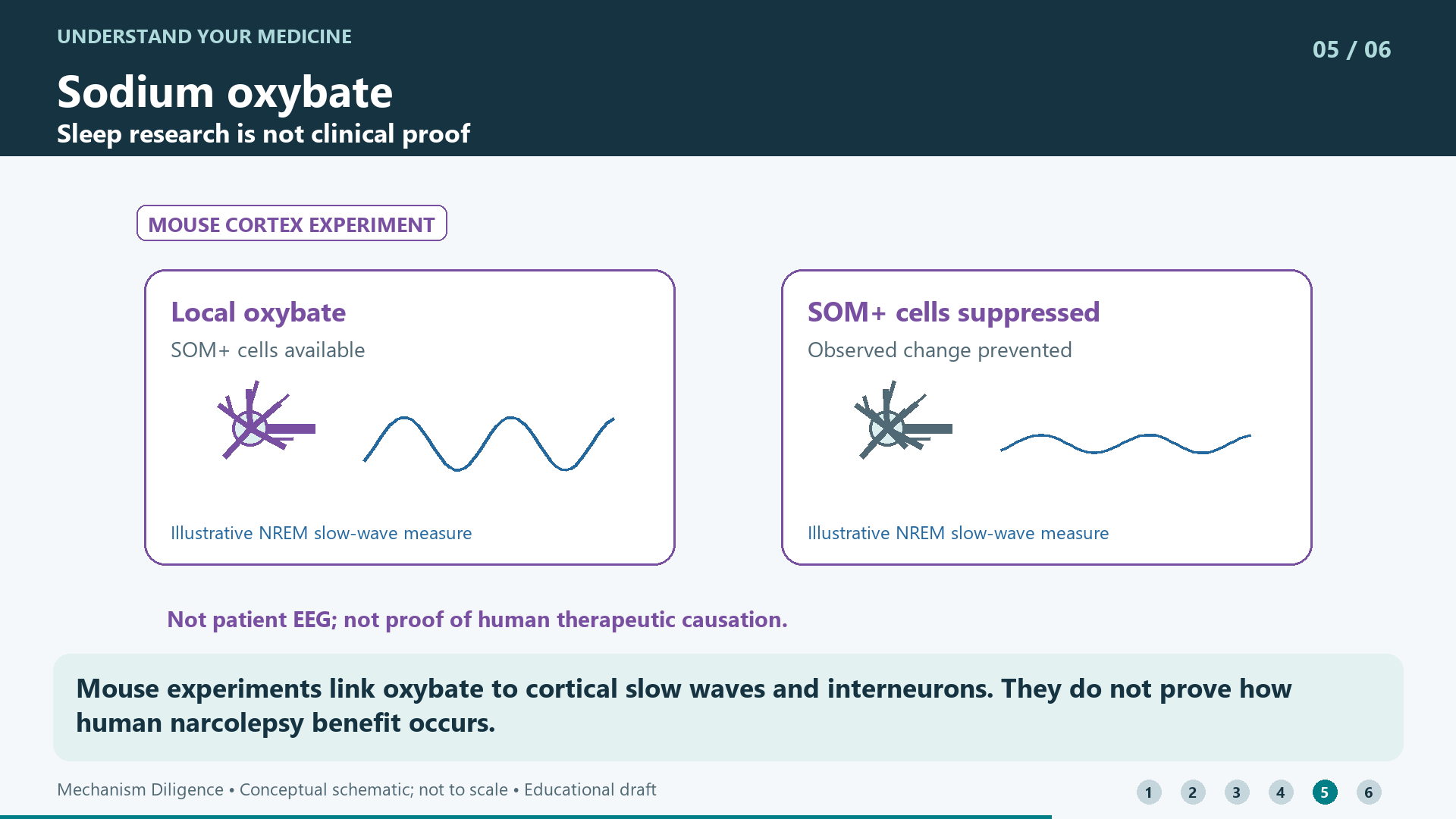
Mouse experiments link oxybate to cortical slow waves and interneurons. They do not prove how human narcolepsy benefit occurs.
Intracortical oxybate increased NREM slow-wave measures in a mouse experiment; suppressing somatostatin-positive interneurons prevented the observed changes. The authors propose a local circuit explanation. Route, species and endpoint differ from clinical oral treatment.
Primary animal experiment; larger slow waves do not by themselves prove human symptom improvement, safer sleep or restoration.
- Spano et al.: Sodium oxybate and cortical sleep slow waves · Abstract; online 2022, journal issue 2024; adult SOM-Cre mice, intracortical injection and chemogenetic manipulation; DOI 10.1111/ejn.15846 · Primary preclinical experiment · checked 2026-10-17
Chapter 6: Benefit and safety stay separate
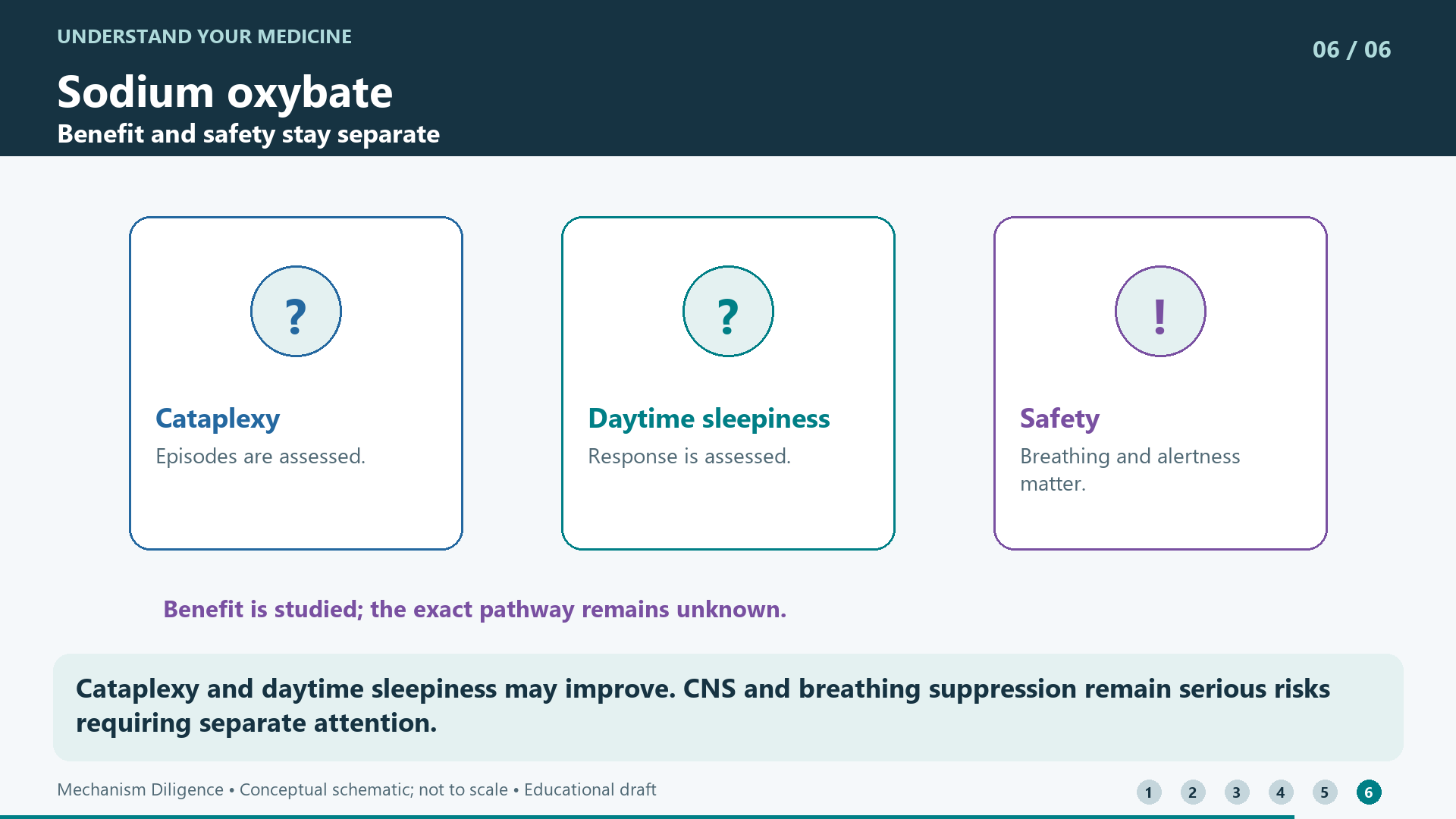
Cataplexy and daytime sleepiness may improve. CNS and breathing suppression remain serious risks requiring separate attention.
Xyrem's clinical outcomes, CNS depression and abuse/misuse risks must not be merged into a single beneficial sedation story. The full label and restricted distribution program remain relevant.
Not a general insomnia claim, a complete safety guide or a signal that heavier sedation means better treatment.
- XYREM US prescribing information · Revised 7/2025; sections 1, 4, 5, 11, 12.1 and 14 · US product label · checked 2026-10-17
References & Sources
Source pages checked October 16, 2026. AI-assisted editorial source checking is not independent clinical review. Sources support the summary, mechanism, safety and access information; references are also kept beside each question.
- DailyMed: XYREM (sodium oxybate) oral solution ↗ · Boxed Warning; 1; 4; 5.1–5.8; 6.1; 7; 9.1 Controlled Substance; 11; 12.1; 14
- XYWAV and XYREM REMS — official prescriber brochure ↗ · Restricted distribution; enrollment; CNS depression; abuse/misuse; patient counseling
- XYREM official healthcare-professional information ↗ · Indication; Important Safety Information; access through XYWAV and XYREM REMS
- DailyMed: LUMRYZ sodium oxybate extended-release oral suspension ↗ · 1 Indications; 3 Dosage form; 5.3 REMS; 12.1 Mechanism; formulation distinction
- DailyMed: XYWAV calcium, magnesium, potassium, and sodium oxybates ↗ · 1.1 Narcolepsy; 1.2 adult idiopathic hypersomnia; 11 ingredients; 12.1 mechanism
- Amneal sodium oxybate oral solution — product-specific REMS and safety information ↗ · Sodium Oxybate REMS program identification; Important Safety Information; no savings claim reused
- FDA: LUMRYZ REMS document (original approval) ↗ · Separate REMS program; current status corroborated by LUMRYZ label
- Primary mouse-cortex study: sodium oxybate, NREM slow waves and somatostatin-positive interneurons ↗ · Abstract; mouse experimental system; GABA-B working hypothesis, not proof of human therapeutic mechanism
Selective US-label-based information, not a complete safety list or a personal treatment recommendation. Do not change treatment based on this page; use the product-specific label and your care team's advice.