Ozempic (Drug class: GLP-1 receptor agonist)
US Ozempic injection and tablets for adults with type 2 diabetes. Cardiovascular eligibility differs by formulation; only injection carries the kidney-outcomes indication. Neither is approved for weight management or children. This guide explains mechanisms and evidence, not dosing or switching instructions.
Educational draft · independent clinical review pending. Silent mechanism animation available; no recorded narration.
Uses / Symptoms
- Adults with type 2 diabetes: blood-sugar control alongside diet and exercise
- Injection: cardiovascular risk reduction with established cardiovascular disease; kidney-risk reduction with chronic kidney disease
- Tablets: cardiovascular risk reduction in adults with type 2 diabetes at high cardiovascular risk
Effects
- Helps the body release insulin and reduce glucagon when blood sugar is high
- Lowers blood sugar; body weight may also decrease
- Reduces specified cardiovascular or kidney risks in the populations and formulations studied
Side effects
- Nausea, vomiting, diarrhea, abdominal pain or constipation; tablets may also reduce appetite
- Important risks include pancreatitis, gallbladder disease, severe digestive problems, dehydration-related kidney injury and allergic reactions
- Boxed thyroid C-cell tumor warning; low blood sugar risk rises with insulin or sulfonylureas
How does Ozempic work? What is the Mechanism Of Action (MOA)?
Ozempic contains semaglutide, which activates the same receptor as the body's GLP-1 hormone. When blood sugar is high, this helps release more insulin and reduce glucagon, a hormone that raises blood sugar. The injection and tablet contain the same active ingredient but have different approved uses and are not interchangeable on your own.
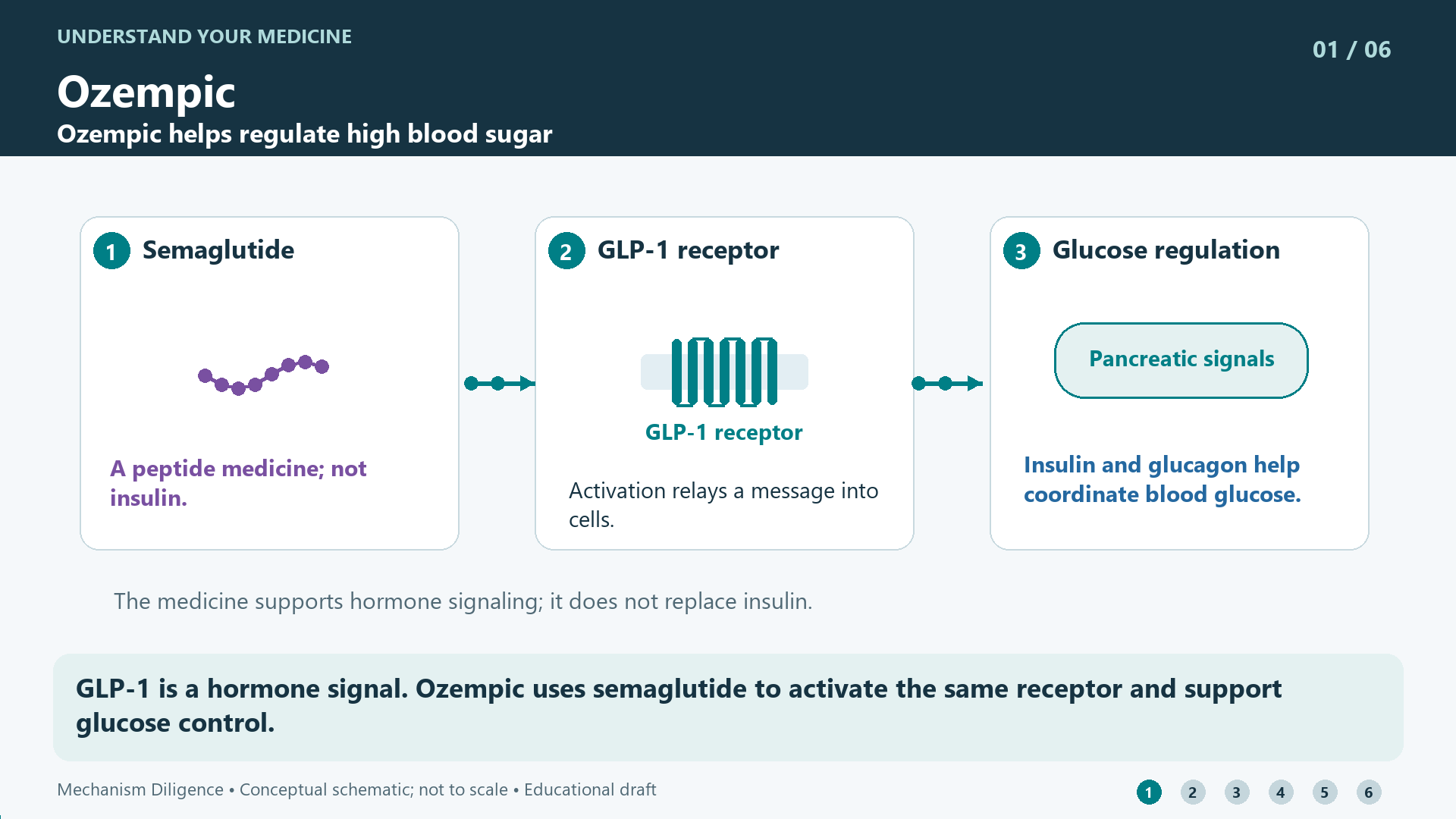
The mechanism, step by step
- A hormone signal helps regulate glucose
The body's GLP-1 signal helps coordinate insulin and glucagon after food.
- The formulation delivers semaglutide
Injection delivers the drug under the skin; tablets use SNAC to help it cross the stomach lining.
- GLP-1 receptors are activated
Semaglutide activates the receptor targeted by the natural hormone.
- High glucose triggers a stronger response
Insulin release increases and glucagon release decreases in a glucose-dependent way; early stomach emptying also slows.
- Measured outcomes depend on the product
Blood sugar can improve. Cardiovascular and kidney claims come from clinical evidence for particular formulations and populations, not from the receptor diagram alone.
- Ozempic injection US prescribing information, revised May 2026 ↗
- Rybelsus and Ozempic tablets US prescribing information, revised January 2026 ↗
- Perkovic et al. FLOW randomized kidney-outcomes trial, 2024 ↗
- McGuire et al. SOUL randomized oral cardiovascular-outcomes trial, 2025 ↗
- Buckley et al. Transcellular stomach absorption of oral semaglutide, 2018 ↗
- Novo Nordisk: Ozempic tablets US introduction, May 1, 2026 ↗
A perspective-aware, six-chapter visual narration is available when JavaScript is enabled.
Questions & Answers (FAQ)
How does Ozempic work?
Ozempic contains semaglutide, which activates the same receptor as the body's GLP-1 hormone. When blood sugar is high, this helps release more insulin and reduce glucagon, a hormone that raises blood sugar. The injection and tablet contain the same active ingredient but have different approved uses and are not interchangeable on your own.
- Ozempic injection US prescribing information, revised May 2026 ↗
- Rybelsus and Ozempic tablets US prescribing information, revised January 2026 ↗
- Perkovic et al. FLOW randomized kidney-outcomes trial, 2024 ↗
- McGuire et al. SOUL randomized oral cardiovascular-outcomes trial, 2025 ↗
- Buckley et al. Transcellular stomach absorption of oral semaglutide, 2018 ↗
- Novo Nordisk: Ozempic tablets US introduction, May 1, 2026 ↗
What is Ozempic approved for in the US?
Injection and tablets improve blood-sugar control in adults with type 2 diabetes alongside diet and exercise. Injection reduces major cardiovascular events in those with established cardiovascular disease and specified kidney risks in those with chronic kidney disease. Tablets reduce major cardiovascular events in adults with type 2 diabetes at high risk for those events; they do not carry the injection's kidney-outcomes indication.
Is Ozempic now a pill as well as an injection?
Yes. Ozempic tablets were introduced in the US in May 2026 using an updated oral semaglutide formulation formerly branded Rybelsus. Injection has its own label and devices; switching formulations requires the prescriber's instructions, not a milligram-for-milligram conversion.
Is Ozempic insulin, and how does it lower glucose?
It is not insulin. Semaglutide activates GLP-1 receptors, helping the body release insulin and reduce glucagon when blood sugar is high. A modest slowing of early stomach emptying also contributes to glucose control.
Is Ozempic approved for weight loss or children?
Neither Ozempic formulation is approved as a weight-management treatment, even though weight may decrease during treatment. Safety and effectiveness have not been established in children. Wegovy has different indications, including a specific adolescent obesity indication for its injection.
How can the injection help kidneys yet also have a kidney warning?
In adults with type 2 diabetes and chronic kidney disease, the injection reduces the risk of sustained kidney-function decline, end-stage kidney disease and cardiovascular death. Separately, vomiting or diarrhea can cause dehydration and acute kidney injury. These are different outcomes; persistent digestive symptoms need prompt clinical attention, and the long-term kidney benefit does not remove the dehydration risk.
What side effects are common?
Nausea, vomiting, diarrhea, abdominal pain and constipation are common with both formulations; reduced appetite is also common with tablets. Severe or persistent symptoms should be reported. The labels do not recommend use in people with severe gastroparesis.
Which symptoms need urgent attention?
Severe, persistent abdominal pain, sometimes reaching the back, can signal pancreatitis and needs immediate medical advice. Breathing difficulty or swelling of the face, tongue or throat may be a serious allergic reaction and needs emergency help. Promptly report vision changes, persistent vomiting or diarrhea, or upper abdominal pain with fever or jaundice.
What does the boxed thyroid warning mean?
Semaglutide caused thyroid C-cell tumors in rodents; whether it causes these tumors in humans is unknown. Ozempic is contraindicated with a personal or family history of medullary thyroid carcinoma or multiple endocrine neoplasia syndrome type 2, and with prior serious hypersensitivity to its ingredients. A neck lump, persistent hoarseness or trouble swallowing should be assessed.
Can blood sugar fall too low?
Yes, especially when Ozempic is combined with insulin or an insulin-releasing medicine such as a sulfonylurea. Glucose-dependent action does not make hypoglycemia impossible. The care team may need to adjust the other medicine and should provide a low-glucose action plan.
What should I mention about other medicines or procedures?
Give the care team a complete medicine list because delayed stomach emptying can affect oral-drug absorption; oral semaglutide can increase levothyroxine exposure. Tell the anesthesia team before surgery or deep sedation because aspiration has been reported. Never share an Ozempic pen, even with a new needle, and do not create your own switching or procedure-hold schedule.
What about pregnancy or breastfeeding?
Discuss pregnancy plans early because semaglutide remains in the body for weeks and the labels require stopping before a planned pregnancy. Use during pregnancy requires an individualized benefit-risk assessment. Breastfeeding is not recommended with tablets because of their SNAC absorption enhancer; the injection's lactation guidance is different and requires discussion with the clinician.
Where can I check legitimate product and access information?
Use the official Ozempic site and the label for the exact formulation, then confirm the prescription, coverage and pharmacy supply with the care team and pharmacist. Manufacturer information can change and does not confirm your eligibility, price or local stock. Rybelsus-to-Ozempic tablet branding should not prompt an unsupervised substitution.
Online stores and Pharmacies (Buy)
Prescription medicine. Official resources explain the injection and tablet products and current access options; they do not establish personal eligibility, a price or pharmacy stock.
- Official Ozempic product and access information ↗
- Injection prescribing information ↗
- Tablet prescribing information ↗
No live price, stock or individual eligibility is verified here.
Animation chapters, evidence & visual limits
US Ozempic semaglutide injection and tablets in adults with type 2 diabetes. Separate formulation-specific indications apply; this is not a dosing or switching guide.
Educational draft; independent clinical review pending. Original schematic animation, not a molecular simulation, measured organ response or prediction for a patient. Injection and tablets share an active ingredient but are not interchangeable milligram for milligram. Ozempic is not approved for weight management. The injectable kidney-outcomes indication does not apply to tablets. Exact cardiovascular eligibility differs by formulation. Glucose-dependent action does not eliminate hypoglycemia, especially with insulin or sulfonylureas. Other important risks remain in the full product information.
Original conceptual illustrations. AI-assisted editorial source check; independent clinical review pending. No recorded narration.
Chapter 1: Ozempic helps regulate high blood sugar
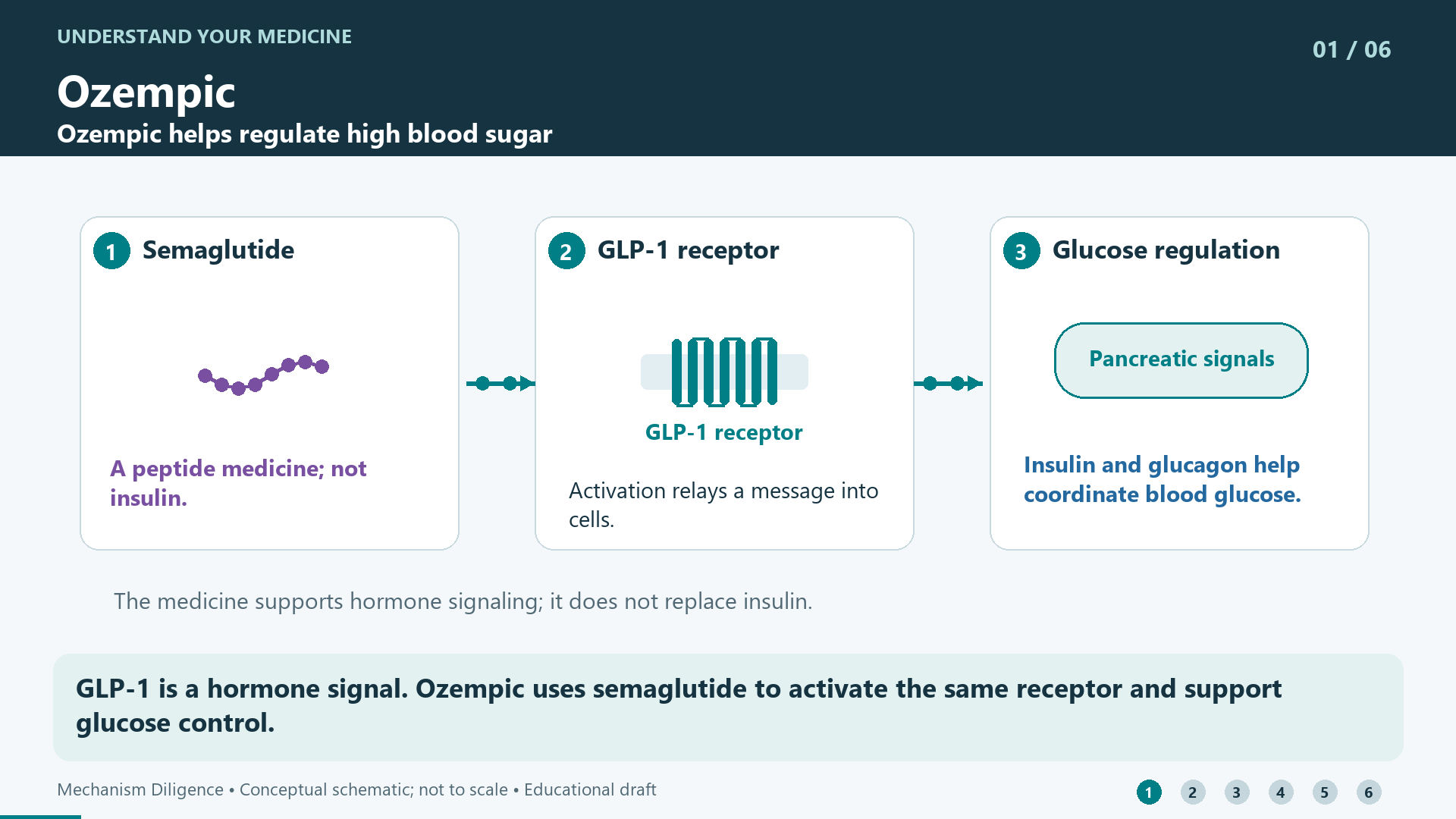
GLP-1 is a hormone signal. Ozempic uses semaglutide to activate the same receptor and support glucose control.
Begin with the normal gut-to-pancreas signaling context. Semaglutide is a hormone-like peptide medicine, not insulin and not a replacement for every action of GLP-1.
A simplified context for type 2 diabetes, not a complete disease model.
- Ozempic injection US prescribing information, May 2026 · Sections 1, 5, 11, 12.1–12.3 and 14.2–14.3 · Current manufacturer-hosted US label; selected sections inspected · checked 2026-10-17
- Rybelsus and Ozempic tablets US prescribing information, January 2026 · Sections 1, 2, 5, 11, 12.1–12.3 and 14.4 · Current manufacturer-hosted US label; selected sections inspected · checked 2026-10-17
Chapter 2: Two delivery routes, one active ingredient
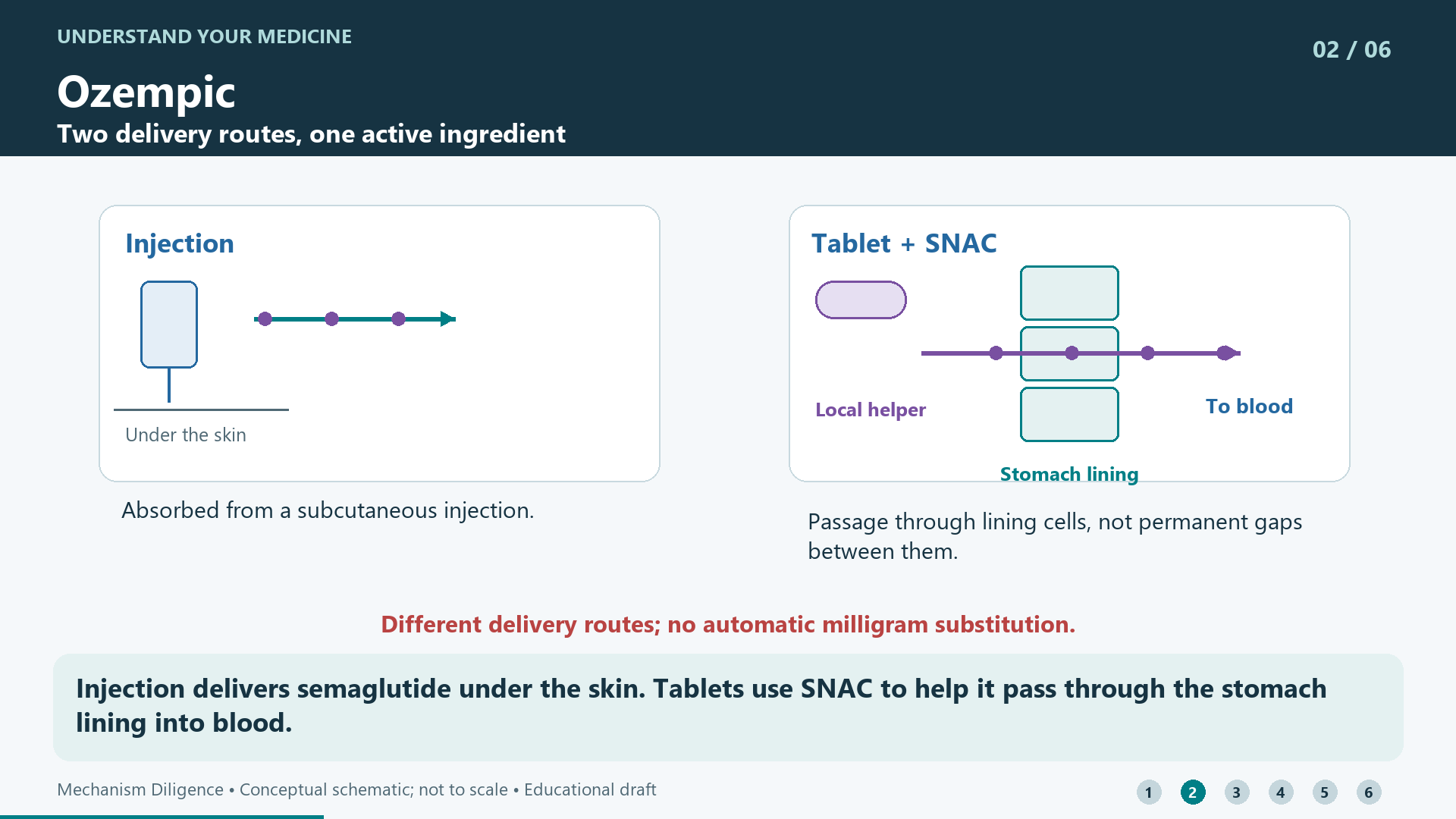
Injection delivers semaglutide under the skin. Tablets use SNAC to help it pass through the stomach lining into blood.
The oral absorption enhancer acts locally near the dissolving tablet. The routes converge on circulating semaglutide, but their instructions, strengths and approved uses are not identical.
Absorption is schematic; no bioavailability, speed or dose equivalence is represented.
- Ozempic injection US prescribing information, May 2026 · Sections 1, 5, 11, 12.1–12.3 and 14.2–14.3 · Current manufacturer-hosted US label; selected sections inspected · checked 2026-10-17
- Rybelsus and Ozempic tablets US prescribing information, January 2026 · Sections 1, 2, 5, 11, 12.1–12.3 and 14.4 · Current manufacturer-hosted US label; selected sections inspected · checked 2026-10-17
- Buckley et al. — Transcellular stomach absorption of a derivatized GLP-1 receptor agonist, 2018 · Abstract; DOI 10.1126/scitranslmed.aar7047 · Primary clinical and preclinical gastric-absorption study; abstract inspected · checked 2026-10-17
Chapter 3: Semaglutide activates GLP-1 receptors
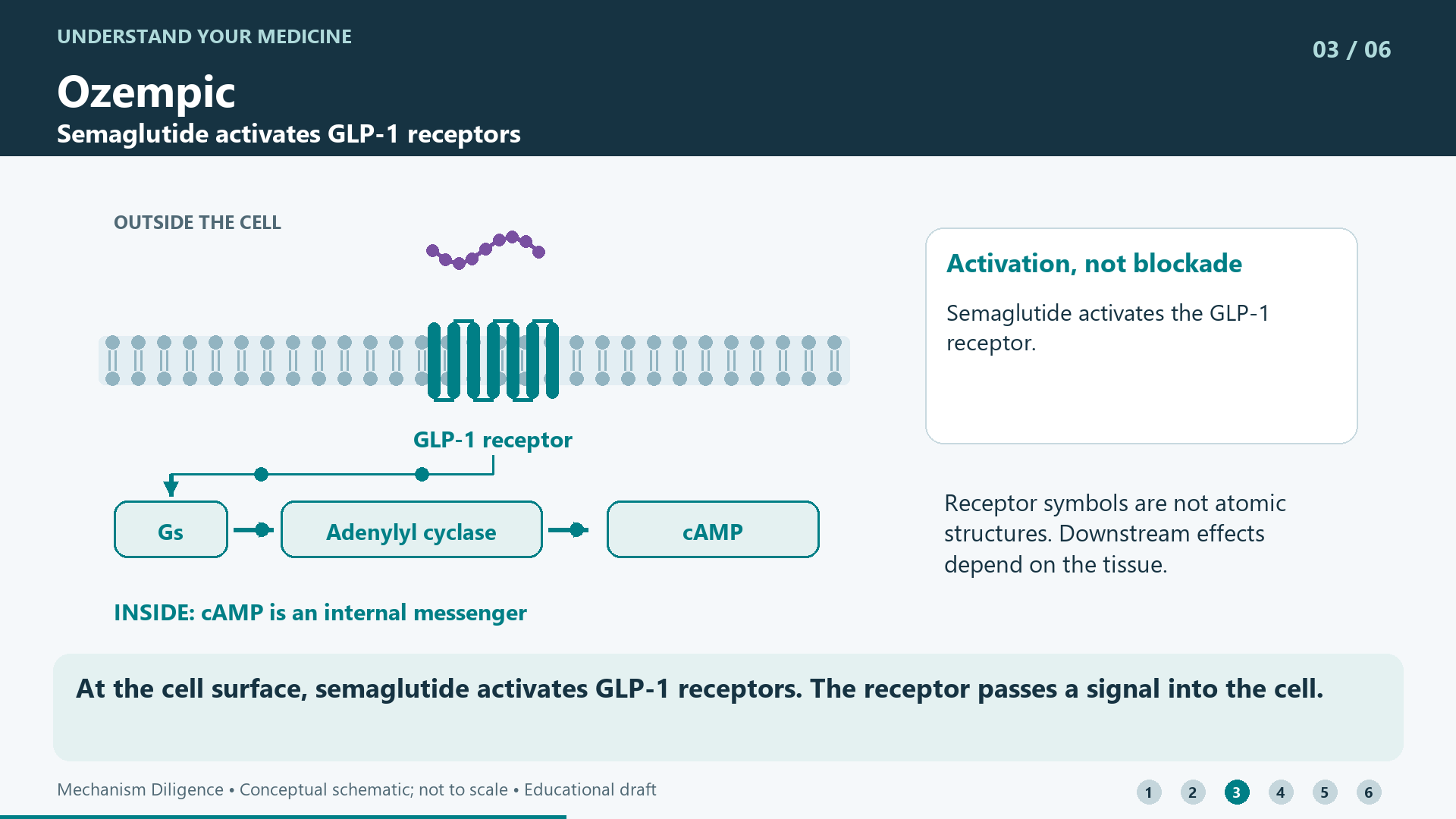
At the cell surface, semaglutide activates GLP-1 receptors. The receptor passes a signal into the cell.
Structural and cell experiments support a GLP-1 receptor–Gs signaling complex and cAMP responses. This is signal amplification, not a pore that lets the peptide travel through the receptor.
The schematic omits many signaling branches; laboratory structures are not a filmed event in a patient.
- Structure and dynamics of semaglutide- and taspoglutide-bound GLP-1R–Gs complexes, 2021 · Summary; Figures 2–4; cAMP accumulation assay; DOI 10.1016/j.celrep.2021.109374 · Primary cryo-EM and recombinant-cell study; selected text and methods inspected · checked 2026-10-17
Chapter 4: Insulin rises and glucagon falls with high glucose
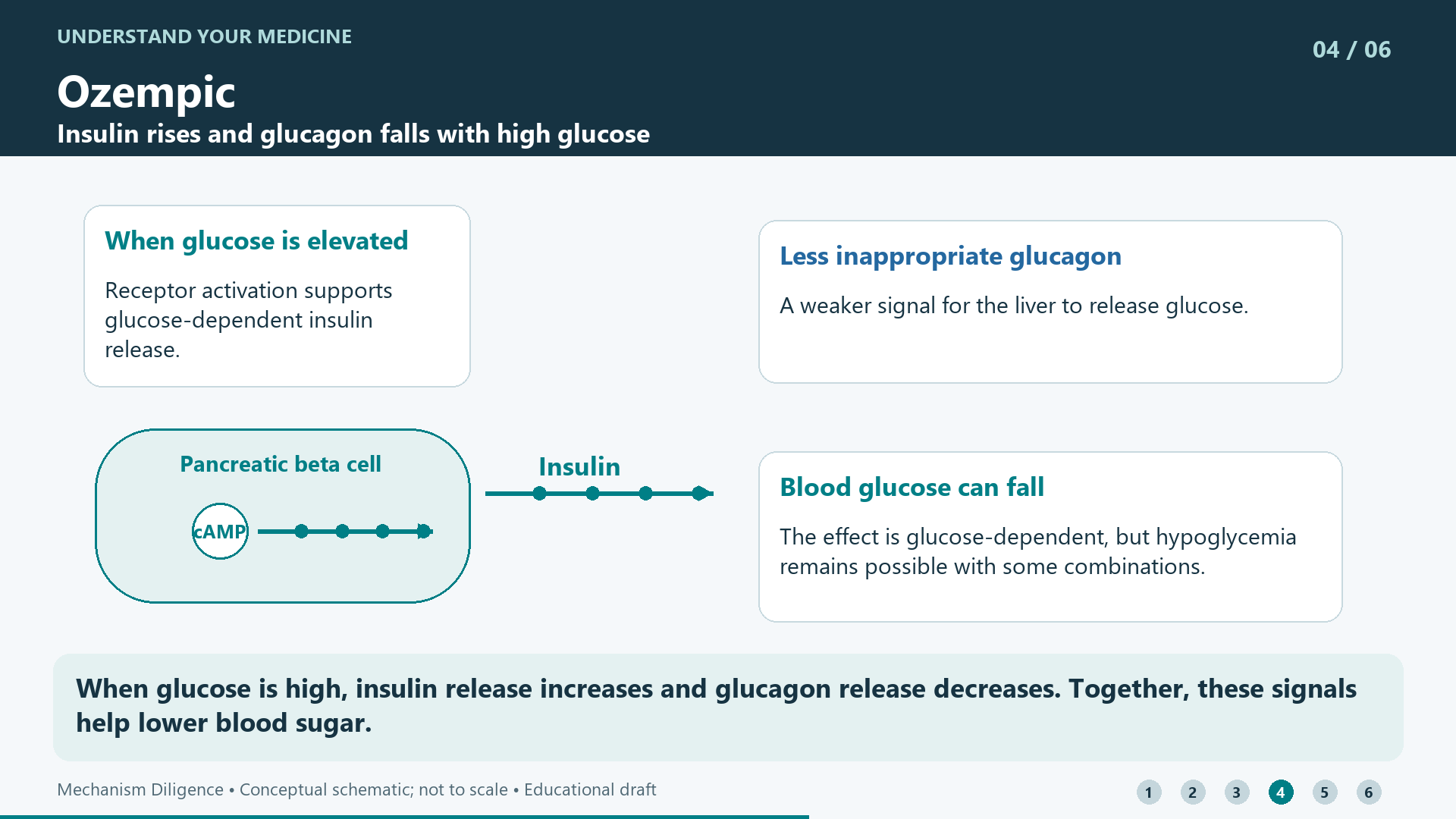
When glucose is high, insulin release increases and glucagon release decreases. Together, these signals help lower blood sugar.
Insulin supports glucose handling, while less glucagon reduces the liver's glucose-raising signal. Do not depict semaglutide as directly blocking a liver enzyme or permanently switching off glucagon.
The glucagon arm summarizes whole-islet physiology rather than asserting one direct alpha-cell receptor pathway.
- Ozempic injection US prescribing information, May 2026 · Sections 1, 5, 11, 12.1–12.3 and 14.2–14.3 · Current manufacturer-hosted US label; selected sections inspected · checked 2026-10-17
- Rybelsus and Ozempic tablets US prescribing information, January 2026 · Sections 1, 2, 5, 11, 12.1–12.3 and 14.4 · Current manufacturer-hosted US label; selected sections inspected · checked 2026-10-17
Chapter 5: Other signals affect meals and appetite
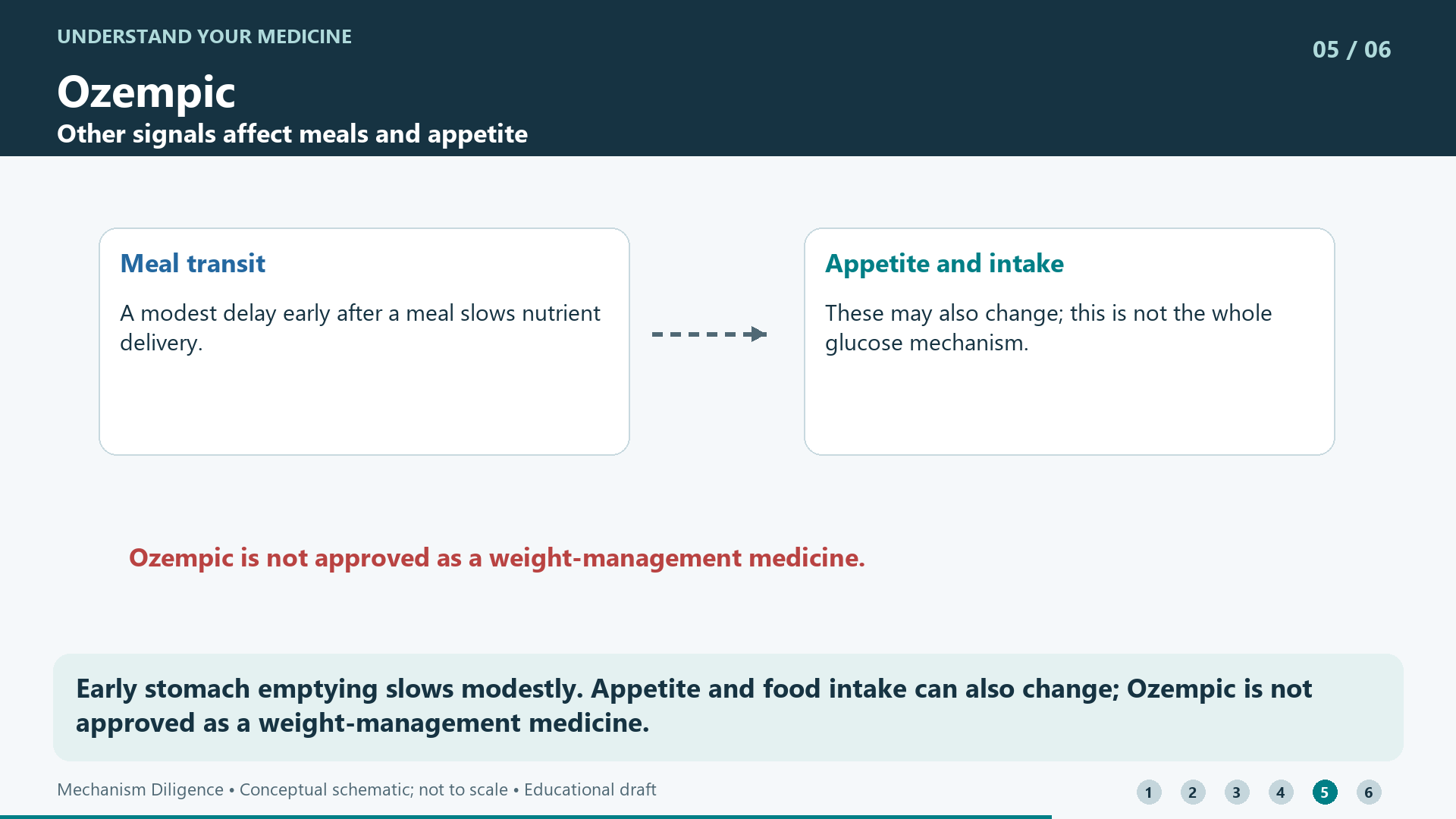
Early stomach emptying slows modestly. Appetite and food intake can also change; Ozempic is not approved as a weight-management medicine.
Glucose control is not simply a blocked stomach. Appetite research with a different semaglutide regimen supports reduced intake, but does not make its measured effect size an Ozempic promise.
Appetite data from obesity studies cannot specify each Ozempic user's response.
- Ozempic injection US prescribing information, May 2026 · Sections 1, 5, 11, 12.1–12.3 and 14.2–14.3 · Current manufacturer-hosted US label; selected sections inspected · checked 2026-10-17
- Rybelsus and Ozempic tablets US prescribing information, January 2026 · Sections 1, 2, 5, 11, 12.1–12.3 and 14.4 · Current manufacturer-hosted US label; selected sections inspected · checked 2026-10-17
- Friedrichsen et al. — Semaglutide, appetite, energy intake and gastric emptying, 2021 · Abstract and conclusion: 72 adults with obesity, 20 weeks, subcutaneous 2.4 mg · Primary randomized human mechanistic study; not an Ozempic-indication trial · checked 2026-10-17
Chapter 6: Clinical benefits depend on the formulation
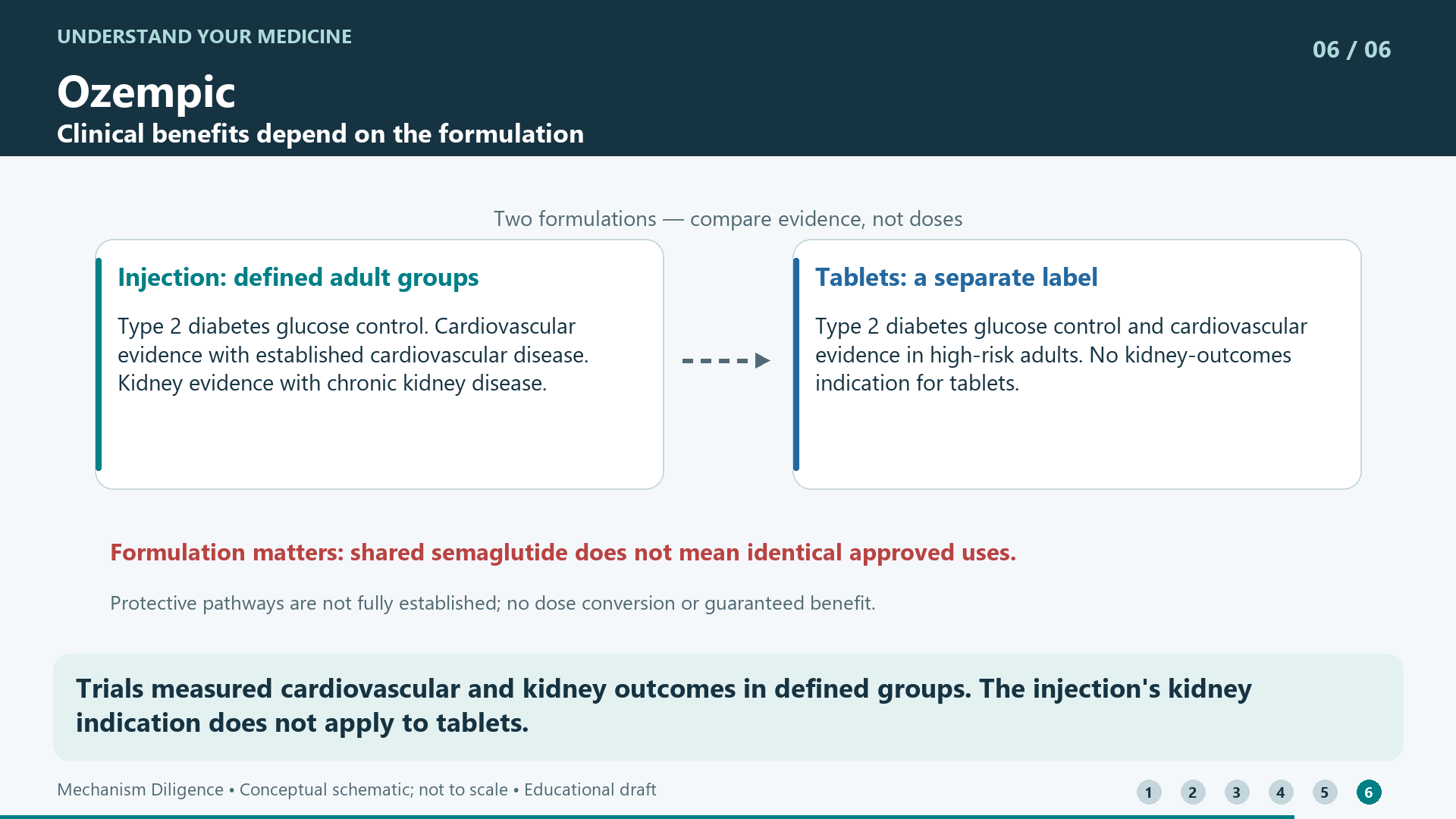
Trials measured cardiovascular and kidney outcomes in defined groups. The injection's kidney indication does not apply to tablets.
FLOW studied injected semaglutide in type 2 diabetes with CKD; SOUL studied oral treatment in high-risk type 2 diabetes. These outcome trials do not identify a complete protective pathway. Injectable and oral cardiovascular eligibility also differs.
No guaranteed benefit or equal reduction in every composite-outcome component; full safety information still applies.
- Perkovic et al. — FLOW kidney-outcomes trial, 2024 · Abstract: injected semaglutide, adult type 2 diabetes and CKD population, composite outcome · Randomized clinical outcome trial; indexed abstract inspected · checked 2026-10-17
- McGuire et al. — SOUL oral semaglutide cardiovascular-outcomes trial, 2025 · Abstract: high-risk type 2 diabetes population and cardiovascular composite; DOI 10.1056/NEJMoa2501006 · Randomized clinical outcome trial; abstract inspected · checked 2026-10-17
- Ozempic injection US prescribing information, May 2026 · Sections 1, 5, 11, 12.1–12.3 and 14.2–14.3 · Current manufacturer-hosted US label; selected sections inspected · checked 2026-10-17
- Rybelsus and Ozempic tablets US prescribing information, January 2026 · Sections 1, 2, 5, 11, 12.1–12.3 and 14.4 · Current manufacturer-hosted US label; selected sections inspected · checked 2026-10-17
References & Sources
Source pages checked 2026-10-17. AI-assisted editorial source checking is not independent clinical review. Sources support the summary, mechanism, safety and access information; references are also kept beside each question.
- Ozempic injection US prescribing information, revised May 2026 ↗ · Boxed warning; 1; 3–8; 11–12; 14.2–14.3; Medication Guide
- Rybelsus and Ozempic tablets US prescribing information, revised January 2026 ↗ · Boxed warning; 1–5; 6–8; 11–12; 14.4; Medication Guide
- FDA approval of oral R2 formulation renaming, January 30, 2026 ↗ · Page 1: NDA 213051/S-030, Rybelsus formulation R2 renamed Ozempic tablets; signature page date
- Novo Nordisk: Ozempic tablets US introduction, May 1, 2026 ↗ · May 4 introduction; updated formulation and branding; separate injection and tablet indications
- Perkovic et al. FLOW randomized kidney-outcomes trial, 2024 ↗ · Abstract: population, injected semaglutide, composite kidney outcome and limitations
- McGuire et al. SOUL randomized oral cardiovascular-outcomes trial, 2025 ↗ · Abstract: adult T2D population, MACE and confirmatory secondary outcomes
- Buckley et al. Transcellular stomach absorption of oral semaglutide, 2018 ↗ · Abstract: clinical and preclinical gastric absorption; SNAC coformulation
- Wegovy injection and tablets US prescribing information, revised June 2026 ↗ · 1; 8.4: formulation-specific indications and pediatric limits
- Official Ozempic patient product information ↗ · Injection and pill product information; current access resources
Selective US-label-based information, not a complete safety list or a personal treatment recommendation. Do not change treatment based on this page; use the product-specific label and your care team's advice.