Mounjaro (Drug class: Dual GIP and GLP-1 receptor agonist)
US Mounjaro (tirzepatide) subcutaneous injection, label revised August 2026. For glucose control in type 2 diabetes from age 10, alongside diet and exercise; also to reduce major cardiovascular-event risk in high-risk adults with type 2 diabetes. The cardiovascular indication is adult-only; Zepbound has different labeled uses.
Educational draft · independent clinical review pending. Silent mechanism animation available; no recorded narration.
Uses / Symptoms
- Blood-glucose control in type 2 diabetes from age 10
- Reduction of major cardiovascular-event risk in high-risk adults with type 2 diabetes
- Glycemic use accompanies diet and exercise; not a type 1 diabetes indication
Effects
- Activates both GIP and GLP-1 receptors
- Increases glucose-dependent insulin release and reduces glucagon
- Lowers glucose and can reduce appetite and body weight
Side effects
- Nausea, diarrhea, vomiting, constipation or abdominal pain
- Reduced appetite and indigestion are common
- Boxed thyroid-tumor warning; important pancreatic, allergic, dehydration and low-glucose risks
How does Mounjaro work? What is the Mechanism Of Action (MOA)?
Mounjaro acts on two receptors used by the body's GIP and GLP-1 signals. It helps the pancreas release insulin when glucose is high and reduces glucagon, a signal that raises blood glucose. It can also reduce appetite and slow stomach emptying.
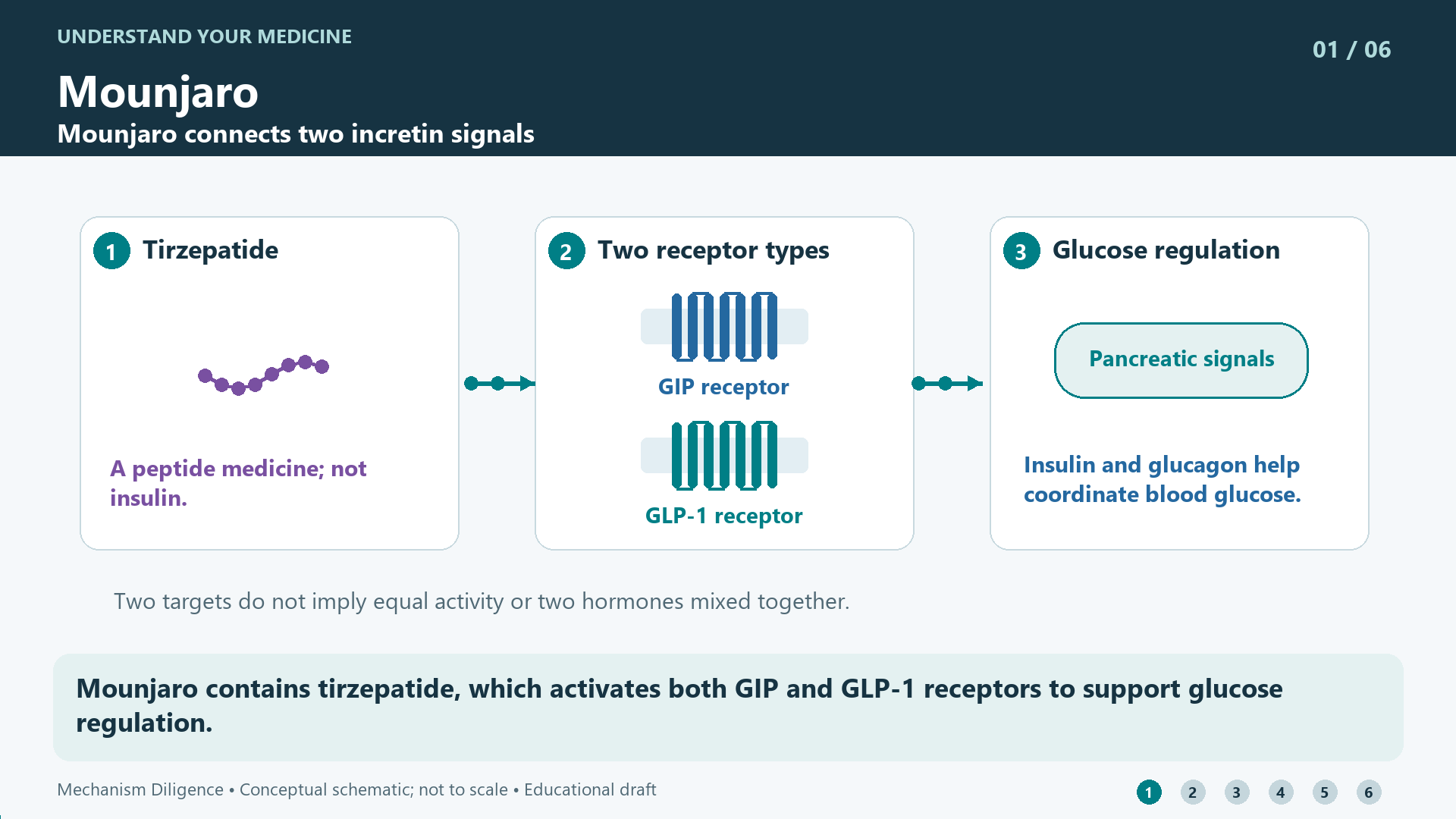
The mechanism, step by step
- Incretin signals link meals and glucose control
GIP and GLP-1 receptors participate in the body's response to nutrients and glucose.
- Tirzepatide activates both receptors
One peptide molecule supplies both GIP-receptor and GLP-1-receptor agonist activity.
- Insulin and glucagon responses change
Glucose-dependent insulin secretion rises and glucagon falls, supporting lower fasting and after-meal glucose.
- Additional effects contribute
Reduced food intake, improved insulin sensitivity and a diminishing gastric-emptying delay also contribute to the overall response.
- Clinical outcomes require clinical evidence
Glucose control and cardiovascular-event outcomes were evaluated in trials; neither is guaranteed by a receptor diagram.
A perspective-aware, six-chapter visual narration is available when JavaScript is enabled.
Questions & Answers (FAQ)
How does Mounjaro work?
Mounjaro acts on two receptors used by the body's GIP and GLP-1 signals. It helps the pancreas release insulin when glucose is high and reduces glucagon, a signal that raises blood glucose. It can also reduce appetite and slow stomach emptying.
What is Mounjaro approved for now?
The August 2026 US label covers glucose control in type 2 diabetes from age 10, with diet and exercise. It also covers reducing cardiovascular death, nonfatal heart attack or nonfatal stroke in adults with type 2 diabetes at high risk for these events.
Is Mounjaro the same as Zepbound?
They contain the same active ingredient, tirzepatide, but have different labeled uses. Mounjaro's current indications concern type 2 diabetes and specified adult cardiovascular risk; Zepbound covers adult weight management and moderate-to-severe obstructive sleep apnea in adults with obesity. Shared ingredient identity is not a substitution instruction.
Do all indications apply to children?
No. Glycemic control in type 2 diabetes is labeled for ages 10 and older. The cardiovascular-risk indication is restricted to adults. Safety and effectiveness below age 10 are not established; this is not a pediatric obesity indication.
What did the cardiovascular trial establish?
SURPASS-CVOT compared tirzepatide with dulaglutide in adults with type 2 diabetes and established cardiovascular disease. Tirzepatide met the trial's noninferiority criterion for cardiovascular death, heart attack or stroke; superiority on that primary endpoint was not established. The current label nevertheless includes the specified adult cardiovascular-risk indication.
What side effects are common?
Nausea, diarrhea, reduced appetite, vomiting, constipation, indigestion and abdominal pain are common. Severe gastrointestinal reactions also occur, and Mounjaro is not recommended in severe gastroparesis.
What is the thyroid boxed warning?
Tirzepatide caused thyroid C-cell tumors in rats; whether it causes these tumors in humans is unknown. A personal or family history of medullary thyroid carcinoma, or MEN2, is a contraindication. This is not evidence that all thyroid conditions have the same restriction.
What other important risks are described?
The label includes pancreatitis, serious allergic reactions, dehydration-related kidney injury, gallbladder disease and diabetic-retinopathy complications. It also describes rare pulmonary aspiration during general anesthesia or deep sedation associated with residual stomach contents.
Can glucose become too low?
Yes, particularly with insulin or insulin-releasing medicines such as sulfonylureas. Mounjaro's glucose-dependent action does not eliminate this risk, and serious low-glucose episodes can occur with these combinations.
Why do oral medicines and pregnancy matter?
Delayed gastric emptying can affect absorption of oral medicines, including oral hormonal contraceptives. Animal findings raise fetal-harm concerns and human pregnancy data are insufficient to define risk. The full label explains the reproductive precautions.
What formulation does this page describe?
The US subcutaneous injection. Current labeling includes several pen and vial presentations whose instructions are not interchangeable. The pharmacology here applies to the approved product, not to unapproved compounded or research-labeled material.
Where is official support information?
The Mounjaro manufacturer site provides savings and coverage information with eligibility conditions. A prescription is required. This page supplies no price quote, pharmacy-stock claim or promise that a particular insurance plan covers treatment.
Online stores and Pharmacies (Buy)
Official US manufacturer support, checked October 17, 2026. A prescription and program-specific eligibility are required. No current price, stock or individual insurance coverage is asserted.
No live price, stock or individual eligibility is verified here.
Animation chapters, evidence & visual limits
US Mounjaro (subcutaneous tirzepatide), August 2026 label: type 2 diabetes glucose control from age 10 and cardiovascular-risk reduction in high-risk adults with type 2 diabetes. Zepbound has different uses.
Educational draft; independent clinical review pending. Dual agonism does not mean equal receptor activity or two molecules permanently bridging receptors. No insulin replacement, beta-cell regeneration or type 1 diabetes indication is implied. Cell assays and a small human clamp study cannot partition each receptor's contribution to long-term outcomes.
Original conceptual illustrations. AI-assisted editorial source check; independent clinical review pending. No recorded narration.
Chapter 1: Mounjaro connects two incretin signals
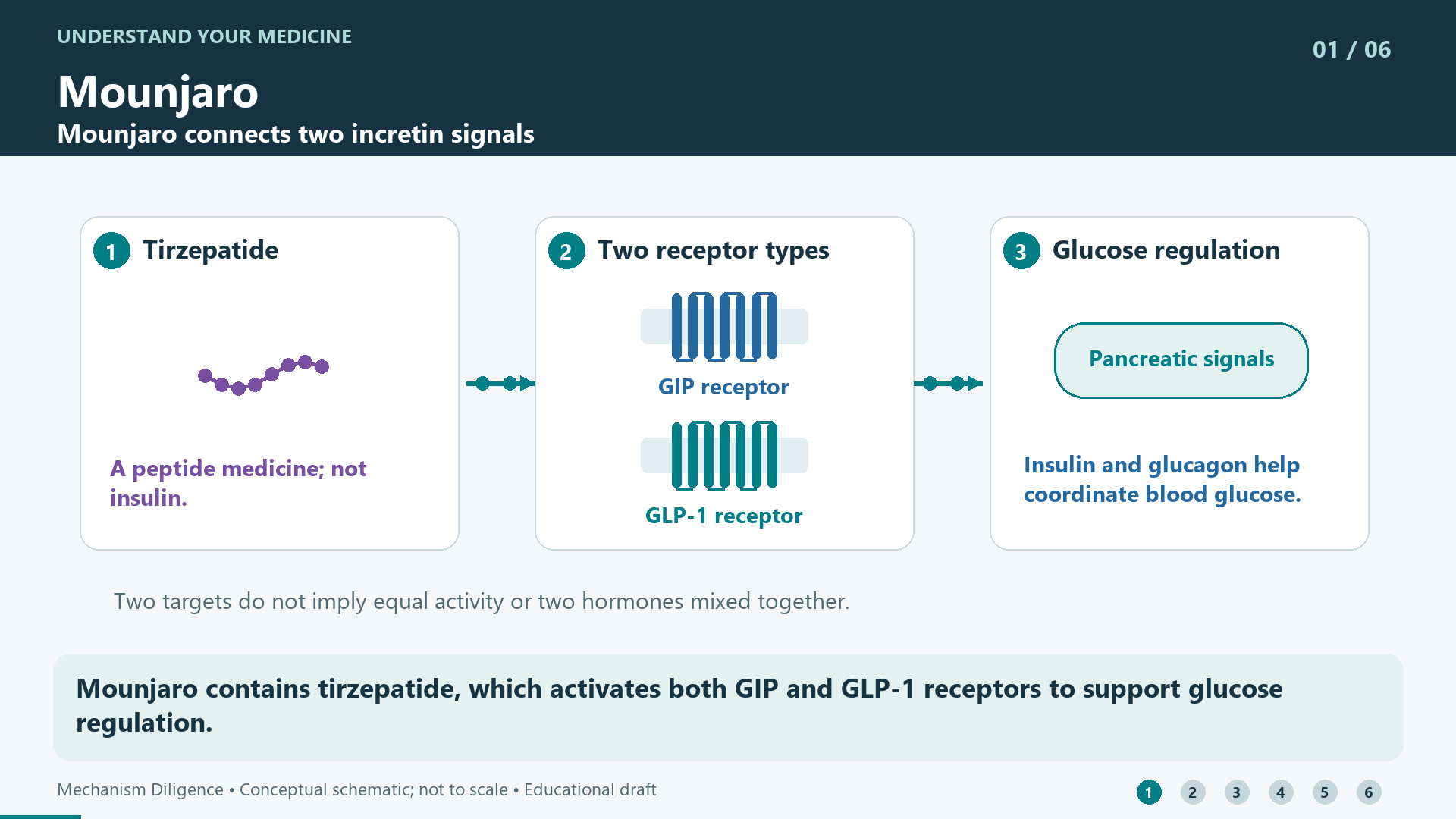
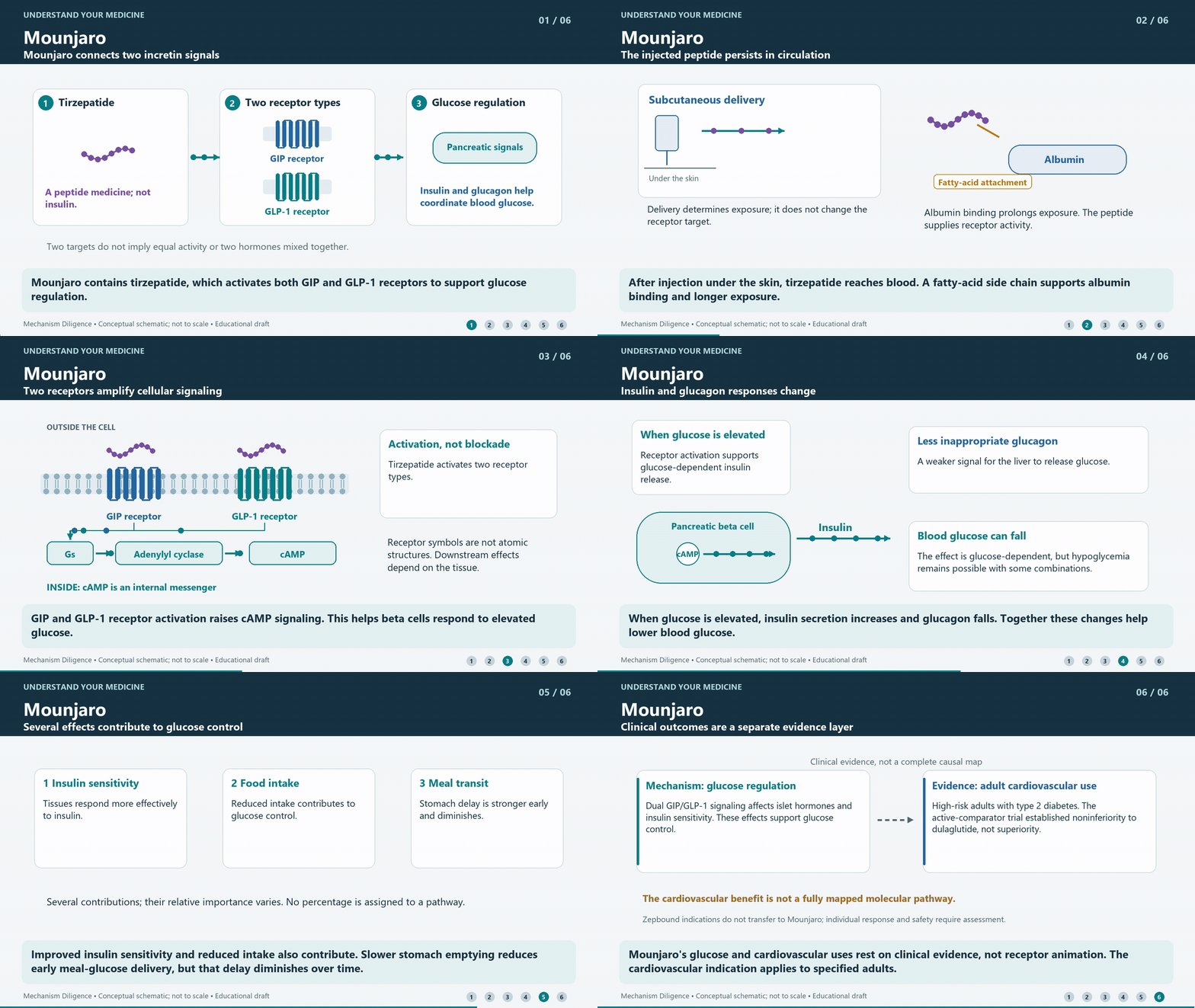
Mounjaro contains tirzepatide, which activates both GIP and GLP-1 receptors to support glucose regulation.
GIP and GLP-1 are incretin signals. Their receptors couple to intracellular signaling that can amplify insulin secretion; this is different from supplying insulin itself.
Natural meal signaling is simplified; tirzepatide is a medicine, not the two native hormones mixed together.
- Willard et al. — Tirzepatide is an imbalanced and biased dual GIP/GLP-1 receptor agonist · Results and Figure 1: Gs/cAMP, receptor pharmacology and albumin effects; DOI 10.1172/jci.insight.140532 · Primary receptor-assay study; results inspected · checked 2026-10-17
Chapter 2: The injected peptide persists in circulation
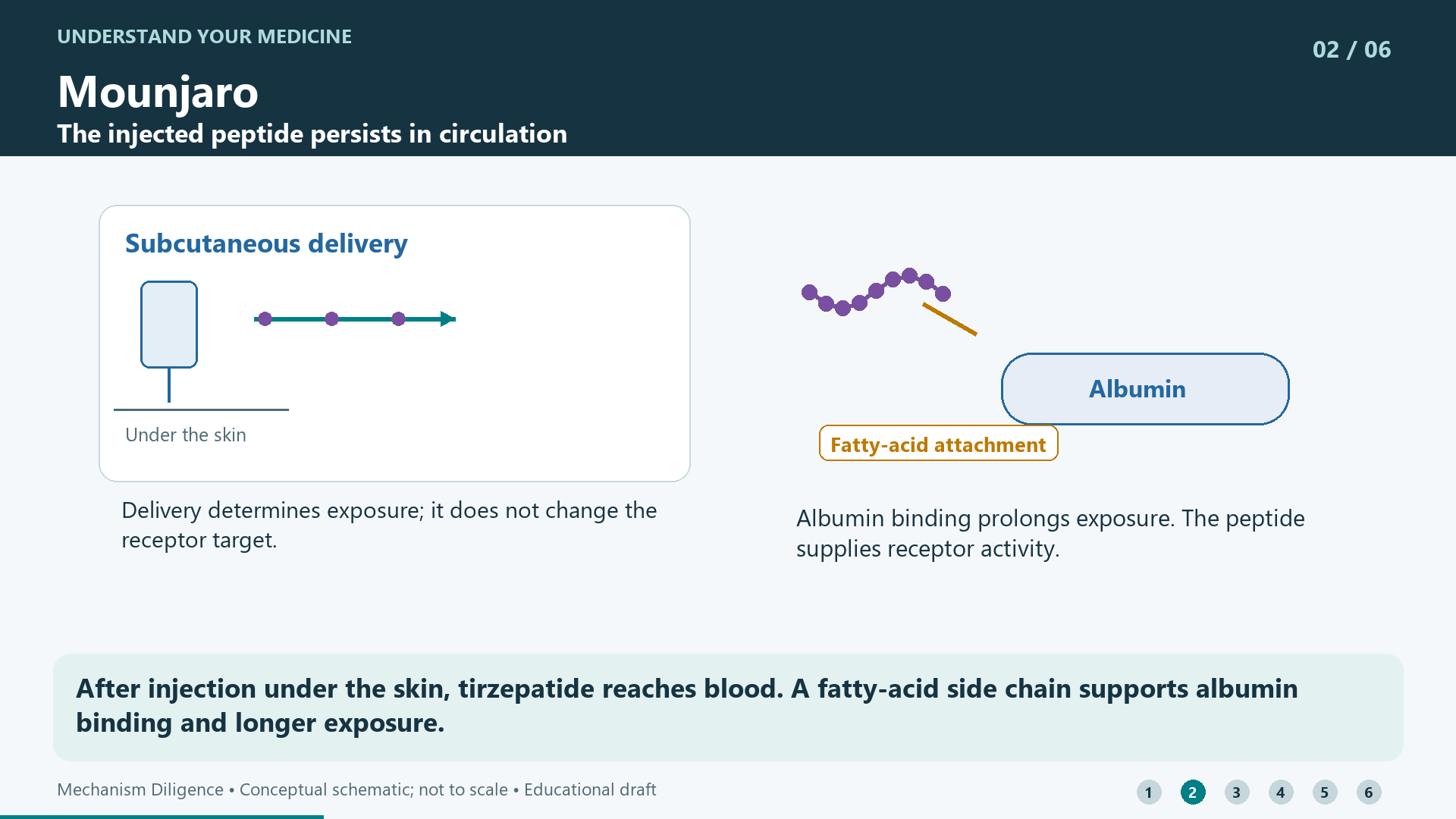
After injection under the skin, tirzepatide reaches blood. A fatty-acid side chain supports albumin binding and longer exposure.
Albumin binding helps persistence; it is not the receptor mechanism. Free and bound drug exchange rather than albumin permanently delivering a locked complex to each receptor.
Schematic protein association, not an actual molecular structure or residence-time measurement.
- Mounjaro prescribing information — August 2026 · Sections 1, 5.3, 11, 12.1–12.3 and 14.6 · Current manufacturer US prescribing information; selected sections inspected · checked 2026-10-17
- Willard et al. — Tirzepatide is an imbalanced and biased dual GIP/GLP-1 receptor agonist · Results and Figure 1: Gs/cAMP, receptor pharmacology and albumin effects; DOI 10.1172/jci.insight.140532 · Primary receptor-assay study; results inspected · checked 2026-10-17
Chapter 3: Two receptors amplify cellular signaling
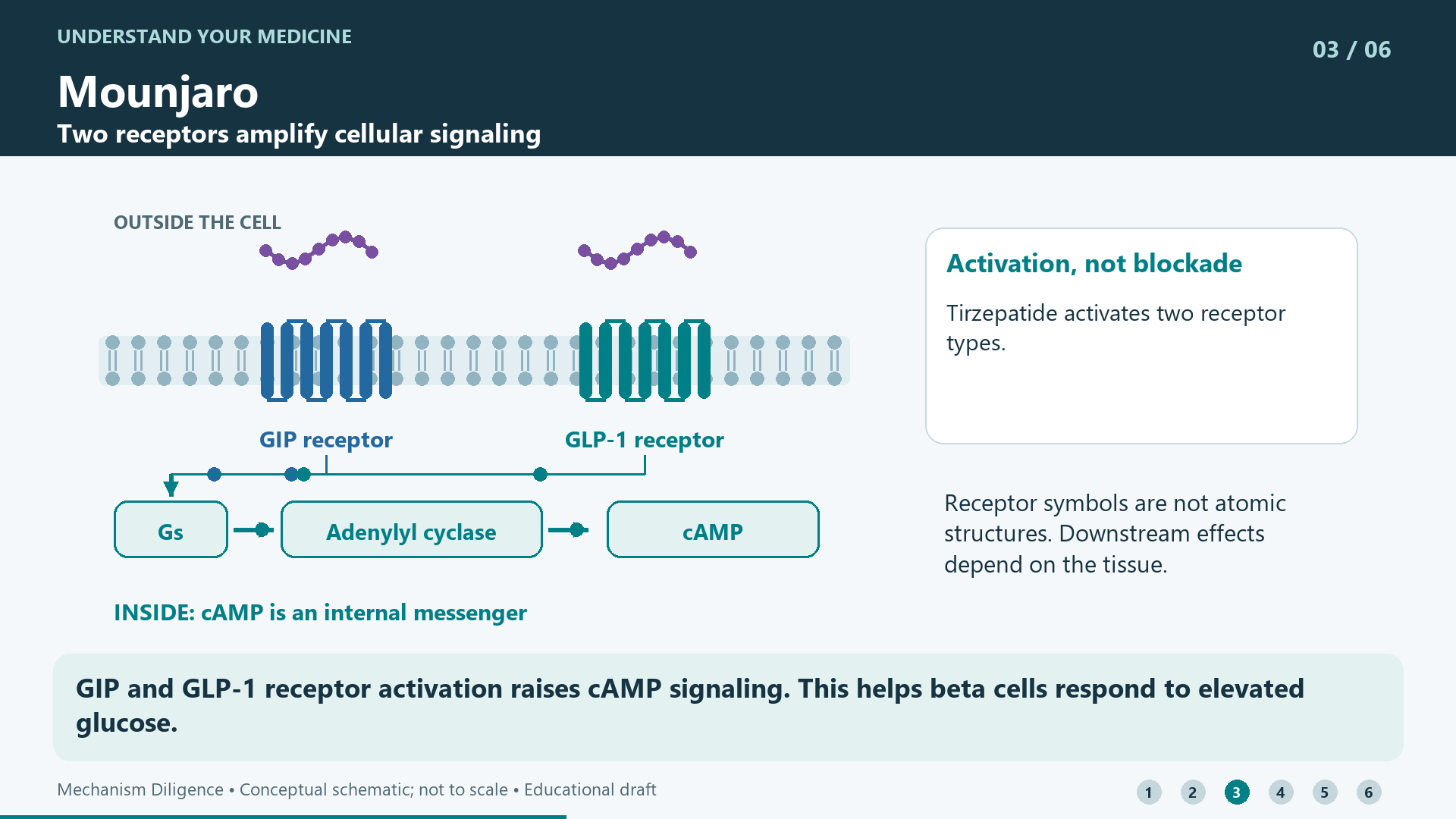
GIP and GLP-1 receptor activation raises cAMP signaling. This helps beta cells respond to elevated glucose.
Receptor assays support Gs/cAMP activity at both targets, with different pharmacological profiles. GLP-1R signaling bias in those assays does not prove one receptor accounts for a particular fraction of clinical benefit.
This is signal amplification, not autonomous insulin release regardless of glucose.
- Willard et al. — Tirzepatide is an imbalanced and biased dual GIP/GLP-1 receptor agonist · Results and Figure 1: Gs/cAMP, receptor pharmacology and albumin effects; DOI 10.1172/jci.insight.140532 · Primary receptor-assay study; results inspected · checked 2026-10-17
Chapter 4: Insulin and glucagon responses change
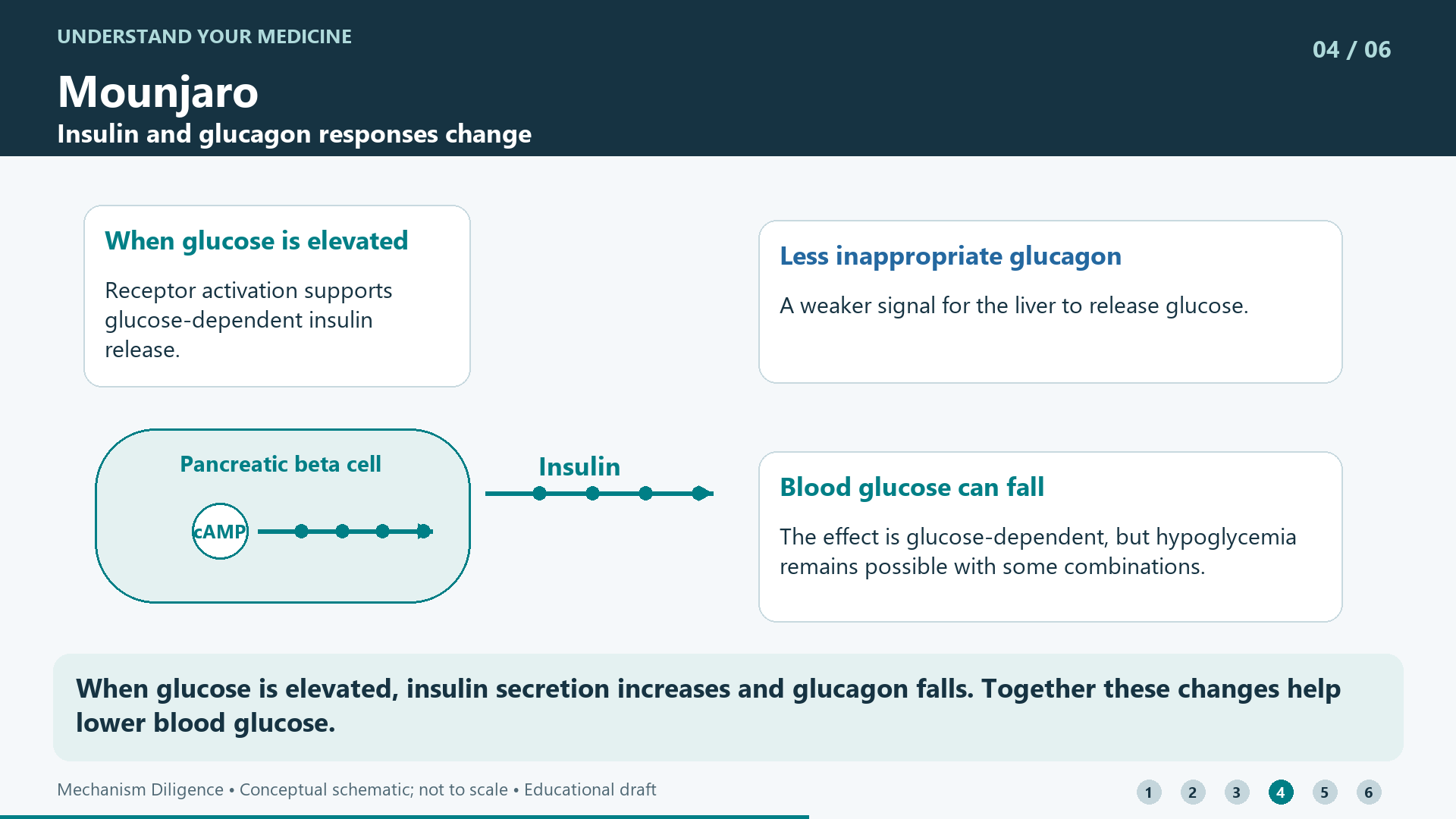
When glucose is elevated, insulin secretion increases and glucagon falls. Together these changes help lower blood glucose.
Human clamp and meal studies support altered islet function and glucose control. Lower glucagon reduces a liver glucose-production signal; do not portray tirzepatide as directly plugging liver glucose transport.
Low-glucose risk is not zero, especially with insulin or sulfonylureas.
- Mounjaro prescribing information — August 2026 · Sections 1, 5.3, 11, 12.1–12.3 and 14.6 · Current manufacturer US prescribing information; selected sections inspected · checked 2026-10-17
- Heise et al. — Tirzepatide, pancreatic islet function and insulin sensitivity · Abstract: 28-week randomized phase 1 study, clamp and meal-test outcomes · Primary human mechanistic trial; abstract inspected · checked 2026-10-17
Chapter 5: Several effects contribute to glucose control
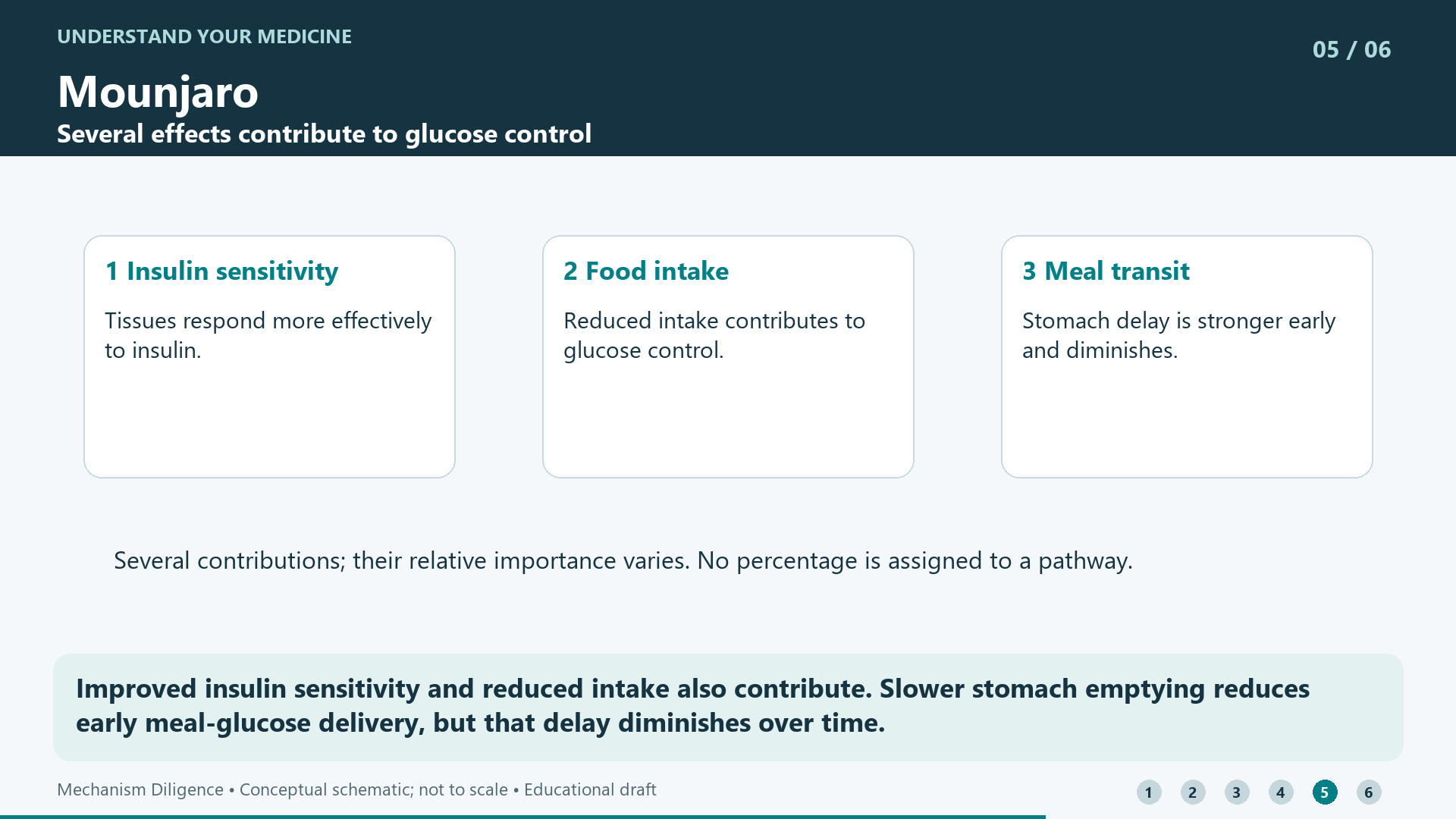
Improved insulin sensitivity and reduced intake also contribute. Slower stomach emptying reduces early meal-glucose delivery, but that delay diminishes over time.
The human mechanistic trial measured improved insulin sensitivity. Gastric studies found a stronger early effect that lessened with repeated exposure; this does not explain all sustained glucose lowering.
Measured physiology does not establish which changes are direct, weight-mediated or dominant in every person.
- Heise et al. — Tirzepatide, pancreatic islet function and insulin sensitivity · Abstract: 28-week randomized phase 1 study, clamp and meal-test outcomes · Primary human mechanistic trial; abstract inspected · checked 2026-10-17
- Urva et al. — Tirzepatide transiently delays gastric emptying · Abstract and clinical gastric-emptying results; DOI 10.1111/dom.14110 · Primary preclinical and phase 1 gastric-emptying study; indexed abstract inspected · checked 2026-10-17
- Mounjaro prescribing information — August 2026 · Sections 1, 5.3, 11, 12.1–12.3 and 14.6 · Current manufacturer US prescribing information; selected sections inspected · checked 2026-10-17
Chapter 6: Clinical outcomes are a separate evidence layer
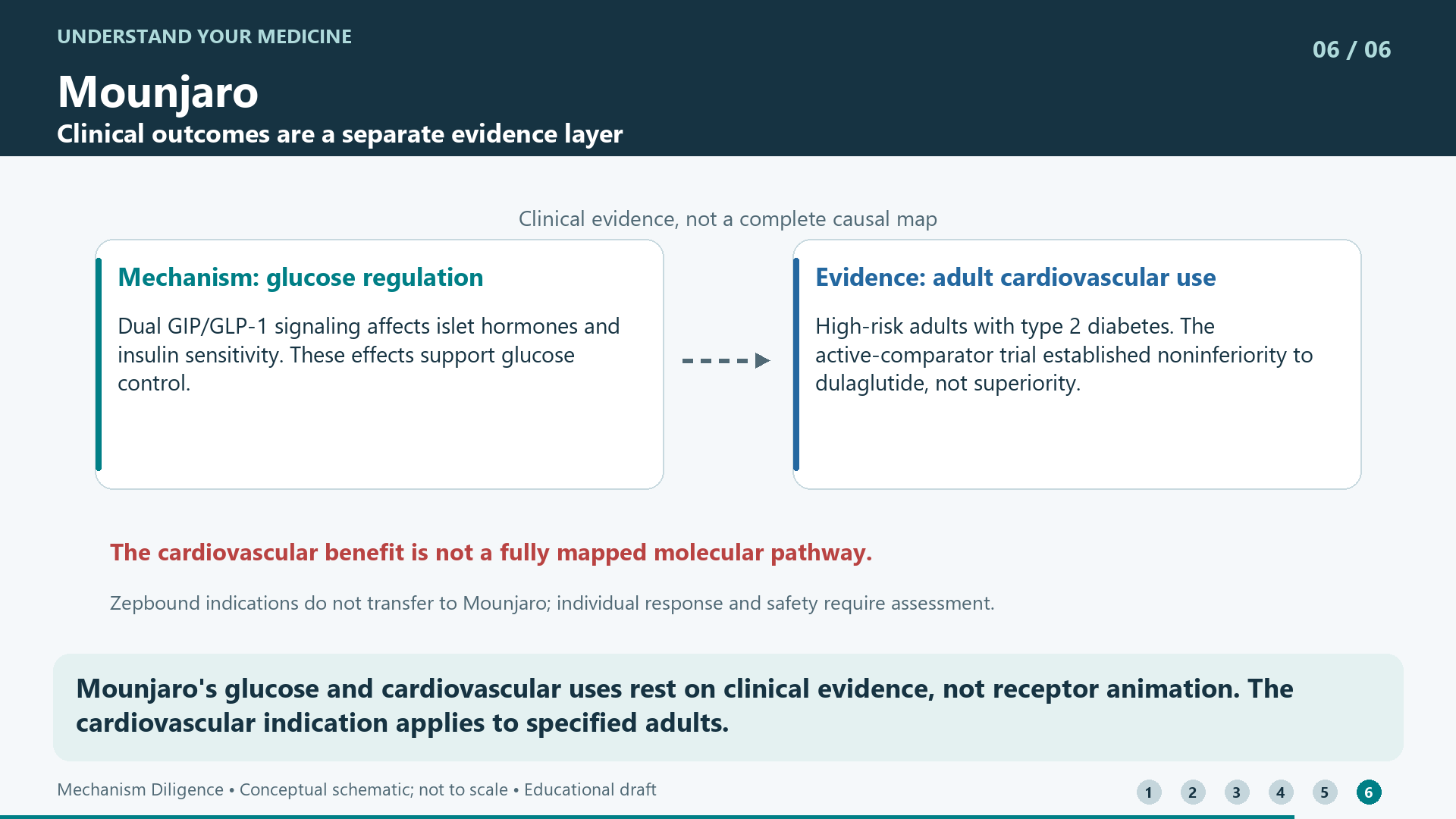
Mounjaro's glucose and cardiovascular uses rest on clinical evidence, not receptor animation. The cardiovascular indication applies to specified adults.
The current label includes cardiovascular-event risk reduction in high-risk adults with type 2 diabetes. Its active-comparator trial established noninferiority to dulaglutide, not superiority. That result is not a mapped molecular explanation of cardiovascular protection.
No transfer of Zepbound's weight or OSA indications; no guarantee of individual benefit.
- Mounjaro prescribing information — August 2026 · Sections 1, 5.3, 11, 12.1–12.3 and 14.6 · Current manufacturer US prescribing information; selected sections inspected · checked 2026-10-17
References & Sources
Source pages checked 2026-10-17. AI-assisted editorial source checking is not independent clinical review. Sources support the summary, mechanism, safety and access information; references are also kept beside each question.
- FDA Mounjaro prescribing information — revised August 2026 ↗ · Boxed Warning; 1, 3–8, 11, 12.1–12.3, 14.5–14.6; Medication Guide
- FDA Mounjaro cardiovascular-indication supplemental approval ↗ · NDA 215866/S-044 and S-045; S-044 cardiovascular indication based on SURPASS-CVOT
- Cardiovascular Outcomes with Tirzepatide versus Dulaglutide in Type 2 Diabetes ↗ · Primary randomized active-comparator trial; prespecified noninferiority and superiority tests
- Tirzepatide is an imbalanced and biased dual GIP and GLP-1 receptor agonist ↗ · Primary receptor-signaling experiments; experimental bias is not a comparative clinical claim
- Zepbound US prescribing information — revised August 2026 ↗ · 1: brand-specific weight-management and OSA indications; 8.4
- Mounjaro official savings and coverage information ↗ · Current program eligibility and terms; prices intentionally not reproduced
Selective US-label-based information, not a complete safety list or a personal treatment recommendation. Do not change treatment based on this page; use the product-specific label and your care team's advice.