Esketamine (Drug class: Noncompetitive NMDA receptor antagonist; antidepressant treatment)
US SPRAVATO intranasal esketamine for adults. This information does not describe racemic ketamine infusions, compounded ketamine products, or an anesthetic indication. Educational draft; independent clinical review pending.
Educational draft · independent clinical review pending. Silent mechanism animation available; no recorded narration.
Uses / Symptoms
- Treatment-resistant depression in adults, either alone or with an oral antidepressant.
- Depressive symptoms with major depression and acute suicidal thoughts or behavior in adults, with an oral antidepressant.
Effects
- Can reduce depressive symptom severity; response varies.
- Suicide prevention or reduced suicidal thoughts or behavior has not been established.
Side effects
- Common effects: detachment (dissociation), dizziness, nausea, sleepiness, headache, anxiety or vomiting.
- Serious risks: sedation, breathing suppression, abuse or misuse, and increased blood pressure.
- Boxed warning also covers suicidal thoughts and behaviors in younger people taking antidepressants.
- Other concerns include cognitive or driving impairment, urinary symptoms and pregnancy-related risks; see the FAQ and full label.
How does Esketamine work? What is the Mechanism Of Action (MOA)?
Esketamine blocks NMDA receptors, which respond to the brain messenger glutamate. It can reduce depressive symptoms, but scientists do not yet know exactly how this receptor action produces the antidepressant benefit.
The mechanism, step by step
- Nasal delivery
Spravato delivers esketamine through the nose under direct healthcare supervision.
- NMDA receptor action
Esketamine blocks NMDA receptors, which are glutamate-responsive ion channels.
- Clinical effect assessed separately
Trials measure changes in depressive symptoms; the complete pathway connecting receptor action to benefit remains unknown.
- Monitored treatment
Observation addresses sedation, dissociation, breathing and blood-pressure effects; these are not measures of antidepressant success.
Questions & Answers (FAQ)
How does Esketamine work?
Esketamine blocks NMDA receptors, which respond to the brain messenger glutamate. It can reduce depressive symptoms, but scientists do not yet know exactly how this receptor action produces the antidepressant benefit.
What is Spravato used for?
In the US, Spravato treats treatment-resistant depression in adults, either alone or with an oral antidepressant. It also treats depressive symptoms in adults with major depressive disorder and acute suicidal ideation or behavior, in conjunction with an oral antidepressant. These are different labeled treatment settings.
Does improvement mean it prevents suicide?
No such benefit has been established. The label states that effectiveness in preventing suicide or reducing suicidal ideation or behavior has not been demonstrated. Clinical assessment and hospitalization, when warranted, remain necessary even if depressive symptoms improve.
Is Spravato the same as ketamine treatment?
Spravato is a specific intranasal product containing esketamine, the S-enantiomer of ketamine. Its label and REMS do not automatically apply to racemic ketamine infusions, compounded nasal sprays or oral ketamine products. Spravato is not approved as an anesthetic.
What side effects may occur?
Common effects include dissociation or feeling detached, dizziness, nausea, sedation, headache, anxiety, vomiting and increased blood pressure. The adverse-effect pattern depends on the studied treatment setting. Trial percentages are not an individual prediction.
Which major warnings matter?
The boxed warning covers sedation, dissociation, respiratory depression, abuse and misuse, and suicidal thoughts and behaviors. Blood-pressure increases, cognitive or driving impairment, urinary symptoms and embryo-fetal risk are additional concerns. The full label describes contraindications, including certain vascular conditions, previous intracerebral hemorrhage and hypersensitivity.
Why is treatment supervised?
Spravato is administered in a REMS-certified healthcare setting under direct observation. The label requires monitoring for at least two hours, including respiratory assessment with pulse oximetry, followed by assessment of readiness to leave. It is not a take-home Spravato treatment.
Why do other medicines and driving matter?
Other CNS depressants can increase sedation, and certain medicines can increase blood-pressure concerns. Spravato can impair attention, judgment and reaction time; its Medication Guide provides specific driving restrictions and transport requirements. Medication review and those instructions remain important even when the person feels better.
What do the clinical studies establish?
Controlled trials support reductions in depressive symptom scores in defined adult populations, including a monotherapy trial in treatment-resistant depression. They do not prove a complete molecular mechanism or guarantee response for an individual. The monotherapy trial reported manufacturer involvement and conflicts of interest; this educational page has not undergone independent clinical validation.
Online stores and Pharmacies (Buy)
Prescription treatment through a REMS-certified healthcare setting. Patients self-administer the nasal spray under direct observation; outpatient enrollment and post-administration monitoring are required. This is access information, not a purchase, eligibility, price or coverage claim.
No live price, stock or individual eligibility is verified here.
Animation chapters, evidence & visual limits
US SPRAVATO intranasal esketamine in adults; excludes racemic or compounded ketamine. Educational animation draft; independent clinical review pending.
Original schematics are not molecular structures, measured concentrations, real-time recordings or predictions for a patient. Rodent ketamine plasticity findings do not prove intranasal esketamine repairs human synapses.
Original conceptual illustrations. AI-assisted editorial source check; independent clinical review pending. No recorded narration.
Chapter 1: Glutamate carries a signal
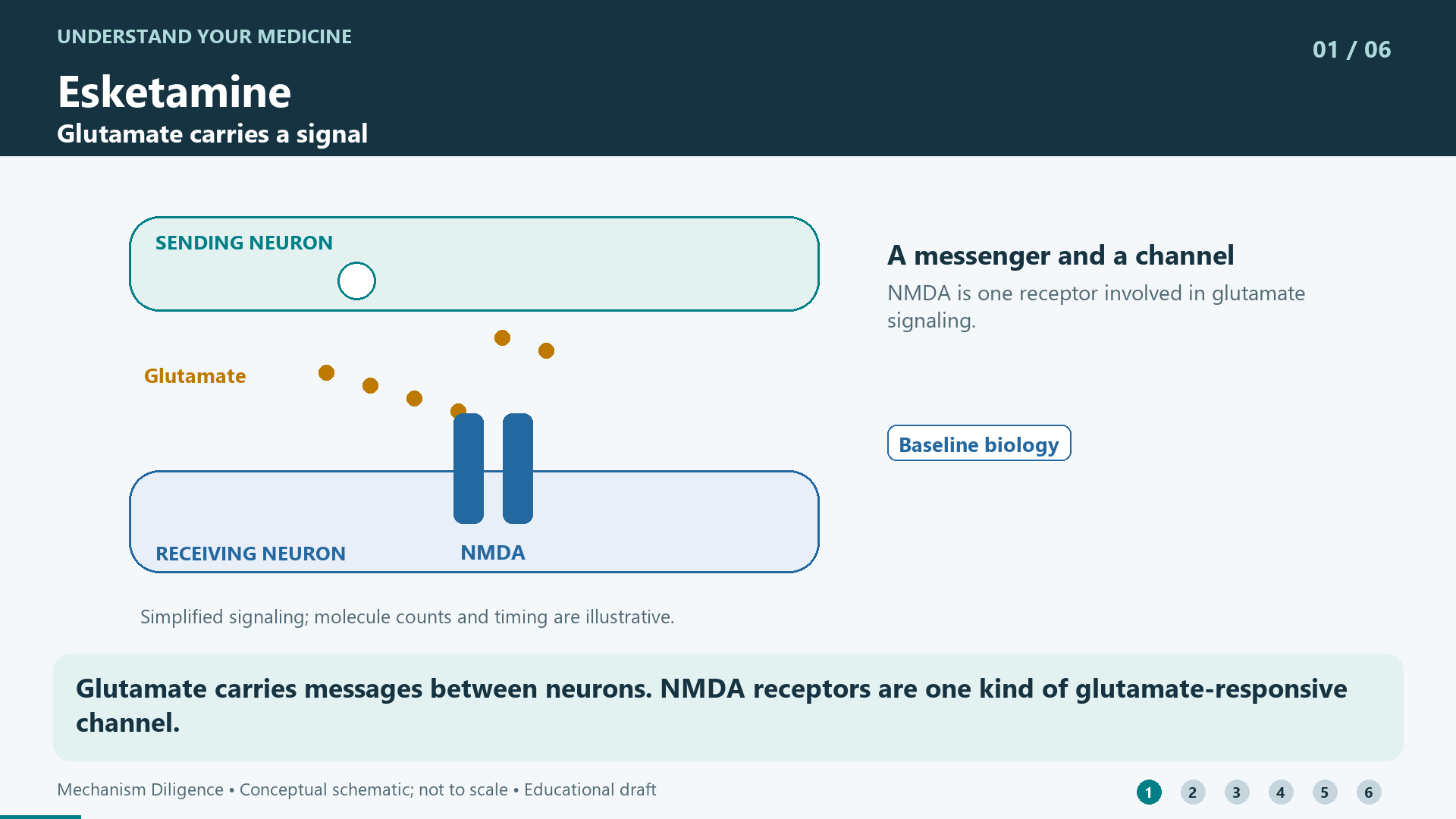
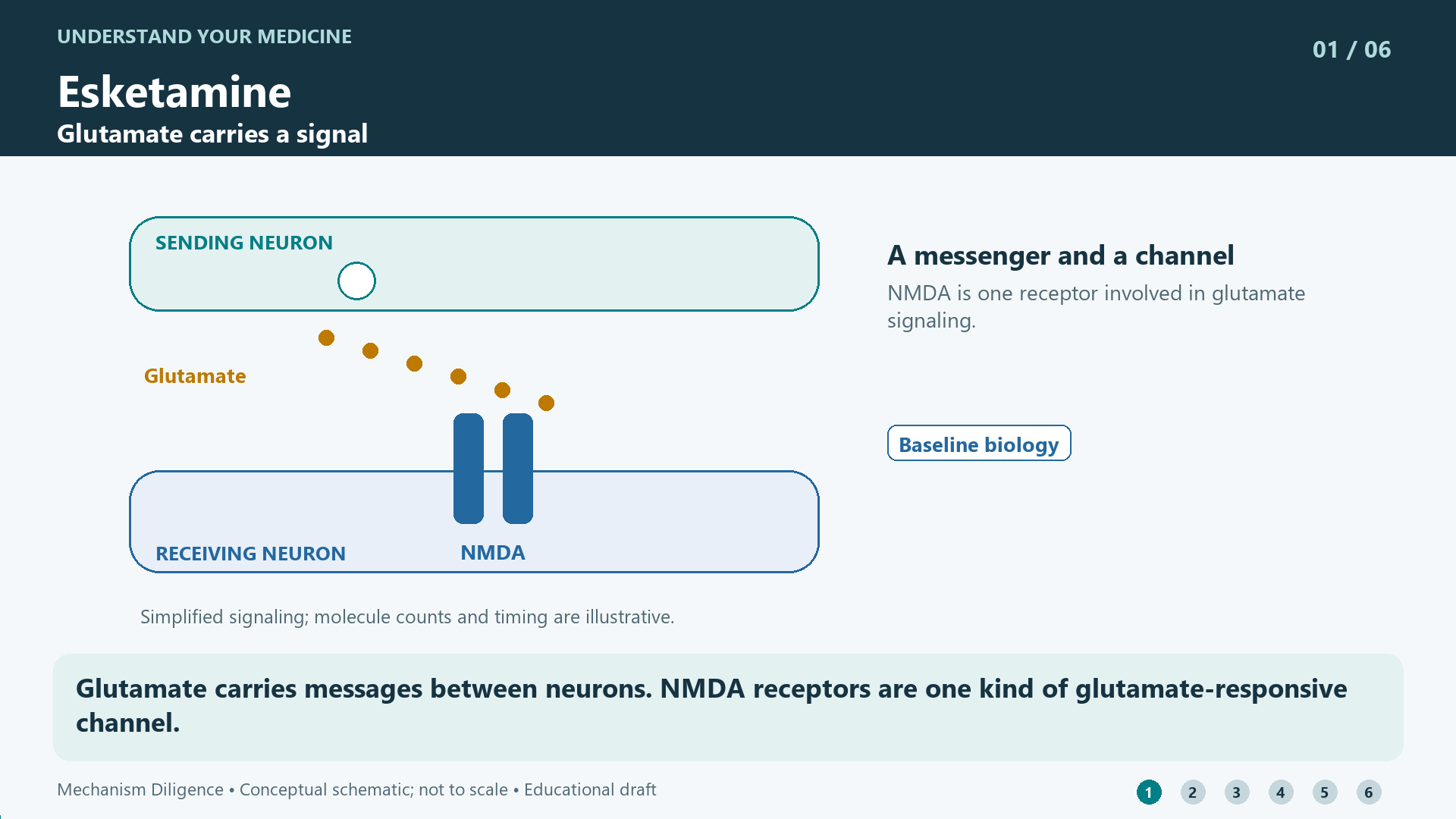
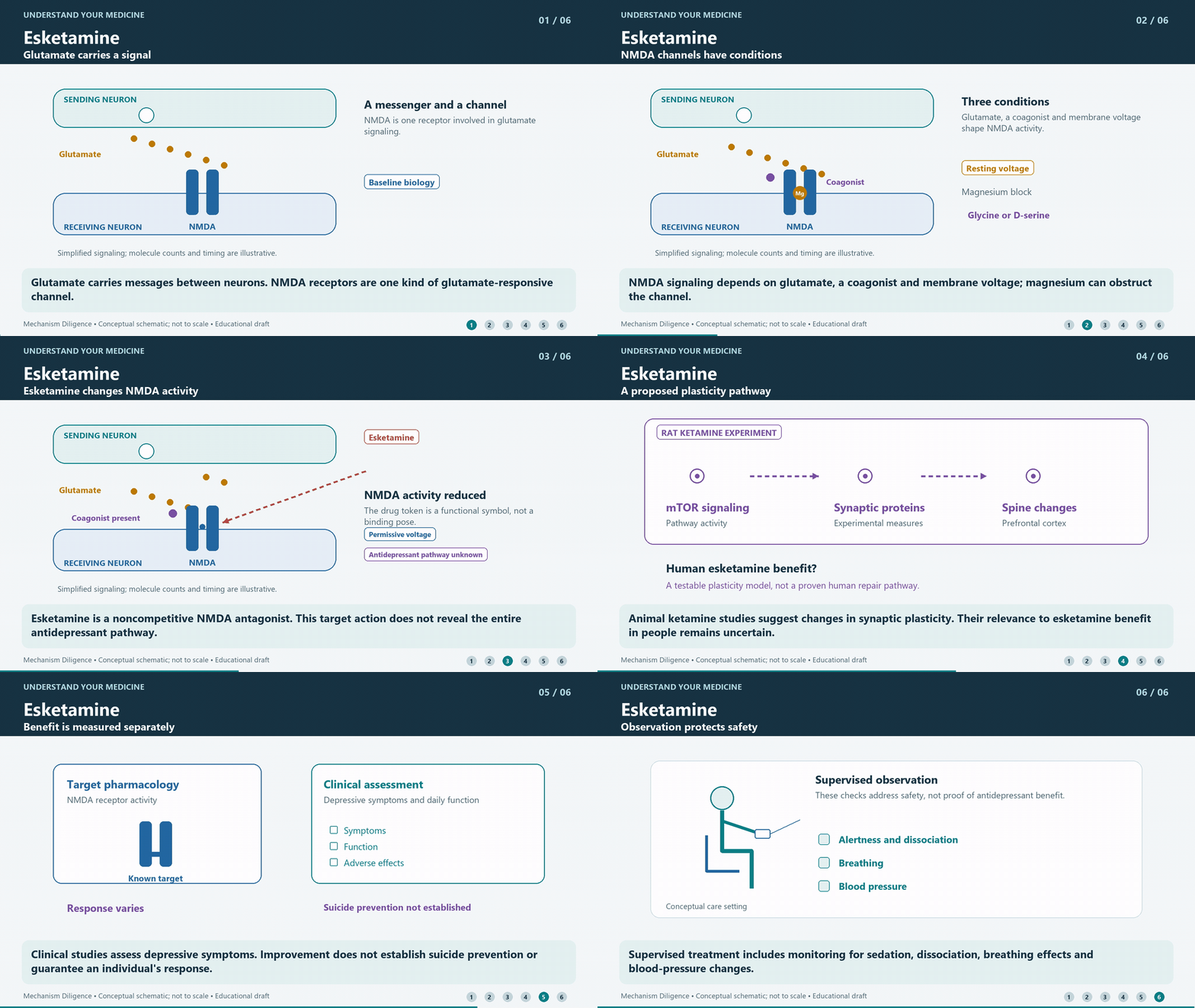
Glutamate carries messages between neurons. NMDA receptors are one kind of glutamate-responsive channel.
Begin with ordinary signaling rather than depicting depression as a simple shortage or excess of glutamate. A schematic synaptic cleft establishes the locations of the releasing terminal, extracellular messenger and receiving membrane.
Baseline physiology is simplified; this scene does not claim a cause of depression.
- SPRAVATO US prescribing information · Sections 1, 5.1–5.7, 12.1, 14; labeling revision 3/2026 · US product label · checked 2026-10-17
- Nowak et al. (1984): Magnesium gates glutamate-activated channels · Abstract; patch-clamp recordings in mouse central neurons · Primary cellular electrophysiology · checked 2026-10-17
Chapter 2: NMDA channels have conditions
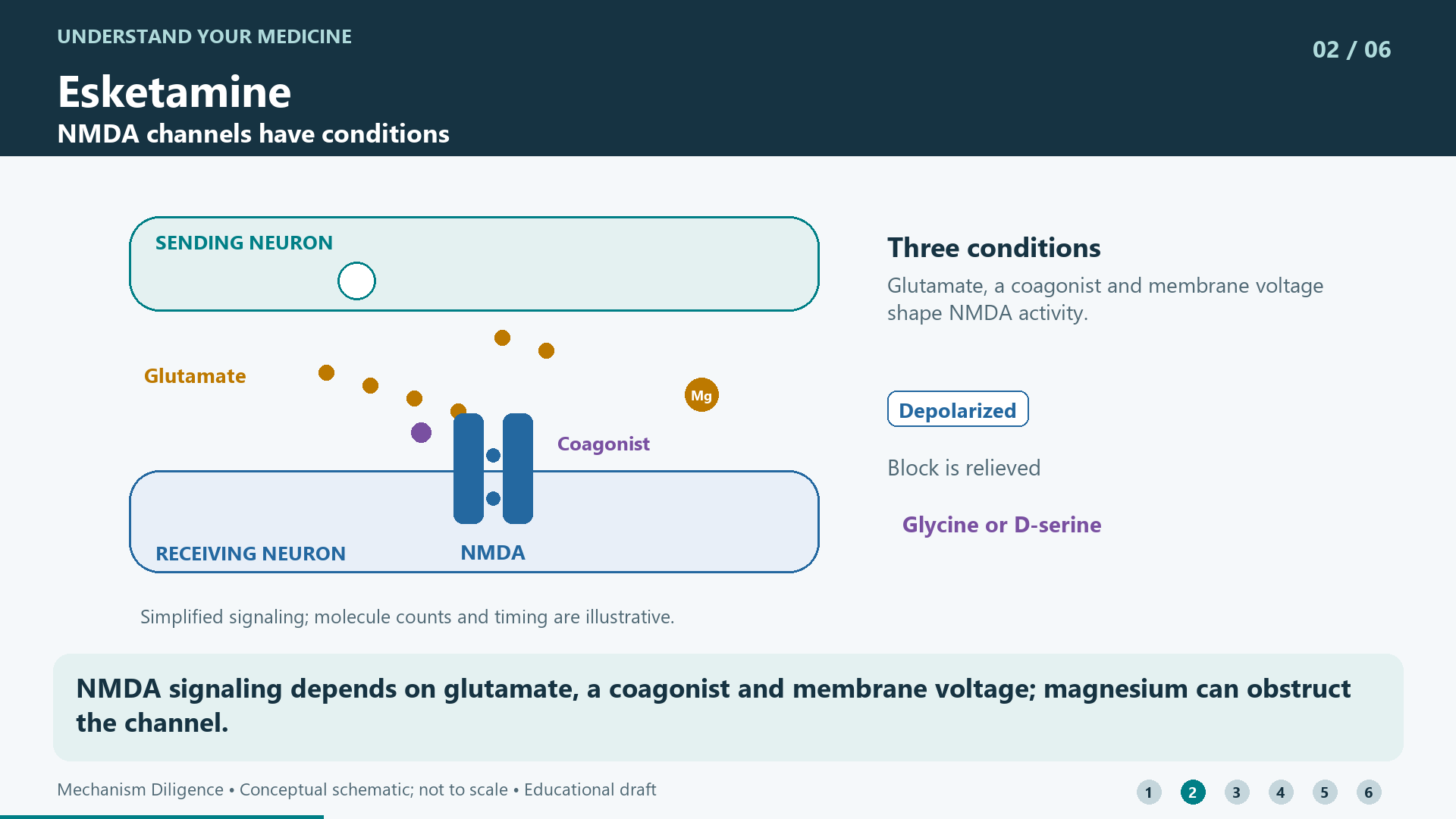
NMDA signaling depends on glutamate, a coagonist and membrane voltage; magnesium can obstruct the channel.
Glycine or D-serine supplies a coagonist signal. The physiological magnesium block is voltage dependent. The diagram should convey these separate conditions without depicting glutamate binding alone as sufficient for substantial current.
Coagonist availability and receptor behavior vary by synapse; animation speed and ion numbers are illustrative.
- Nowak et al. (1984): Magnesium gates glutamate-activated channels · Abstract; patch-clamp recordings in mouse central neurons · Primary cellular electrophysiology · checked 2026-10-17
- Le Bail et al. (2015): NMDA coagonist identity depends on synapse and development · Abstract; rat hippocampal slices; glycine and D-serine coagonism · Primary animal physiology · checked 2026-10-17
Chapter 3: Esketamine changes NMDA activity
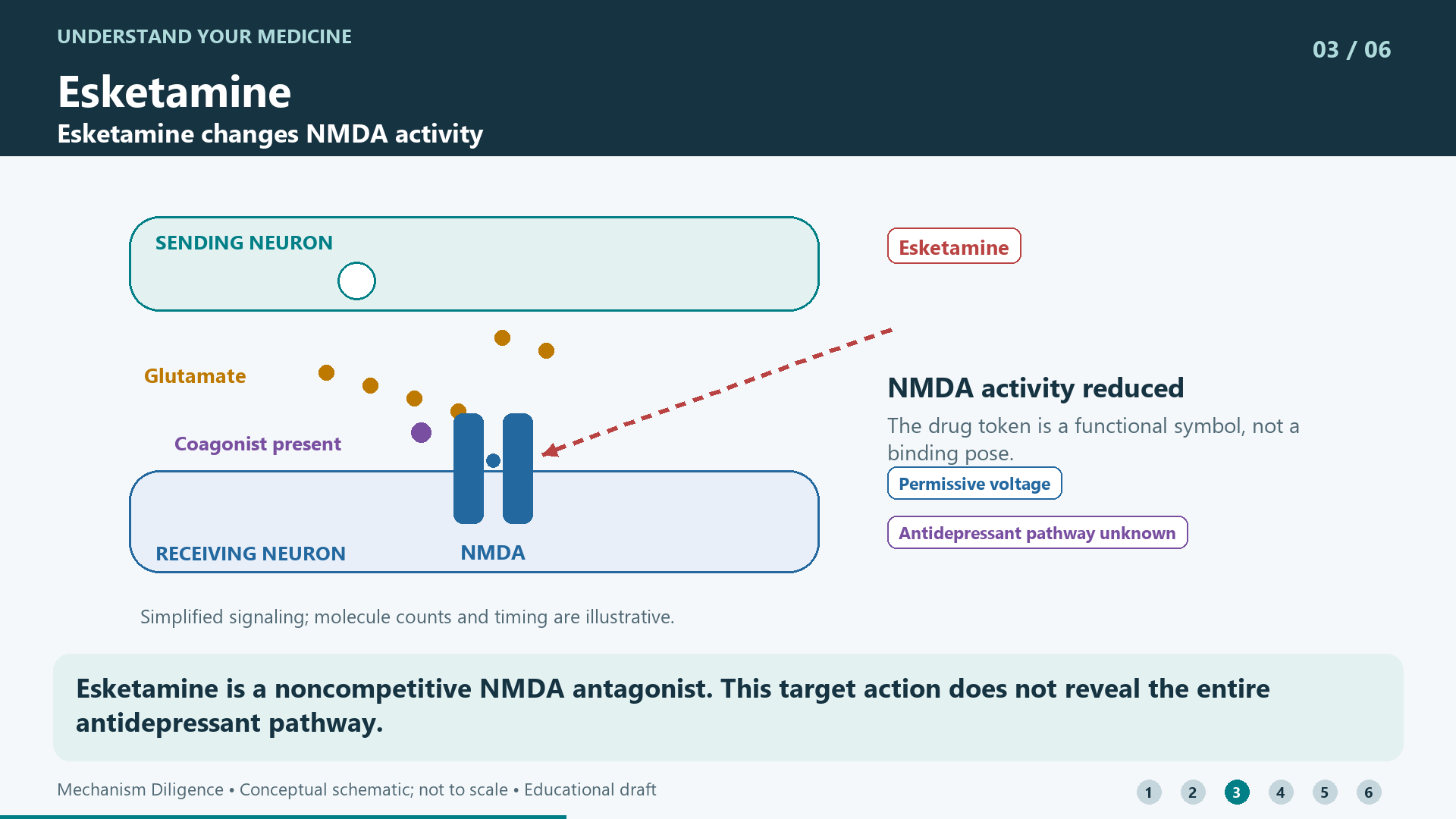
Esketamine is a noncompetitive NMDA antagonist. This target action does not reveal the entire antidepressant pathway.
The label identifies the S-enantiomer of ketamine as an NMDA antagonist and explicitly leaves the antidepressant mechanism unresolved. Noncompetitive antagonism should not look like displacement of glutamate from its binding site.
Target antagonism is established; the causal sequence leading to symptom improvement is not.
- SPRAVATO US prescribing information · Sections 1, 5.1–5.7, 12.1, 14; labeling revision 3/2026 · US product label · checked 2026-10-17
Chapter 4: A proposed plasticity pathway
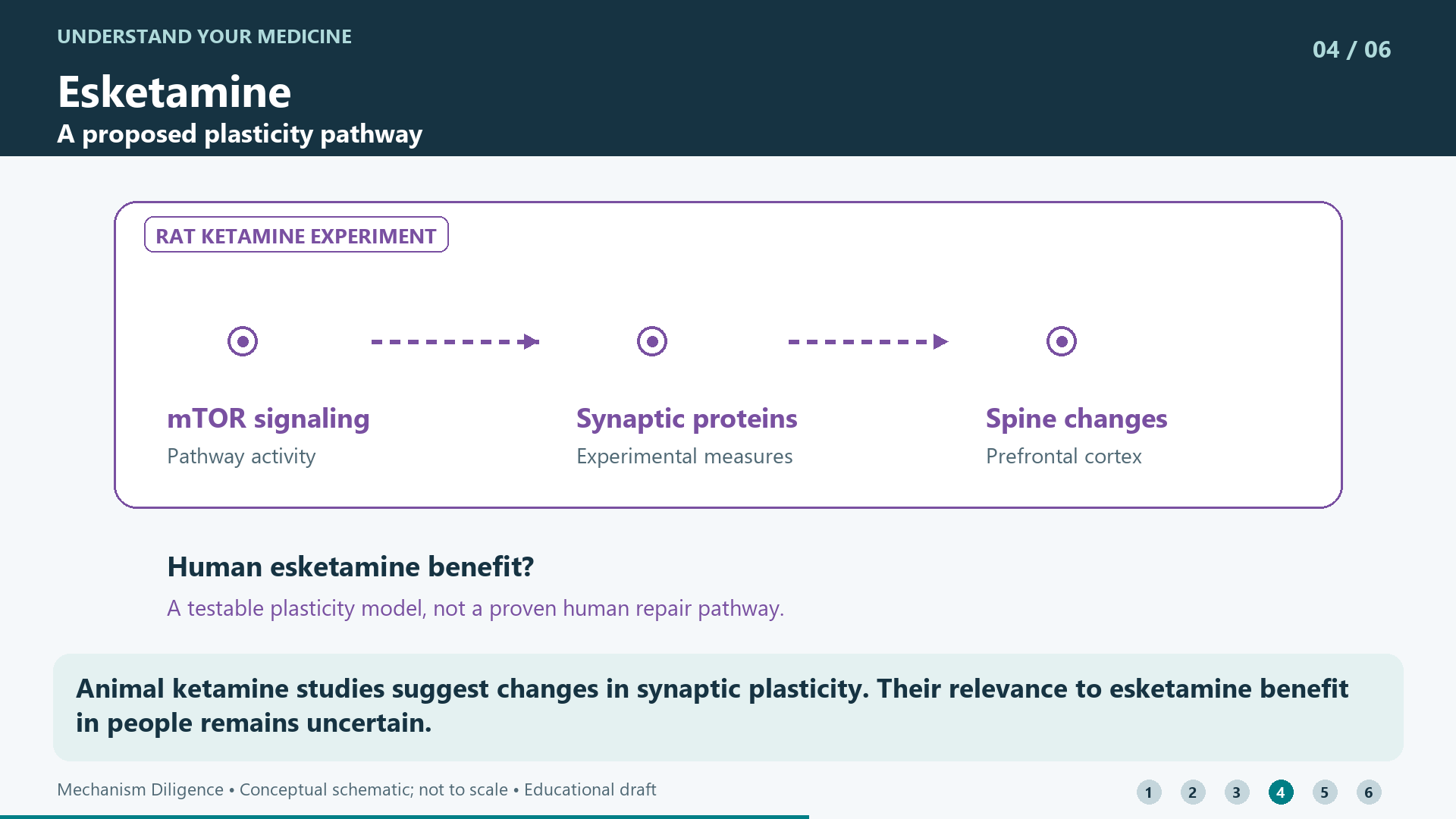
Animal ketamine studies suggest changes in synaptic plasticity. Their relevance to esketamine benefit in people remains uncertain.
In rats, ketamine increased mTOR signaling, synaptic proteins and spine measures; experimentally blocking mTOR prevented selected effects. This supports a testable plasticity model in that system, not proof of a universal human treatment pathway.
Preclinical ketamine evidence; formulation, species and measured outcomes differ from intranasal esketamine treatment.
- Li et al. (2010): mTOR-dependent synapse formation after ketamine · Abstract and figure summaries; rat prefrontal cortex, mTOR blockade, synaptic proteins and spine measures · Primary preclinical experiment · checked 2026-10-17
- SPRAVATO US prescribing information · Sections 1, 5.1–5.7, 12.1, 14; labeling revision 3/2026 · US product label · checked 2026-10-17
Chapter 5: Benefit is measured separately
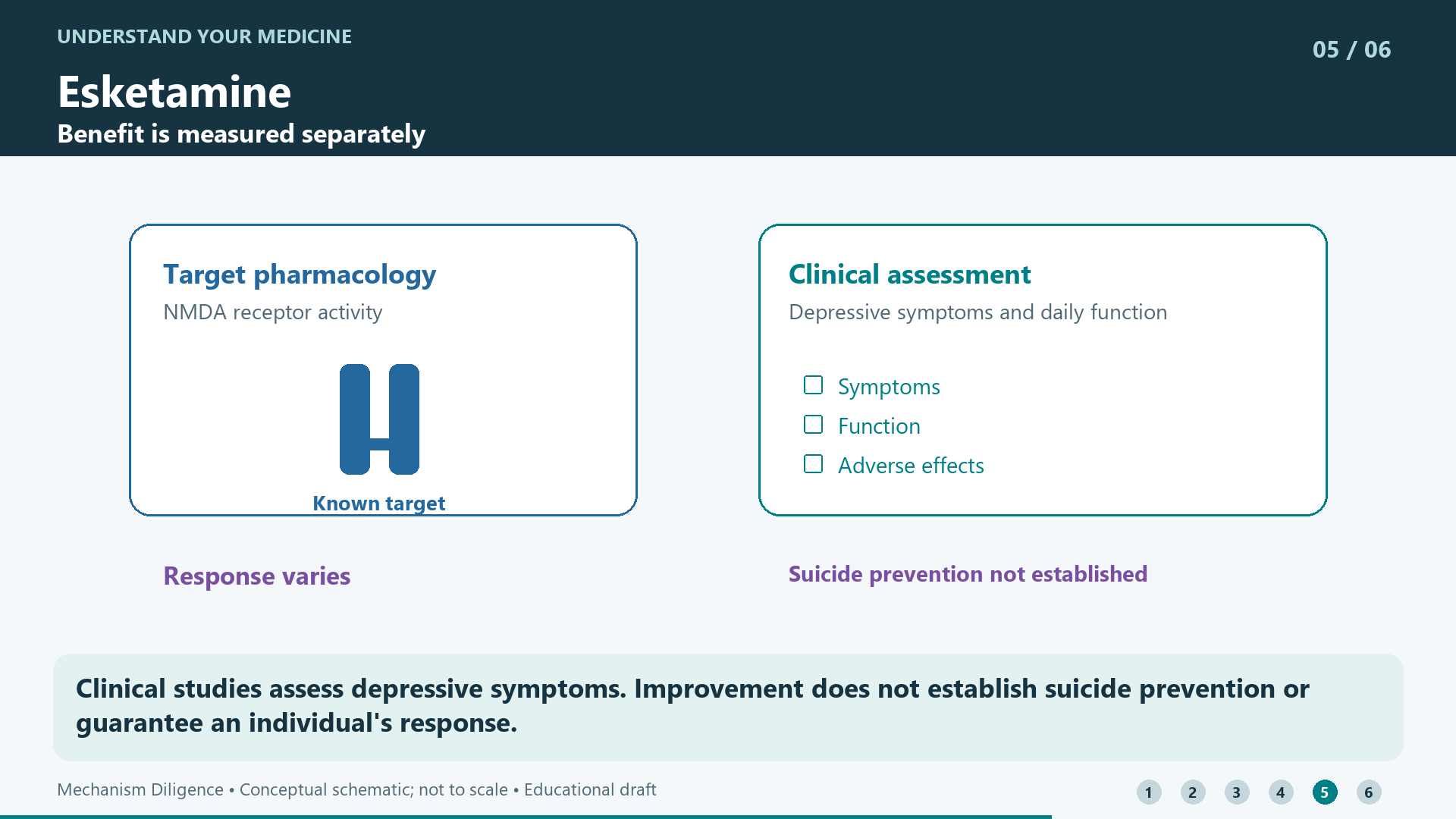
Clinical studies assess depressive symptoms. Improvement does not establish suicide prevention or guarantee an individual's response.
Symptom-rating outcomes and mechanistic experiments answer different questions. The label's limitation on suicide-related outcomes must remain visible even when the animation describes potential improvement.
Clinical efficacy evidence does not complete the molecular mechanism or establish suicide prevention.
- SPRAVATO US prescribing information · Sections 1, 5.1–5.7, 12.1, 14; labeling revision 3/2026 · US product label · checked 2026-10-17
Chapter 6: Observation protects safety
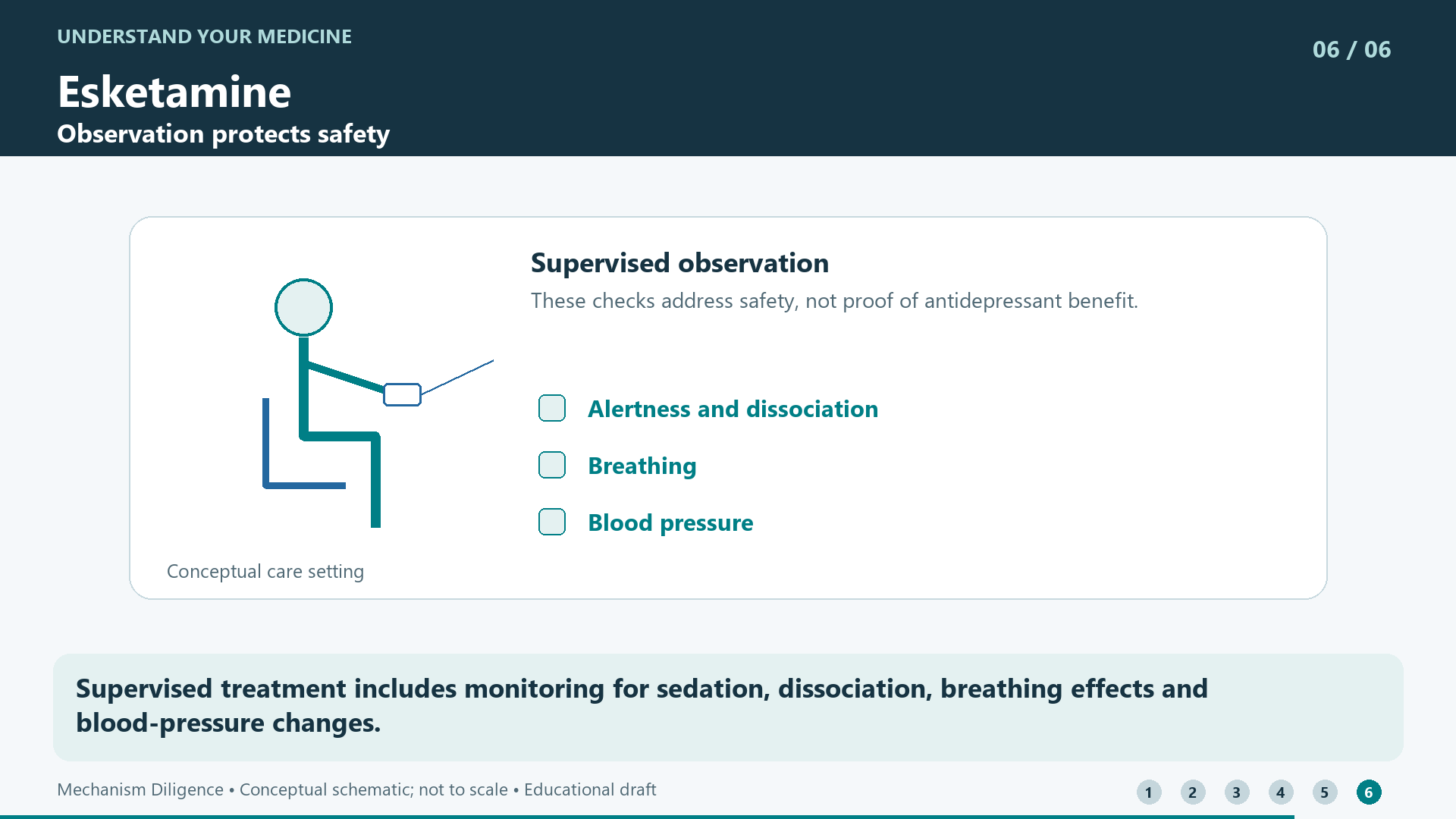
Supervised treatment includes monitoring for sedation, dissociation, breathing effects and blood-pressure changes.
Adverse CNS effects are not a surrogate for antidepressant success. The SPRAVATO care setting and monitoring are part of the product's safety framework.
This is a safety overview, not administration instructions or a complete warning list.
- SPRAVATO US prescribing information · Sections 1, 5.1–5.7, 12.1, 14; labeling revision 3/2026 · US product label · checked 2026-10-17
References & Sources
Source pages checked October 16, 2026. AI-assisted editorial source checking is not independent clinical review. Sources support the summary, mechanism, safety and access information; references are also kept beside each question.
- DailyMed: SPRAVATO (esketamine) nasal spray — current US labeling ↗ · Boxed Warning; 1 Indications; 4 Contraindications; 5 Warnings; 6 Adverse Reactions; 12.1 Mechanism; 14 Clinical Studies
- SPRAVATO manufacturer prescribing information and Medication Guide ↗ · 1; 5.1–5.11; 7; 11; 12.1; Medication Guide
- SPRAVATO REMS — official program resources ↗ · Official program resources; operational requirements corroborated in current prescribing information section 5.5
- Janik et al. (2025): Esketamine monotherapy in adults with treatment-resistant depression ↗ · Randomized trial abstract; MADRS endpoints; adverse events; conflicts of interest
- FDA SPRAVATO label incorporating adult TRD monotherapy (2025) ↗ · 1 Indications and limitations; 12.1 Mechanism; historical approval corroboration, not latest complete label
- CDC: Responding to disruption events involving esketamine and ketamine (September 2026) ↗ · FDA-approved esketamine versus ketamine products; REMS-certified setting distinction
Selective US-label-based information, not a complete safety list or a personal treatment recommendation. Do not change treatment based on this page; use the product-specific label and your care team's advice.