Bydureon BCise (Drug class: GLP-1 receptor agonist — extended-release injection)
US Bydureon BCise: extended-release exenatide suspension in a single-dose subcutaneous autoinjector, labeled for glucose control with diet and exercise in people aged 10 years and older with type 2 diabetes. FDA lists this product as discontinued. Byetta is a different formulation; this guide does not provide dosing or switching instructions.
Educational draft · independent clinical review pending. Silent mechanism animation available; no recorded narration.
Uses / Symptoms
- Labeled for type 2 diabetes in adults and children aged 10 years and older
- Used alongside diet and exercise; not a weight-management indication
- US marketing status: discontinued, checked October 17, 2026
Effects
- Helps the pancreas release insulin when glucose is elevated
- Reduces excess glucagon signaling and slows stomach emptying
- Extended-release particles prolong exenatide exposure; response varies
Side effects
- Injection-site lumps and nausea are common
- Important risks include pancreatitis, dehydration-related kidney injury and severe allergic reactions
- Boxed thyroid C-cell tumor warning; low glucose risk rises with insulin or sulfonylureas
How does Bydureon BCise work? What is the Mechanism Of Action (MOA)?
Bydureon BCise releases exenatide slowly from tiny particles under the skin. Exenatide activates GLP-1 receptors, helping the pancreas release insulin when blood sugar is high. It also reduces glucagon, a signal that tells the liver to release sugar, and slows food leaving the stomach.
The mechanism, step by step
- Gut signals help regulate glucose
After nutrients arrive, incretin signals such as GLP-1 help coordinate insulin release with the glucose level.
- Microspheres release exenatide gradually
BCise contains exenatide in a biodegradable polymer formulation that prolongs exposure after subcutaneous administration.
- GLP-1 receptors amplify the insulin response
Receptor activation increases beta-cell signaling, including cAMP pathways, and supports insulin secretion when glucose is elevated.
- Other glucose-regulating actions contribute
Exenatide reduces inappropriately elevated glucagon secretion and slows gastric emptying, changing glucose delivery after food.
- Clinical outcomes require separate evidence
These actions explain glucose lowering, not a cure or a guaranteed outcome. The EXSCEL cardiovascular trial established noninferiority, not superiority, for its primary endpoint.
A perspective-aware, six-chapter visual narration is available when JavaScript is enabled.
Questions & Answers (FAQ)
How does Bydureon BCise work?
Bydureon BCise releases exenatide slowly from tiny particles under the skin. Exenatide activates GLP-1 receptors, helping the pancreas release insulin when blood sugar is high. It also reduces glucagon, a signal that tells the liver to release sugar, and slows food leaving the stomach.
Who is this product labeled for?
Adults and children aged 10 years and older with type 2 diabetes, alongside diet and exercise. It is not an approved weight-management product or a treatment for type 1 diabetes.
Is Bydureon BCise still marketed in the US?
On October 17, 2026, Drugs@FDA listed Bydureon BCise as discontinued. DailyMed records a marketing end date of October 31, 2025. Those records do not establish local stock or, by themselves, a safety-related withdrawal of approval.
Is it the same as Byetta?
Both contain exenatide, but BCise is an extended-release microsphere suspension in a single-dose autoinjector; Byetta is an immediate-release solution in a multidose pen. They have different instructions and renal restrictions. The BCise label advises against using it with other exenatide products.
Does it have a cardiovascular-risk-reduction indication?
No such indication appears in the reviewed BCise label. In EXSCEL, extended-release exenatide met the cardiovascular noninferiority criterion but did not significantly outperform placebo on the primary major-event endpoint. Results from other GLP-1 products cannot be substituted.
What side effects are common?
Injection-site nodules and nausea are the most common reactions highlighted in the BCise label. Severe or worsening injection-site pain, swelling or skin damage needs medical assessment rather than being assumed to be a harmless lump.
What does the thyroid boxed warning mean?
Extended-release exenatide caused thyroid C-cell tumors in rats; whether it causes these tumors in humans is unknown. BCise is contraindicated with a personal or family history of medullary thyroid carcinoma or MEN2. This product-specific warning should not be copied automatically to Byetta.
Why does kidney function matter?
The BCise label does not recommend use when eGFR is below 45 mL/min/1.73 m² or in end-stage renal disease. Vomiting or diarrhea can cause dehydration and worsen kidney function. This is not Byetta's creatinine-clearance threshold.
Can blood glucose become too low?
Yes, especially with insulin or an insulin-releasing medicine such as a sulfonylurea. Glucose-dependent receptor activity does not remove that combination risk; the treating team should review the full regimen.
Which symptoms need prompt assessment?
Severe persistent abdominal pain can signal pancreatitis. Unusual bleeding or bruising can signal immune-mediated low platelets. Breathing difficulty or face or throat swelling requires emergency help; persistent vomiting or reduced fluid intake also needs prompt assessment.
What should the procedure team know?
Tell the team about exenatide before anesthesia or deep sedation. Delayed stomach emptying can leave stomach contents that may enter the lungs. The label does not establish a universal medicine-holding interval; obtain an individualized plan.
What else belongs in a treatment review?
Discuss pregnancy, severe gastroparesis, previous pancreatitis or serious exenatide reactions, and every medicine taken. Warfarin monitoring and oral-drug absorption may need attention. This page does not provide dosing, switching or device instructions.
Online stores and Pharmacies (Buy)
US FDA marketing status was discontinued when checked October 17, 2026. A retained label is not proof of supply or a reason to switch products yourself. Ask the prescriber and licensed pharmacist about the exact prescribed product; no prices or stock are verified here.
No live price, stock or individual eligibility is verified here.
Animation chapters, evidence & visual limits
Exenatide extended-release subcutaneous formulation; US type 2 diabetes glucose-control indication from age 10 with diet and exercise. This film explains the product, not present pharmacy availability.
Educational draft; independent clinical review pending. Original explanatory schematics, not atomic structures, microscopy, measured concentrations or patient simulations. Selective mechanism and safety context, not complete prescribing information or dosing/switching instructions. BCise and Byetta share exenatide but are not interchangeable formulations. No cardiovascular-risk-reduction or obesity indication is implied.
Original conceptual illustrations. AI-assisted editorial source check; independent clinical review pending. No recorded narration.
Chapter 1: A longer-lasting exenatide formulation
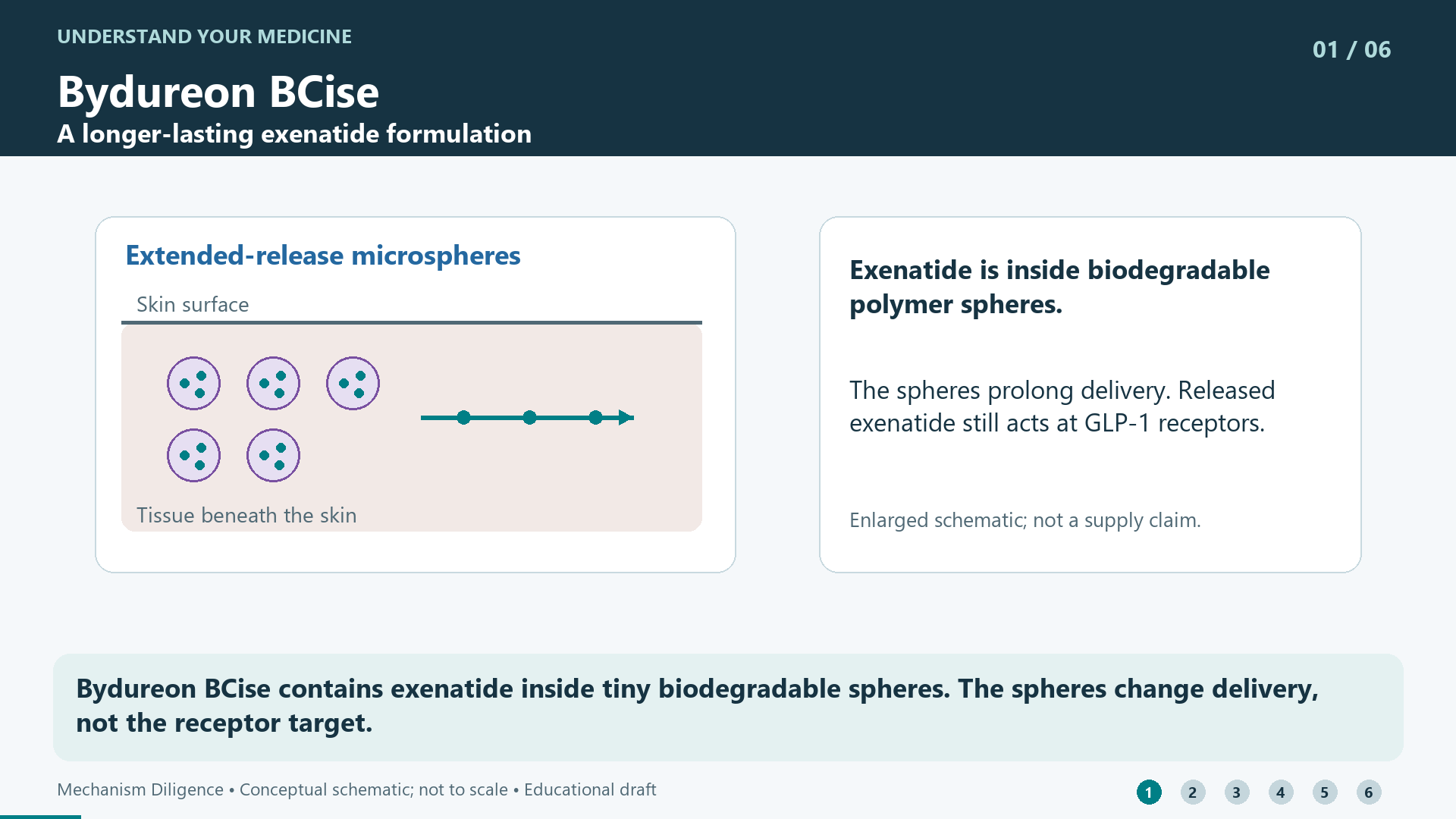
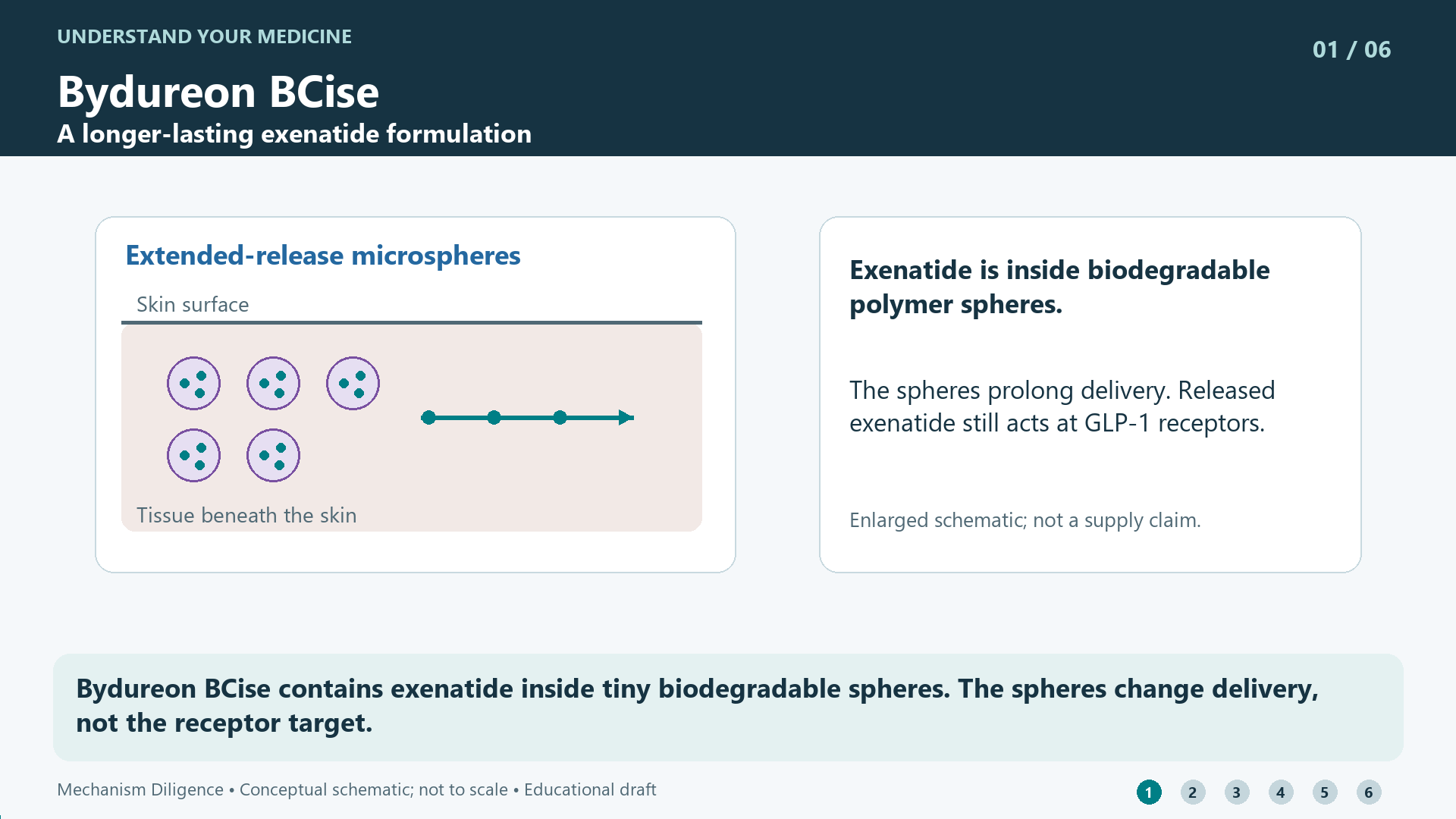
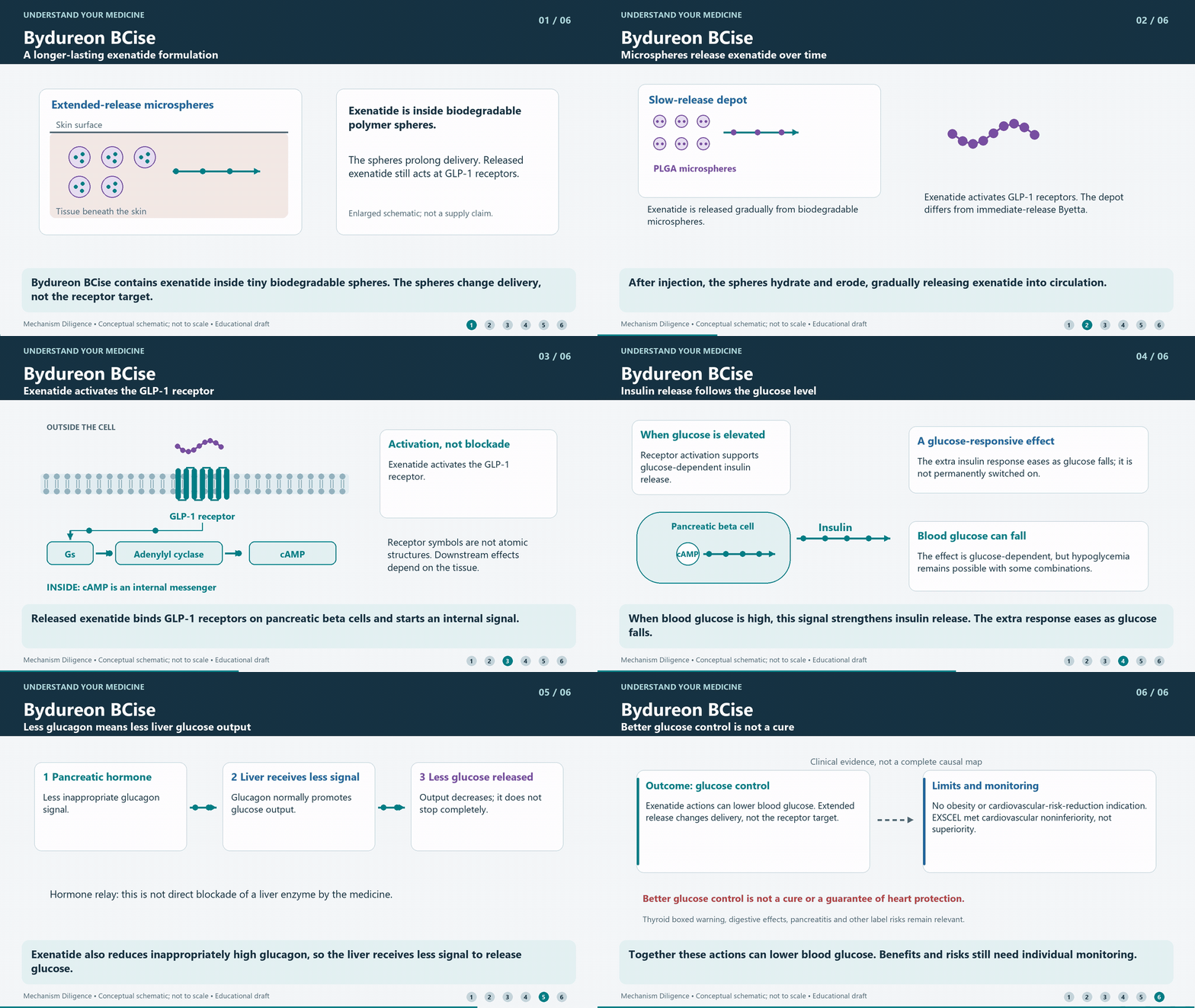
Bydureon BCise contains exenatide inside tiny biodegradable spheres. The spheres change delivery, not the receptor target.
The extended-release suspension contains exenatide in poly(lactide-co-glycolide) microspheres. The product's purpose is type 2 diabetes glucose control; availability and exact use require the product-specific page and prescribing information.
The depot is enlarged and not to scale. The film does not establish current supply.
- Bydureon BCise US prescribing information — AstraZeneca / DailyMed · Revised May 2025; boxed warning; sections 1, 5, 11, 12.1–12.3, 14.5. · Primary source; relevant sections inspected · checked 2026-10-17
Chapter 2: Microspheres release exenatide over time
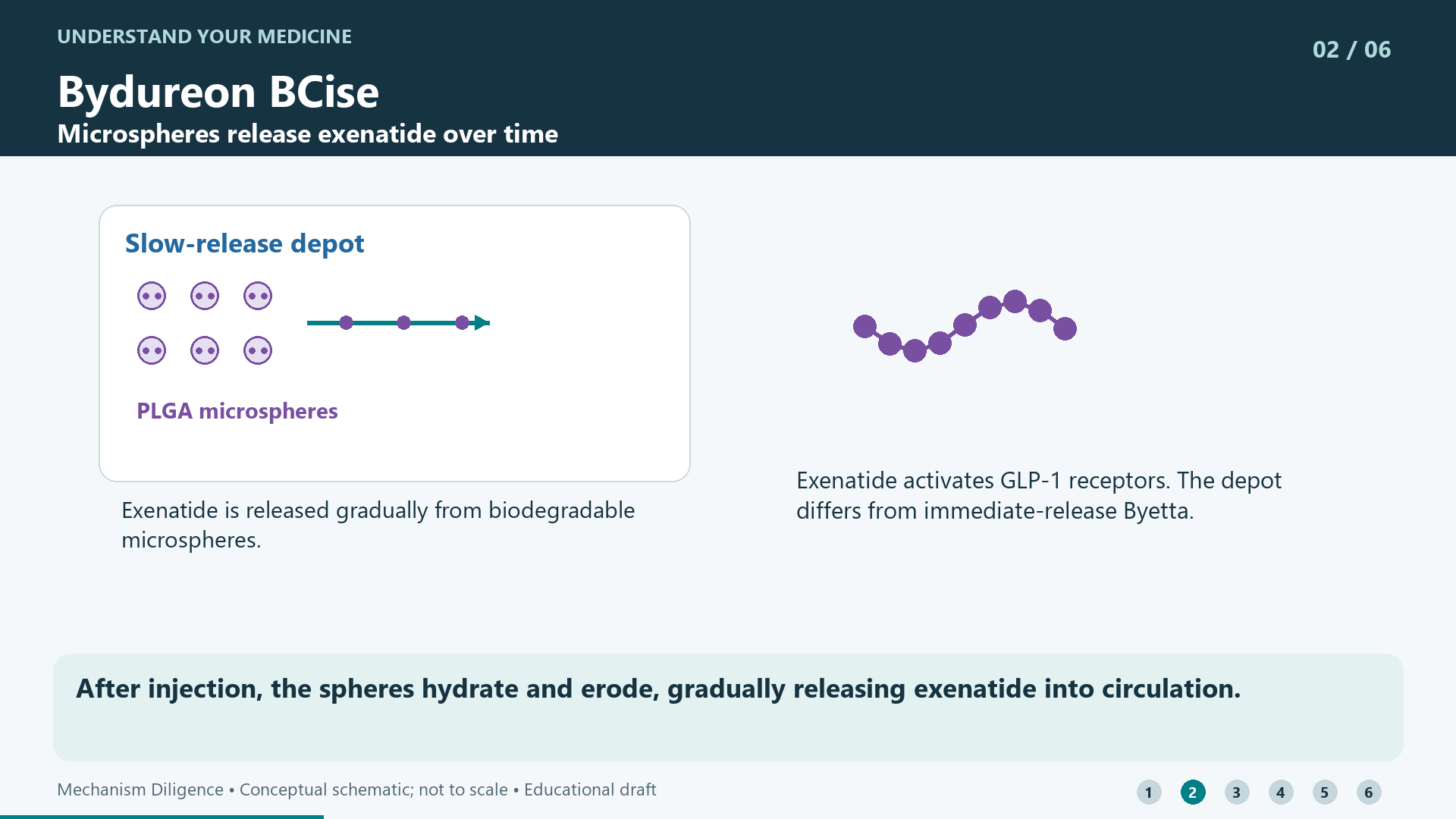
After injection, the spheres hydrate and erode, gradually releasing exenatide into circulation.
A small initial surface-bound release is followed by prolonged release as the polymer hydrates and erodes. Several overlapping processes create exposure; a smooth cartoon must not imply a perfectly constant release rate.
Timing is compressed; no concentration curve, fixed rate or dosing instruction is depicted.
- Bydureon BCise US prescribing information — AstraZeneca / DailyMed · Revised May 2025; boxed warning; sections 1, 5, 11, 12.1–12.3, 14.5. · Primary source; relevant sections inspected · checked 2026-10-17
Chapter 3: Exenatide activates the GLP-1 receptor
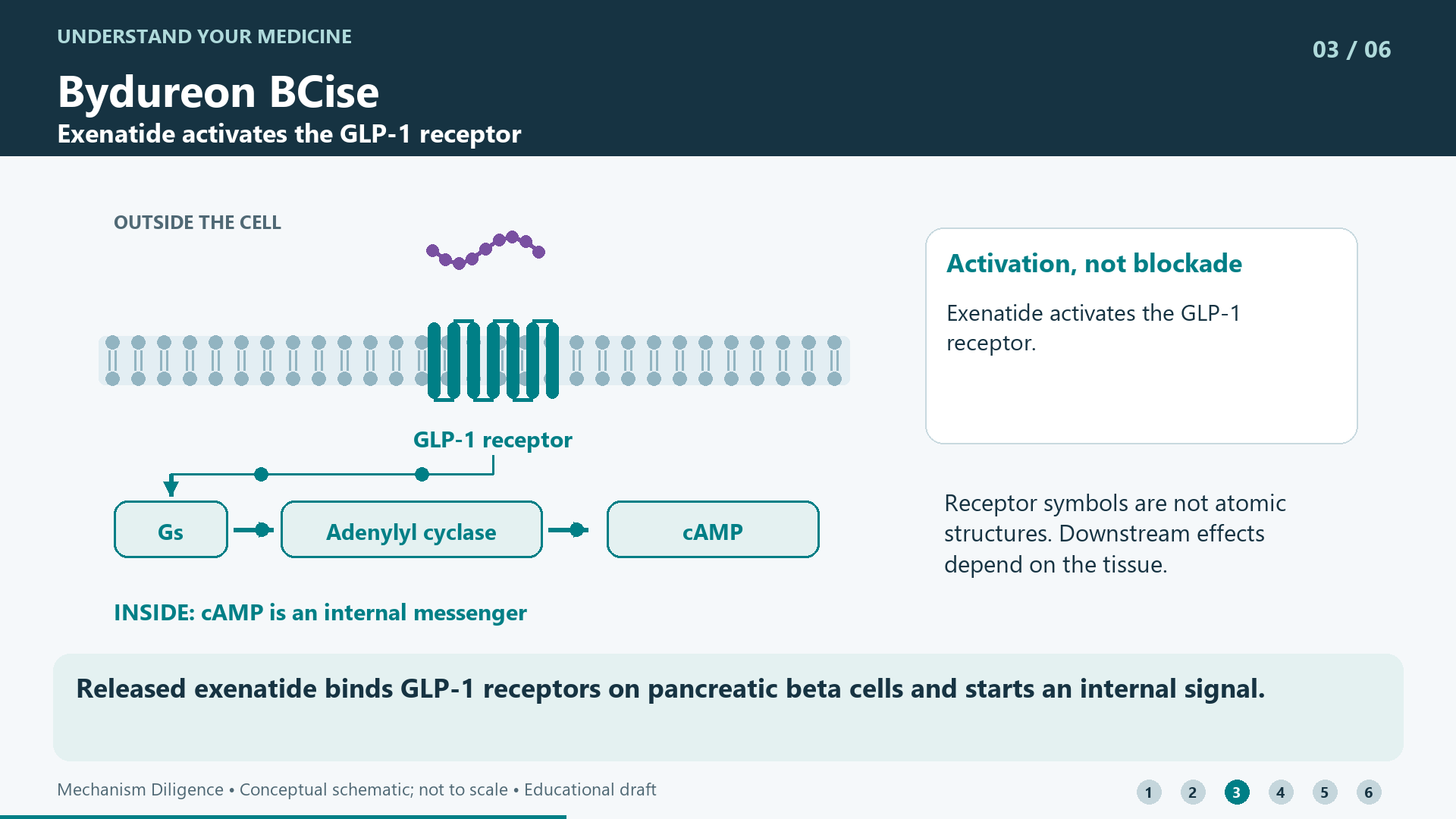
Released exenatide binds GLP-1 receptors on pancreatic beta cells and starts an internal signal.
Exenatide is a peptide agonist rather than insulin. Receptor activation engages intracellular signaling including cAMP; structural research with exendin-4 supports an activated receptor–Gs complex.
Icons are schematic; no exact contacts, receptor occupancy or molecular motion is measured.
- Bydureon BCise US prescribing information — AstraZeneca / DailyMed · Revised May 2025; boxed warning; sections 1, 5, 11, 12.1–12.3, 14.5. · Primary source; relevant sections inspected · checked 2026-10-17
- Dynamics of GLP-1R peptide agonist engagement are correlated with kinetics of G protein activation · Exendin-4-bound GLP-1R–Gs cryo-EM complex; structural/pharmacological results. · Primary structural study; indexed abstract and figure description inspected; direct full text blocked by CAPTCHA. No coordinates used. · checked 2026-10-17
Chapter 4: Insulin release follows the glucose level
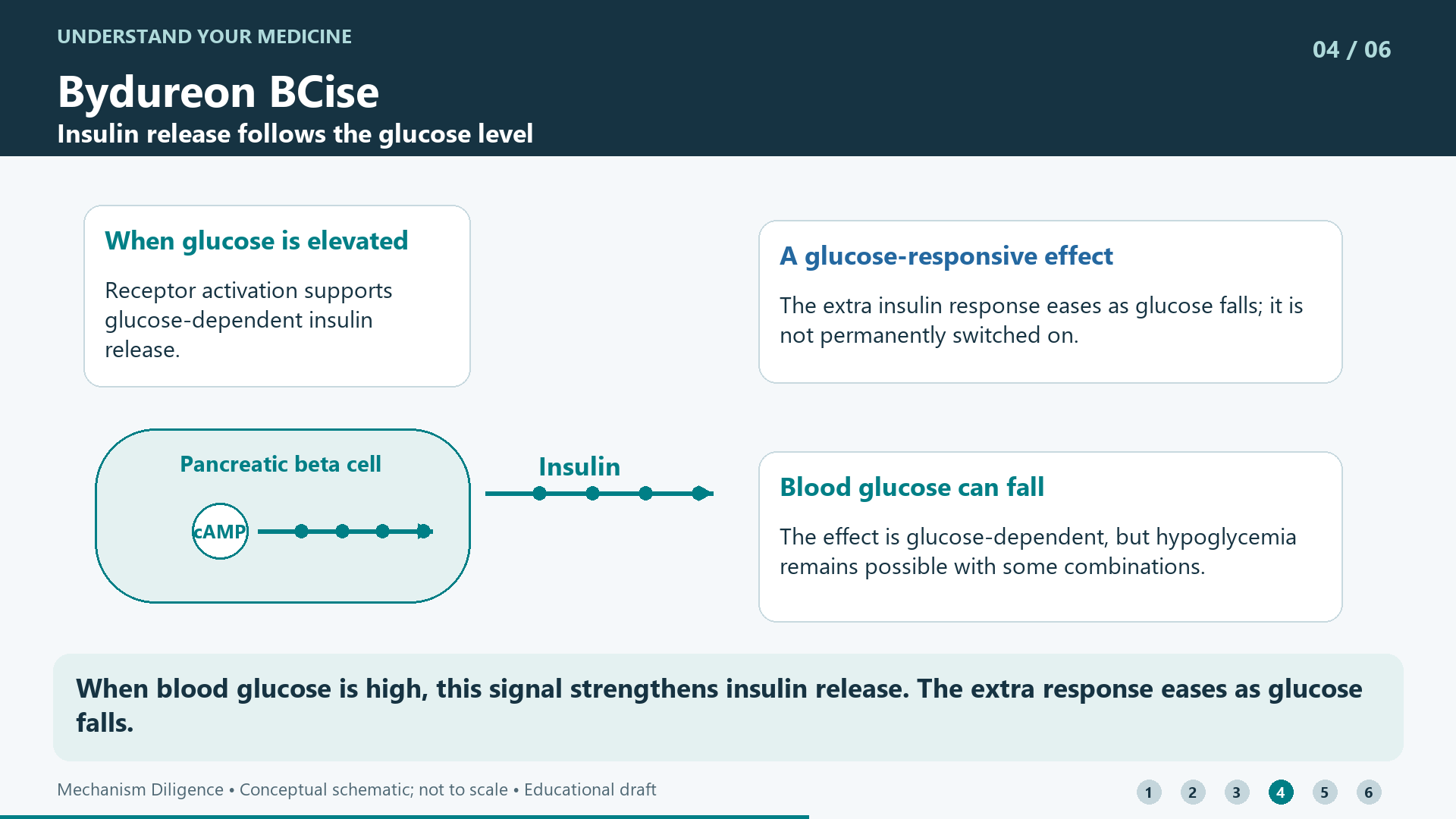
When blood glucose is high, this signal strengthens insulin release. The extra response eases as glucose falls.
The drug amplifies glucose-responsive beta-cell insulin secretion. Experimental clamp evidence supports glucose dependence, but concomitant insulin or sulfonylureas can still cause hypoglycemia.
The clamp used intravenous exenatide, not BCise microspheres; individual low-glucose risk remains.
- Bydureon BCise US prescribing information — AstraZeneca / DailyMed · Revised May 2025; boxed warning; sections 1, 5, 11, 12.1–12.3, 14.5. · Primary source; relevant sections inspected · checked 2026-10-17
- Degn et al. — Exenatide, glucose-dependent insulin secretion and counterregulation · Diabetes 2004; experimental intravenous glucose/hypoglycemia clamp in healthy volunteers. · Primary human mechanistic study; indexed abstract inspected. Not a BCise formulation trial. · checked 2026-10-17
Chapter 5: Less glucagon means less liver glucose output
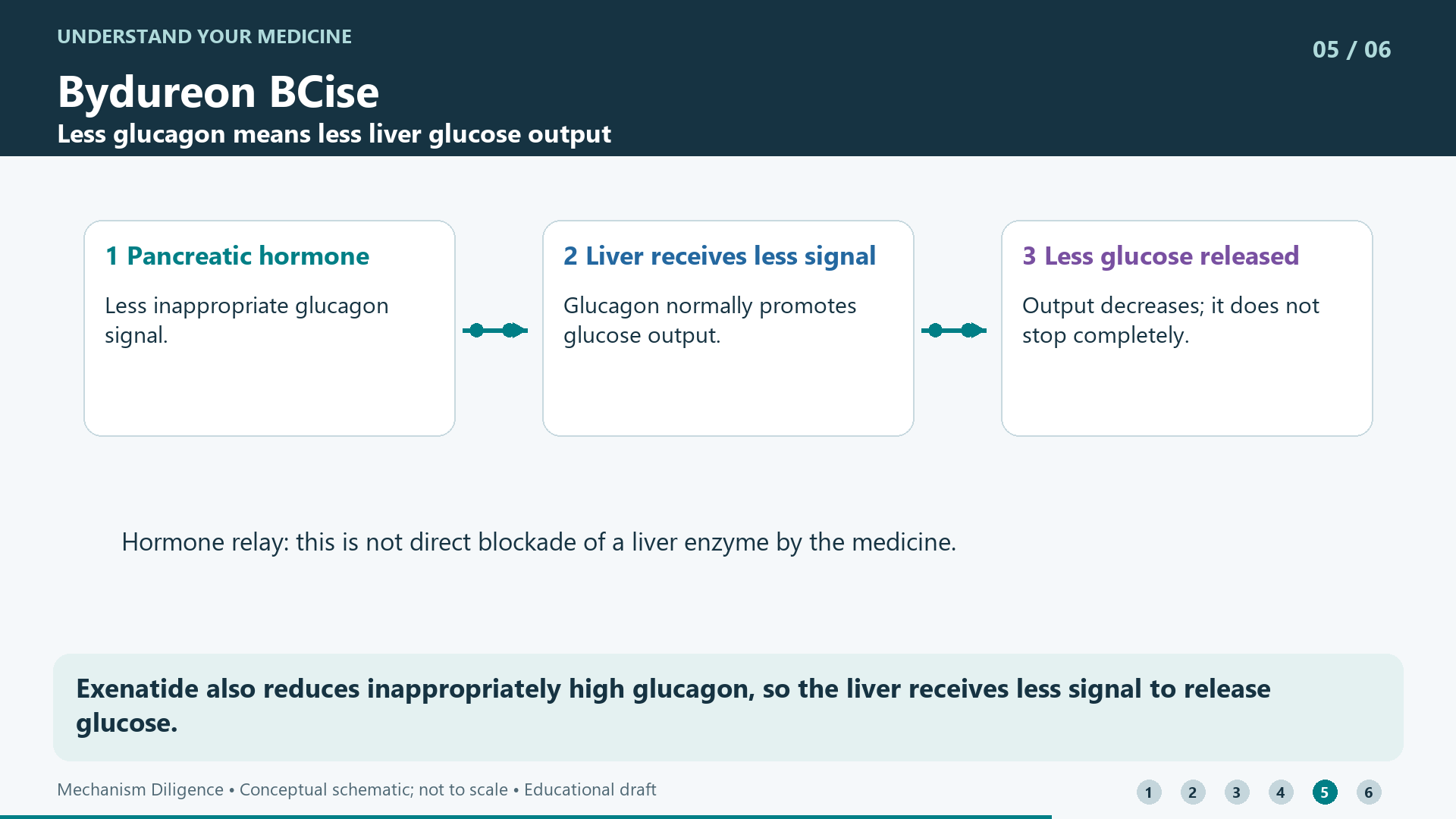
Exenatide also reduces inappropriately high glucagon, so the liver receives less signal to release glucose.
Glucagon is a pancreatic hormone that promotes hepatic glucose output. This is a parallel hormonal effect, not evidence that exenatide directly blocks a liver enzyme. Delayed stomach emptying is another labeled contribution.
Several pathways contribute; the diagram does not assign percentages to their effects.
- Bydureon BCise US prescribing information — AstraZeneca / DailyMed · Revised May 2025; boxed warning; sections 1, 5, 11, 12.1–12.3, 14.5. · Primary source; relevant sections inspected · checked 2026-10-17
Chapter 6: Better glucose control is not a cure
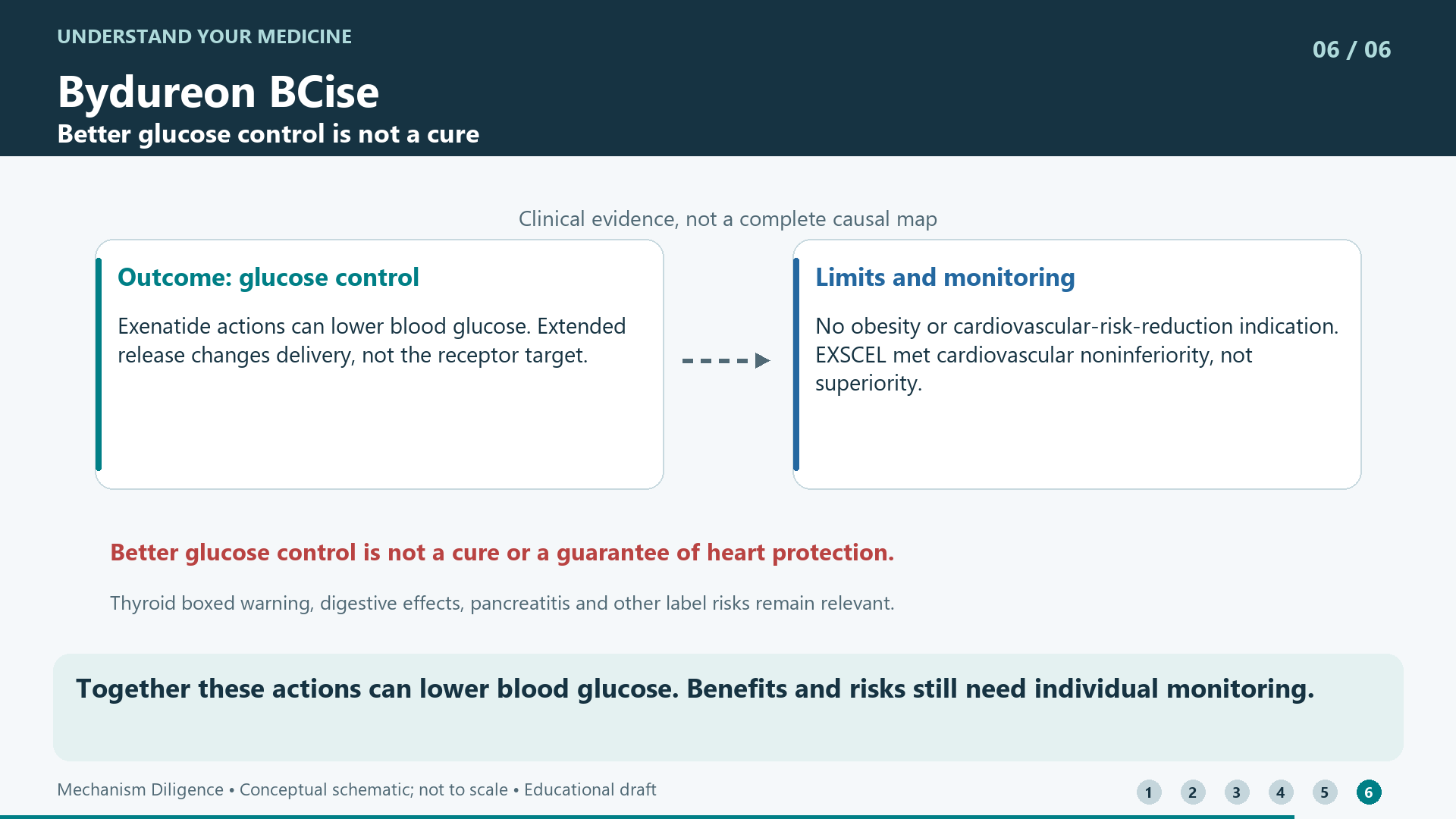
Together these actions can lower blood glucose. Benefits and risks still need individual monitoring.
BCise does not have an obesity or cardiovascular-risk-reduction indication. EXSCEL with extended-release exenatide met cardiovascular noninferiority, not superiority. Important risks include gastrointestinal effects, pancreatitis and a thyroid C-cell boxed warning.
Clinical outcomes are separate from receptor diagrams; warning details and other risks remain in the product page.
- Bydureon BCise US prescribing information — AstraZeneca / DailyMed · Revised May 2025; boxed warning; sections 1, 5, 11, 12.1–12.3, 14.5. · Primary source; relevant sections inspected · checked 2026-10-17
References & Sources
Source pages checked 2026-10-17. AI-assisted editorial source checking is not independent clinical review. Sources support the summary, mechanism, safety and access information; references are also kept beside each question.
- DailyMed: Bydureon BCise — US prescribing information ↗ · PI revised 05/2025; boxed warning; 1; 3–8; 11–12; 14.5–14.6; Medication Guide; marketing end-date table. Checked 2026-10-17.
- FDA Drugs@FDA: Bydureon BCise NDA 209210 ↗ · Products table: discontinued marketing status; approval history. Checked 2026-10-17; not a local-stock record.
- DailyMed: Byetta — formulation and renal-limit comparison ↗ · SPL effective 2025-09-02; 3–5; 8.6; 11. Used only to distinguish Byetta from BCise. Checked 2026-10-17.
- Degn et al. (2004): exenatide insulin secretion and counterregulation ↗ · Primary randomized crossover study; PubMed abstract inspected. Twelve healthy volunteers, intravenous infusion and glucose clamp, not a BCise outcomes trial. Checked 2026-10-17.
- Holman et al. (2017): EXSCEL cardiovascular outcomes ↗ · Primary randomized trial abstract; 14,752 participants; primary noninferiority and superiority analyses. Extended-release exenatide trial, not evidence of superiority for BCise. Checked 2026-10-17.
Selective US-label-based information, not a complete safety list or a personal treatment recommendation. Do not change treatment based on this page; use the product-specific label and your care team's advice.